
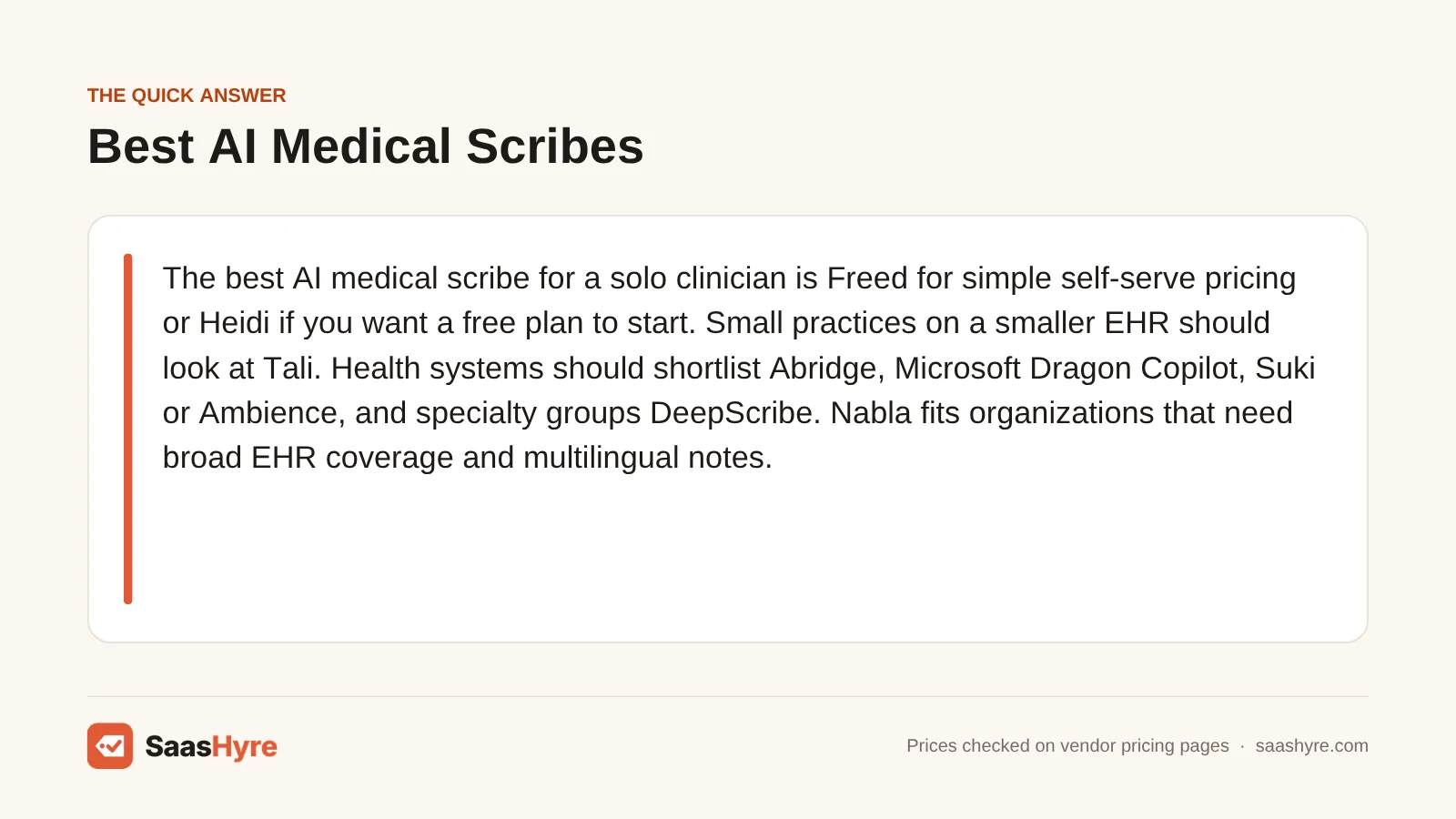
If you work solo, the best AI medical scribe is Freed for simple self-serve pricing, or Heidi if you want a free plan to start. Small practices on a smaller EHR should look at Tali. Health systems should shortlist Abridge, Microsoft Dragon Copilot, Suki or Ambience. Specialty groups should look at DeepScribe. Nabla fits groups that need wide EHR coverage and notes in many languages.
Here is my tip before you compare. Don’t judge scribes on note quality. Almost all of them write good notes now. Judge them on how the note gets into your EHR. A scribe that pushes a finished note into the chart saves you time on every visit. One that makes you copy and paste four sections saves less than the demo suggests. That gap grows as you see more patients.
We took the prices below from each vendor’s own pricing page in September 2026. When a price is not public, we tell you.
This guide is one part of our best AI tools roundup, which compares picks for every job.
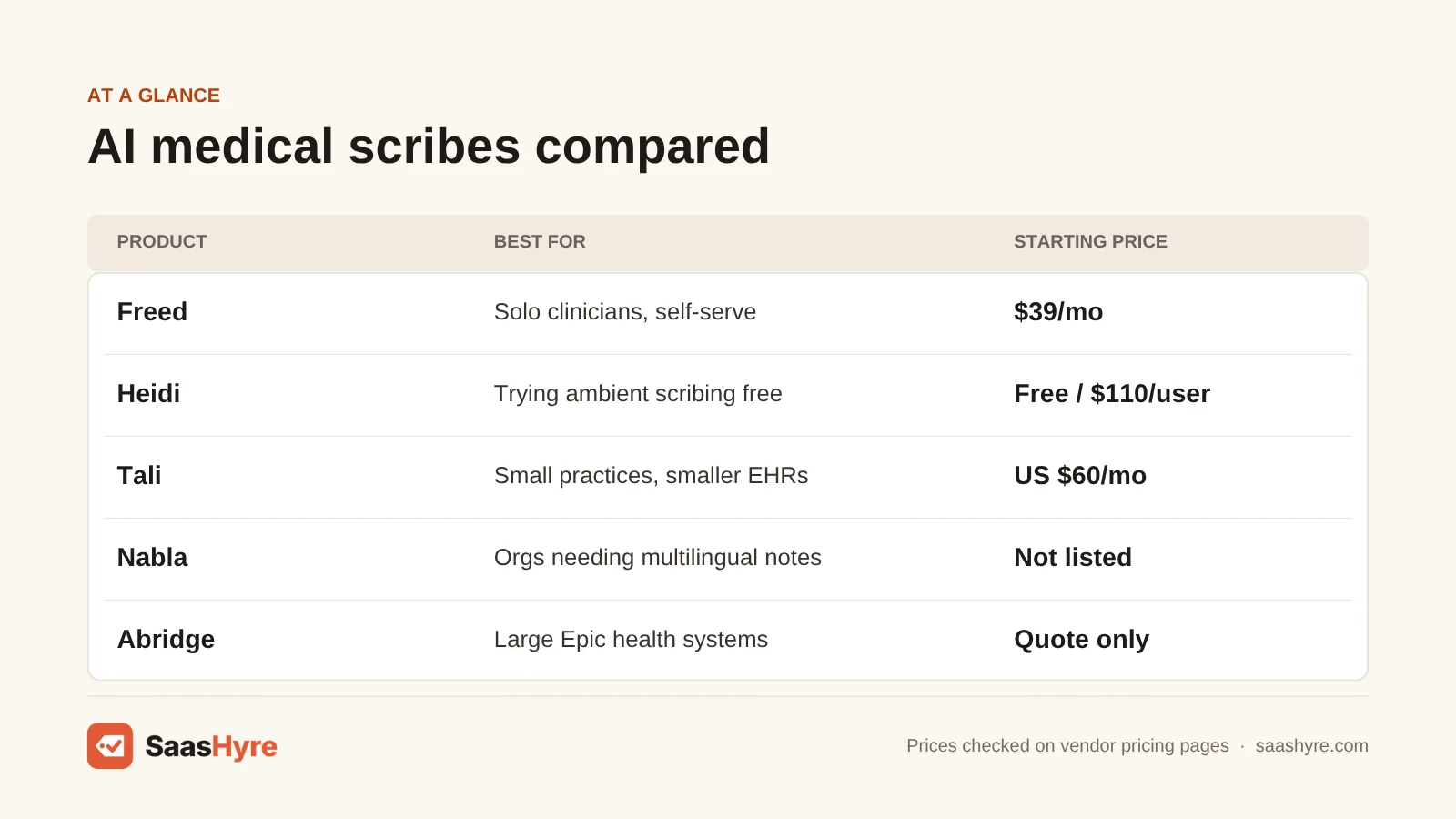
Quick Comparison: AI Medical Scribes at a Glance
| Scribe | Best for | Starting price | Billing model | Free option |
|---|---|---|---|---|
| Freed | Solo clinicians who want to self-serve | $39/mo (Starter, 40 notes) | Per clinician; Groups on quote | 7-day trial, no card |
| Heidi | Trying ambient scribing at no cost | $0; Clinician $110/user/mo billed annually | Per user; Teams on quote | Free plan |
| Tali | Small practices on smaller EHRs | US $60/mo billed annually (Starter, 40 scribes) | Per clinician; Enterprise on quote | Free plan, 5 scribes/mo |
| Nabla | Organizations needing multilingual notes | Not listed on the website | Organization contracts | “Try it for free” offer |
| Abridge | Large Epic health systems | Quote only | Enterprise contract | No |
| Microsoft Dragon Copilot | Microsoft and Dragon Medical shops | Quote only (see note below) | Per-user license plus per-encounter usage | No |
| Suki | Voice commands plus deep EHR sync | Quote only | Per user, volume discounts | No |
| Ambience | Hospitals that want coding at the point of care | Quote only | Enterprise, outcome-linked | No |
| DeepScribe | Oncology and other specialty groups | Quote only | Enterprise contract | No |
What an AI Medical Scribe Actually Does
An AI medical scribe, also called an ambient AI scribe, listens to a patient visit through a phone, laptop or browser. Then it drafts the clinical note for you to review and sign. Most give you a SOAP note or a note for your specialty within a minute after the visit ends.
You are really buying three things. First is the note engine. Second is how the note gets into your EHR. Third is the compliance paperwork, meaning a Business Associate Agreement, data retention settings and audit logs. Lots of doctors use these tools now. In an American Medical Association survey of nearly 1,700 physicians published in 2026, 28% said they use AI for billing codes, medical charts or visit notes. For other AI tools, see our AI tools hub.
What an AI Scribe Really Costs: Solo Practice vs a 10-Clinician Group
If you work solo, a self-serve AI scribe with unlimited notes costs about $79 to $119 a month at list price. A 10-clinician group pays roughly $790 to $1,190 a month at the same rates. But most vendors push groups to a custom quote once you need admin controls, shared templates or a BAA for the whole organization.
The cheapest plans look good until you count your visits. Freed Starter and Tali Starter both cap you at 40 notes a month. Say you are a family doctor who sees 18 patients a day, four days a week. You write more than 280 notes a month. You would use up a 40-note plan in about two and a half clinic days. Tali’s free plan (5 scribes a month) covers less than one morning. Use low-cap plans as trials, not to run your practice.
| Plan (list price) | Note limit | Solo clinician / month | 10 clinicians / month | EHR path on this plan |
|---|---|---|---|---|
| Heidi Free | No cap stated on pricing page | $0 | $0 | Copy and paste |
| Freed Starter | 40 notes | $39 | $390 (too few notes for full-time clinicians) | Copy and paste |
| Tali Starter (annual) | 40 scribes | US $60 | US $600 (same cap problem) | Depends on your EHR |
| Freed Core | Unlimited | $79 | $790 | Copy and paste |
| Freed Premier (annual) | Unlimited | $104 | $1,040 (Groups plan is quoted) | One-click push to browser-based EHRs |
| Heidi Clinician (annual) | Unlimited use of paid features | $110 | $1,100 (Teams plan is quoted) | EHR integration listed on Teams only |
| Abridge, Suki, Ambience, DeepScribe, Nabla, Dragon Copilot | Contract terms | Quote only | Quote only | Native EHR integration is the core selling point |
If you work solo, your real choice is $79 for copy and paste or about $104 to $119 for one-click EHR push. See more than 12 patients a day? Then push is likely worth its extra $25 to $40 a month in saved clicks. If you run a 10-clinician group, don’t just multiply list prices. Freed and Suki both list volume discounts. Ask for a group quote before anyone buys seats one at a time on a card.
Microsoft Dragon Copilot does not publish a price. A Microsoft licensing partner reports three changes from May 1, 2026. Microsoft moved to a single per-user license at a lower price. It dropped the separate Physician Practice offer. And it now bills ambient use per encounter. Reseller listings for the older practice license showed about $160 per user per month with a 12-month commitment. Get a current quote.
What Makes the Best AI Medical Scribe?
The best AI medical scribe is the one that fits your EHR, how many patients you see and your compliance needs. Check five things before you sign. You need a BAA for the plan you buy. Know how the note reaches your EHR. Know the monthly note cap. Read the contract term and renewal. And plan how you will get patient consent.
We read each vendor’s pricing page, product pages, HIPAA or security pages and support docs. “Integration” can mean true two-way sync. It can also mean a browser extension that pastes text. So time a few notes yourself. A 40-note plan does not suit a full-time clinician. Also ask if recordings are stored, for how long, and who controls retention.
Best AI Medical Scribes for Solo Clinicians and Small Practices
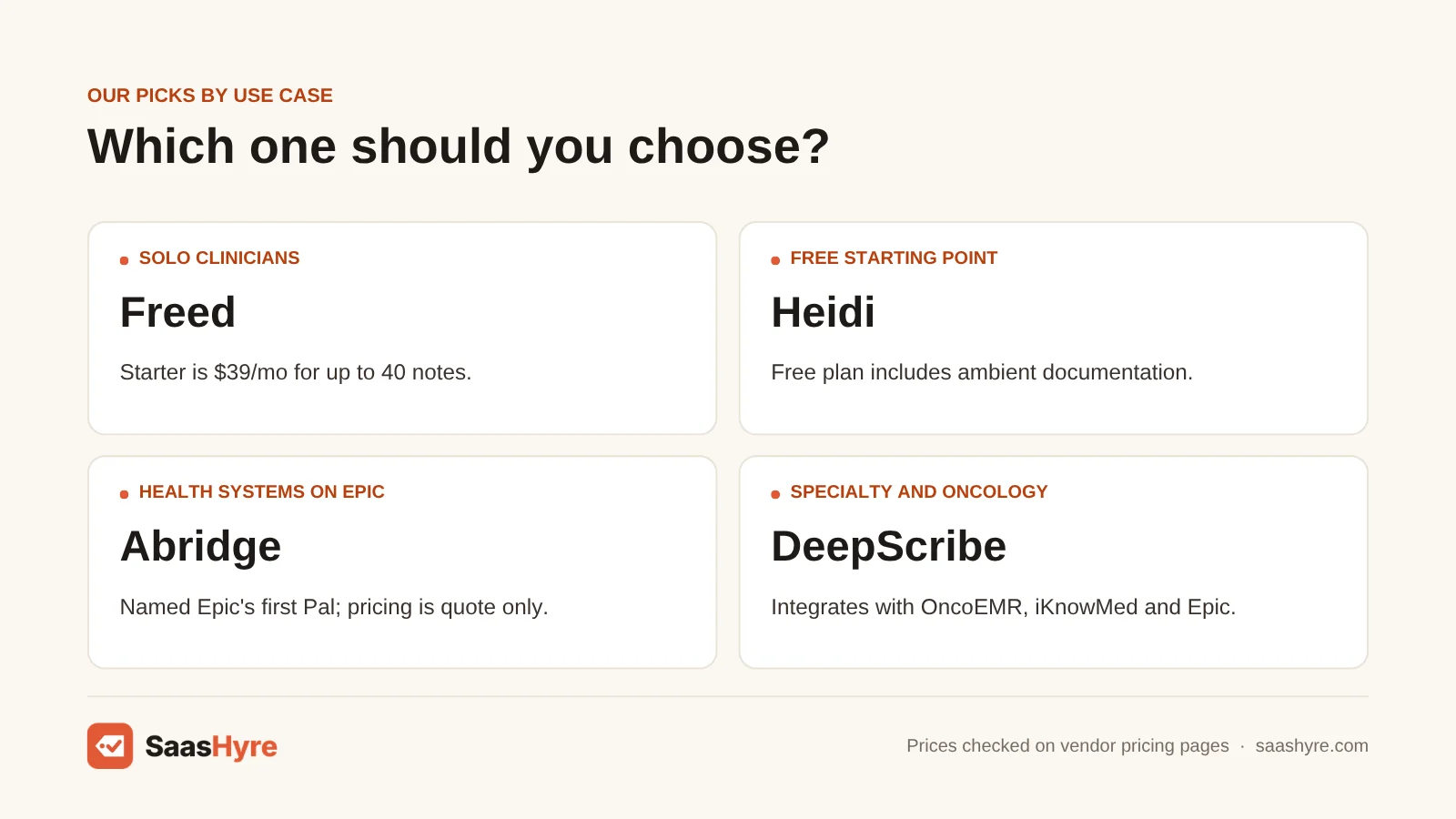
If you work solo or in a practice with fewer than about five clinicians, start with Freed, Heidi or Tali. You can sign up for all three without a sales call. All three publish prices and offer a free trial or free plan. So you can test note quality on your own patients before you pay.
1 Freed: Best for solo clinicians who want to self-serve
Freed is the most popular self-serve AI scribe, and its pricing page is easy to read.
What it does well. You can start today with a 7-day free trial and no credit card. Residents, students and trainees get Core free through a pilot program. Higher plans add EHR push into any browser-based EHR.
Key features:
- Unlimited notes and a template builder on Core
- Cited clinical evidence answers
- EHR push, dictation and visit prep summaries on Premier
- ICD-10 and CPT code ideas on Premier
Pricing. Starter is $39 a month for up to 40 notes. Core is $79 a month with unlimited notes. The page also shows a lower $59 price on its billing toggle, so check which billing term you pick. Premier is $119 a month, or $104 a month billed yearly. It adds patient instructions. Groups get a quote. Group plans add medical assistant seats, SSO, admin dashboards and a BAA for the whole organization.
Best for: You, if you are solo or in a small practice on a web-based EHR and want to start today.
Limitations. Browser push can’t reach an EHR that is a desktop app. There is no native two-way Epic integration.
2 Heidi: Best for trying ambient scribing at no cost
Want to try an ambient scribe for free? Heidi is the easiest place to start.
What it does well. The free plan includes ambient notes and clinical evidence with citations. It is good if you want to try a scribe without a card on file. It also works if you practice outside the US.
Key features:
- Free plan with ambient documentation
- Clinical evidence with citations
- Custom templates and evidence sources on Clinician
- Shared templates, assistant seats, SSO and EHR integration on Teams
Pricing. The free plan costs $0. Clinician is $110 per user per month billed yearly and adds priority support. Teams pricing is custom.
Best for: You, if you want to try ambient notes on real visits without a card on file, or you practice outside the US.
Limitations. Heidi’s HIPAA page says it is a Business Associate and offers a BAA to every covered entity. But the pricing page doesn’t say if the free plan has the same terms. So confirm the BAA before you record a real patient on a free account. EHR integration needs a team contract.
3 Tali: Best for small practices on smaller EHRs
Tali is a Canadian company that also sells in the US. It mixes dictation with ambient notes.
What it does well. Its list of integrations is the reason to look. It names smaller EHRs that few others mention. These are Accuro, CHR, Healthquest, Med Access, Medesync, Oscar Pro, Profile, PS Suite, Net Health, Practice Fusion and Veradigm.
Key features:
- Dictation and ambient notes in one tool
- Works with smaller US and Canadian EHRs
- Unlimited dictation on Starter
- Free plan with a 14-day Pro trial
Pricing. The free Personal plan starts with a 14-day Pro trial. After that you get 5 AI scribes and 60 minutes of dictation a month. Starter is US $68 a month, or US $60 a month billed yearly, for 40 scribes. Pro is unlimited. When we checked, the US pricing page showed Pro in Canadian dollars (CA $100 monthly or CA $68 a month billed yearly). So confirm the US price at checkout. Enterprise is by quote.
Best for: You, if your practice uses one of the EHRs above, or you want one tool for dictation and ambient notes.
Limitations. It is a weaker fit if you use Epic. Group rollouts have no published pricing.
Best AI Medical Scribes for Health Systems and Large Groups
If you run a health system, shortlist Abridge, Microsoft Dragon Copilot, Suki and Ambience. None of them publish prices, and all sell through enterprise contracts. Compare them on how deep the EHR integration goes, coding support and controls. Also compare how well each one handles a rollout to hundreds of clinicians.
4 Abridge: Best for large Epic health systems
Abridge is an enterprise ambient scribe with close ties to Epic.
What it does well. Abridge says more than 300 health systems use it. It says it powers over 100 million conversations a year. Epic named it the first “Pal” in Epic’s partner program. Its support docs show notes going straight into Epic.
Key features:
- Notes sent directly into Epic
- Epic partner program “Pal” status
- Built for system-wide rollouts
Pricing. Quote only, through an enterprise contract. There is no free option.
Best for: You, if your organization runs Epic and plans a system-wide rollout.
Limitations. There is no self-serve plan. So it doesn’t suit independent practices.
5 Microsoft Dragon Copilot: Best for Microsoft and Dragon Medical shops
Dragon Copilot is Microsoft’s current name for the product line that joined Dragon Medical One dictation and DAX Copilot ambient notes.
What it does well. Microsoft announced the joined product in March 2025. You get dictation, ambient notes and an AI assistant in one product.
Key features:
- Dictation from Dragon Medical One
- Ambient notes from DAX Copilot
- AI assistant
Pricing. Microsoft does not list prices in public. You pay for a per-user license plus use per encounter. See the licensing note in the cost section above. There is no free option.
Best for: You, if your clinicians already dictate in Dragon Medical One and your IT team buys through Microsoft.
Limitations. Skip it if you want month-to-month terms or a price you can see before a sales call.
6 Suki: Best for voice commands plus deep EHR sync
Suki mixes voice commands with ambient notes and deep EHR integration.
What it does well. Suki lists deep, real-time, two-way integrations with Epic, Oracle Health, athenahealth and MEDITECH. You can use voice commands along with ambient notes.
Key features:
- Two products, Suki Assistant and Suki Compose
- Two-way sync with Epic, Oracle Health, athenahealth and MEDITECH
- Voice commands plus ambient notes
Pricing. No public prices. You pay per user, with “enterprise volume discounts available.” There is no free option.
Best for: You, if your clinicians like voice commands and you run one of those four EHRs.
Limitations. You can’t sign up on its site by yourself. So you can’t try it on your own this afternoon.
7 Ambience: Best for hospitals that want coding at the point of care
Ambience focuses on notes plus coding while care happens.
What it does well. It creates ICD-10, HCC/MCC/CC classifications and E/M levels during care. It cites 95% coding compliance verified by AAPC (a vendor claim). It covers outpatient, inpatient and emergency settings. It works across more than 200 specialties.
Key features:
- ICD-10 and HCC/MCC/CC classifications
- E/M level suggestions
- Ambulatory, inpatient and emergency settings
- More than 200 specialties
Pricing. Pricing is not public. The company says its fees are tied to outcomes, through an enterprise contract. There is no free option.
Best for: You, if you run a hospital where revenue cycle leaders help pick the tool and coding accuracy is the goal.
Limitations. If all you want is good notes, it is more than a small outpatient practice needs.
Best AI Scribes for Specialty Care and Multilingual Practices
If you run a specialty group, especially in oncology, look at DeepScribe first. It is built around specialty EHRs and templates. If your patients speak many languages, or you mix in-person and telehealth visits, look at Nabla. It lists wide EHR coverage and is used across many organizations.
8 DeepScribe: Best for oncology and other specialty groups
DeepScribe is built around specialty EHRs and templates. Oncology is its main focus.
What it does well. It also covers cardiology, gastroenterology, neurology, orthopedics and urology. It reports an overall score of 98.8 out of 100 in a 2025 KLAS Spotlight report.
Key features:
- Oncology-first design
- Integrations with OncoEMR, iKnowMed and Epic
- Specialty templates for six other fields
Pricing. You can only get pricing by asking, through an enterprise contract. There is no free option.
Best for: You, if you run an oncology or specialty group on OncoEMR, iKnowMed or Epic.
Limitations. It is a poor fit if you are a primary care clinician who wants a low monthly price.
9 Nabla: Best for organizations needing multilingual notes
Nabla is a scribe for groups whose patients speak many languages and who mix in-person and telehealth visits.
What it does well. Nabla says more than 85,000 clinicians use it across 130+ health organizations. It says it handles over 20 million patient visits a year.
Key features:
- Works with Epic, athenahealth, Oracle Health, NextGen, Arya EHR and Greenway Health
- HIPAA, SOC 2 Type 2, ISO 27001 and GDPR credentials
- Notes in many languages
- “Try it for free” signup
Pricing. No public price list. It sells through contracts with organizations. Its old pricing page link now shows an error.
Best for: You, if your group uses one of those EHRs and your patients speak several languages.
Limitations. Skip it if you need to see a price before you talk to anyone.
How to Choose an AI Medical Scribe: A Buyer’s Checklist
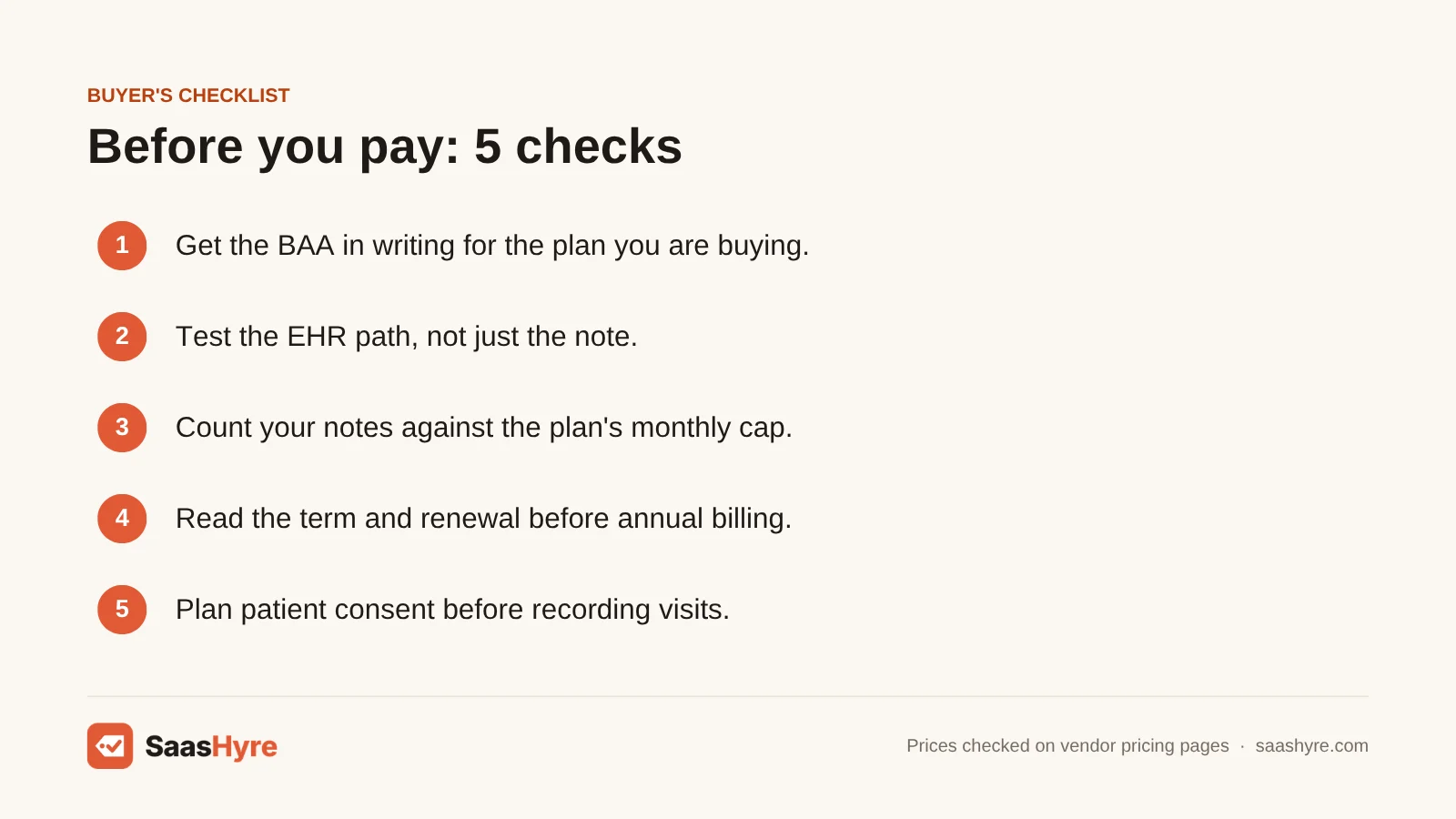
Before you sign, check five things. Look at the BAA, how the note reaches your EHR, the monthly note cap and the contract term. Also plan how your practice will get patient consent. These decide your real cost and risk far more than the demo does.
- Get the BAA in writing for the plan you are buying. Some vendors only offer a BAA for the whole organization on group plans. Don’t record a real patient on a free or trial account until you know it is covered.
- Test the EHR path, not just the note. “Integration” can mean true two-way sync. Or it can mean a browser extension that pastes text. Time five notes.
- Count your notes. Multiply your daily patients by your clinic days. A 40-note plan does not suit a full-time clinician.
- Read the term and renewal. Paying yearly lowers the monthly price but locks you in. Some licenses need a 12-month commitment. Microsoft now also bills ambient use per encounter on top of the license.
- Plan patient consent. Some states, including California, require everyone to agree before a private conversation is recorded. Write a simple script and add a line to intake forms. Know how to turn the scribe off when a patient says no.
- Ask about audio and note retention. Find out if recordings are stored, for how long, and who controls the retention settings. Freed says it does not store patient recordings.
How We Evaluated These Scribes
We read each vendor’s own pricing page, product pages, HIPAA or security pages and support docs in September 2026. When a vendor does not publish a price, we list it as quote only. Numbers like clinician counts, KLAS scores and coding accuracy are the vendors’ own claims. We did not run our own accuracy tests or record patient visits. Nothing here is medical or legal advice. No vendor pays to be listed in this guide. Read our editorial policy to see how we research and update guides.
The Bottom Line
If you work solo, start a Freed trial or a Heidi free account. Pay for EHR push once you know you will keep using it. If your small practice runs a Canadian or smaller US EHR, check Tali’s integration list first. If you run an Epic health system, do a planned pilot of Abridge, Suki and Microsoft Dragon Copilot. Add Ambience if coding is a priority. Oncology and specialty groups should shortlist DeepScribe. Groups with patients who speak many languages should talk to Nabla.
Frequently Asked Questions
What is the best AI medical scribe for a solo practice?
For most solo clinicians, Freed is the simplest paid choice. It costs $79 a month for unlimited notes. Premier with one-click EHR push is $104 a month billed yearly. Heidi is the best free place to start. If you run a smaller EHR like Practice Fusion or Oscar Pro, check Tali. It lists native integrations for those systems.
Is there a free AI medical scribe?
Yes. Heidi has a free plan with ambient notes and cited clinical evidence. Tali’s free Personal plan gives 5 AI scribes and 60 minutes of dictation a month after a 14-day Pro trial. Freed has a 7-day free trial with no card. Make sure a BAA covers any free plan before you record real patients.
What is an ambient AI scribe?
An ambient AI scribe listens in the background during a patient visit. It turns the talk into a structured clinical note, so you don’t have to dictate. You review, edit and sign the draft. Many also draft patient instructions and suggest billing codes.
Are AI medical scribes HIPAA compliant?
The big vendors say they are HIPAA compliant. But compliance depends on having a signed Business Associate Agreement for your account. Heidi says it offers a BAA to every covered entity. Freed offers a BAA for the whole organization on its group plan. Ask which plan your BAA covers and how recordings and notes are kept.
Do patients have to consent to an AI scribe?
Rules vary by state. Some states, including California, require everyone to agree before a private conversation is recorded. So many practices ask every patient. A common approach has three parts. Give a short spoken explanation at the start of the visit. Add a line on intake forms. Turn the scribe off if the patient says no.
How much does an AI medical scribe cost per month?
Self-serve plans run from $0 (Heidi Free) to about $119 per clinician per month (Freed Premier billed monthly). Plans at $39 to $60 usually cap you at 40 notes. Enterprise scribes like Abridge, Suki, Ambience, DeepScribe, Nabla and Microsoft Dragon Copilot don’t publish prices. You get them by quote.