
TL;DR: This guide compares nine residential proxy providers on the price to start, the price at 50 GB and the volume behind each “from” rate. NodeMaven ranks first for clean IPs and long sessions, from $2.20 per GB. Decodo is the runner-up and the easiest start for most buyers at $4 per GB pay as you go, or $150 a month for 50 GB. Evomi and DataImpulse cost far less, and Oxylabs fits big jobs. Work out your monthly GB first, then price that exact amount.
Looking for the best residential proxies? Start with one odd fact. The same 50 GB of traffic costs $49 a month at one provider in this guide and $400 at another.
First, the basics. A proxy is a middleman server that sends your web requests for you. An IP is the address a website sees. A residential proxy uses IPs that internet providers gave to real homes. You pay per GB, which means per gigabyte of data you use.
Most “from” prices only apply at huge volumes. IPRoyal’s $1.75 per GB needs a 10 TB order, which is 10,000 GB. Webshare’s $1.40 per GB needs 3,000 GB a month.
Pool sizes are fuzzy too. Oxylabs advertises 175 million IPs. Yet Proxyway’s 2026 market research saw 3,241,404 unique Oxylabs IPs across 3.6 million requests.
So I read every price on the vendor’s own page on October 7, 2026. We earn a commission on some links, including NodeMaven. We didn’t test these proxies ourselves. Every speed or success figure below comes from a named third party.
This guide is part of our best proxy providers series, which covers every proxy type.
What Are the Best Residential Proxies in 2026?
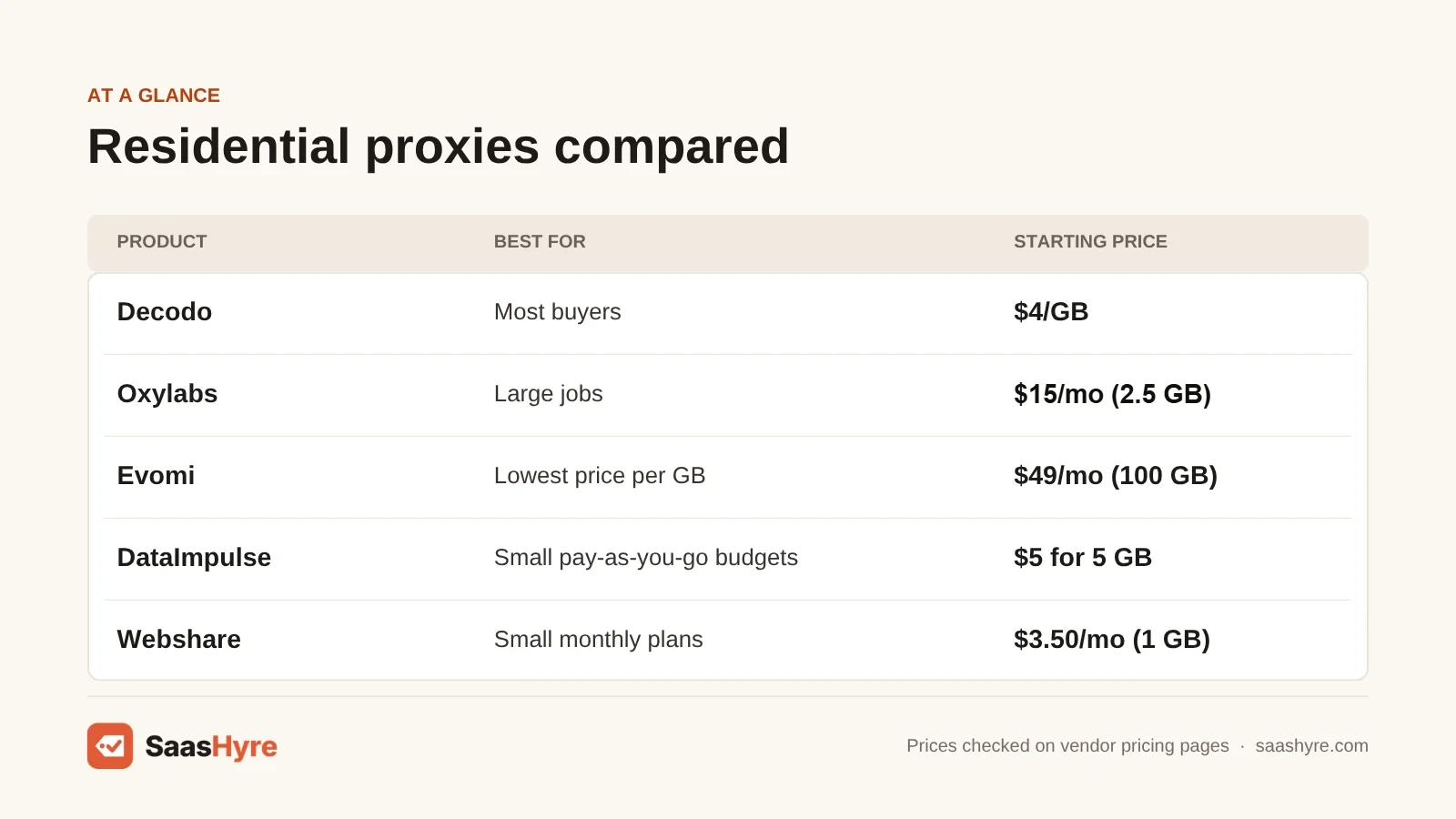
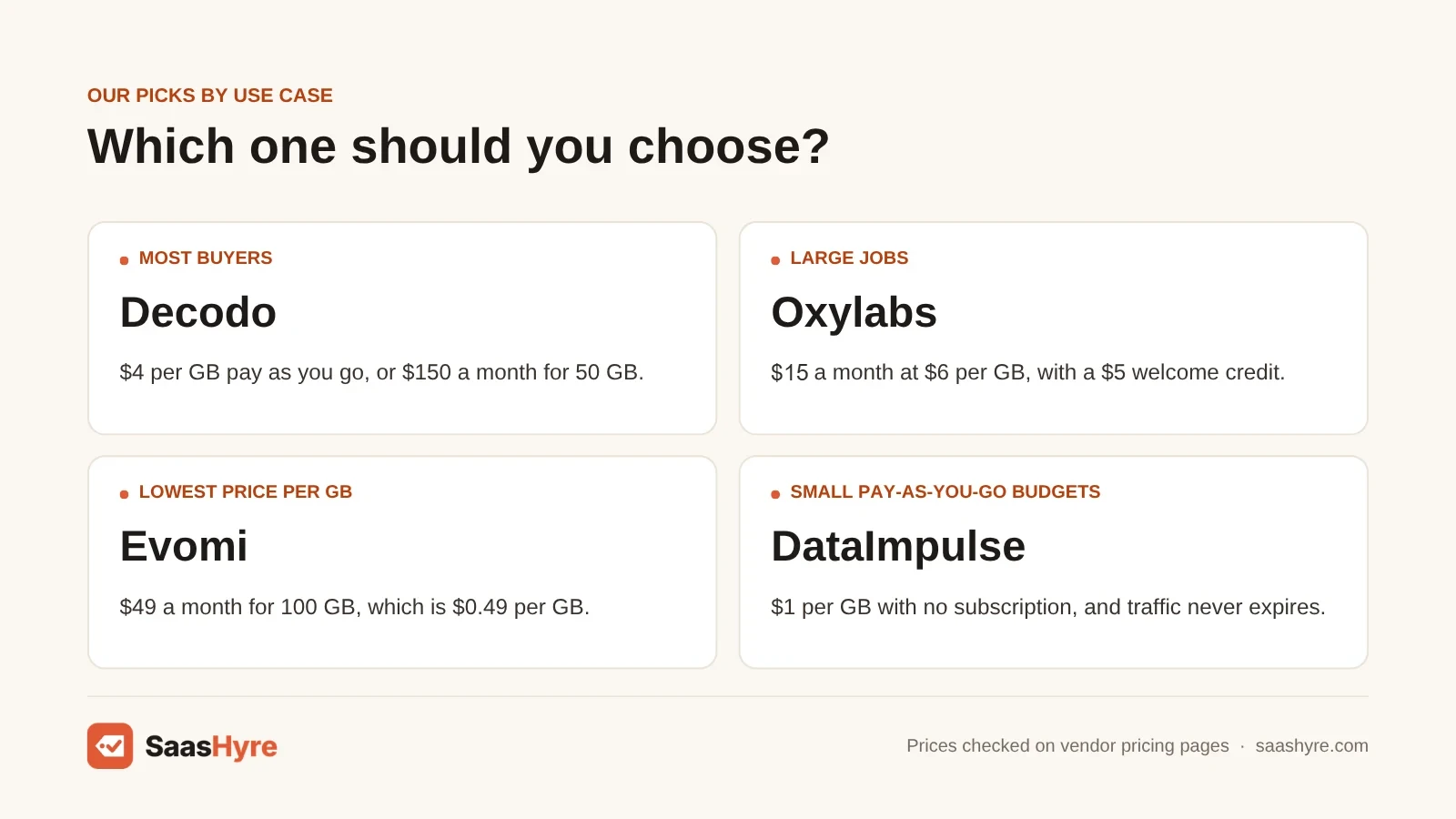
NodeMaven ranks first for clean IPs and long sessions, from $2.20 per GB. The best residential proxies in 2026 are Decodo for most buyers, Oxylabs for large jobs and Evomi for the lowest price per GB. Decodo costs $4 per GB pay as you go. Oxylabs starts at $15 a month. Evomi’s 100 GB plan costs $49 a month, which is $0.49 per GB.
| Provider | Best for | Starting price | Trial or refund |
|---|---|---|---|
| NodeMaven | Clean IPs and long sessions | From $2.20/GB, or $8.50/mo for 2 GB | $3.50 paid trial for 750 MB. No free trial |
| Decodo | Most buyers | $4/GB pay as you go, or $11.25/mo for 3 GB | 3-day free trial or 14-day refund, not both |
| Oxylabs | Large jobs | $15/mo for about 2.5 GB ($6/GB) | $5 welcome credit, no card. Treat as non-refundable |
| Evomi | Lowest price per GB | $49/mo for 100 GB, or $0.99/GB pay as you go | 1-day free trial, card needed. Capped 30-day refund |
| DataImpulse | Small pay-as-you-go budgets | $5 for 5 GB ($1/GB), new users | No free trial. 7-day refund on the first Intro plan |
| Webshare | Small monthly plans | $3.50/mo for 1 GB | No residential trial. 2-day refund under 0.1 GB |
| SOAX | Residential and mobile at one rate | $5.00/GB in Tier 1 countries, no monthly fee | No free trial. Generally non-refundable |
| Bright Data | Verified companies that need fine targeting | $8/GB pay as you go ($4/GB promo) | $2 trial credit for 7 days. Generally non-refundable |
| IPRoyal | Small top-ups that never expire | $7.35 for 1 GB, pay as you go | No free trial published. Refund under 100 MB used |
I ranked these residential proxy providers on published price, terms and fit. Where two were close, Proxyway’s 2026 test results broke the tie.
Not sure you need residential IPs? Our list of the best proxy providers covers every proxy type. You can also browse all our proxy guides.
The 9 Best Residential Proxies, Reviewed
Pool sizes below are vendor claims. Test results come from Proxyway’s 2026 research, which sent about 3.6 million requests through each global pool. Proxyway earns affiliate commissions and says so.
Rotating means you get a new IP on each request. A sticky session keeps the same IP for a set time. An ASN is the ID number of one network, such as a single internet provider. KYC, short for “know your customer”, is an identity check.
1 NodeMaven: Best for clean IPs and long sessions
Promo code: Use SHR35 at checkout for 35% off NodeMaven.
For the full picture, read our NodeMaven review.
If bad IPs keep breaking your jobs, start with NodeMaven.
What it does well. NodeMaven puts clean IPs ahead of pool size, which matters when one bad IP can break a session. Three features stand out.
- IP Quality Filter. NodeMaven screens every IP in real time before it is assigned to you, so flagged or slow IPs are dropped before they reach your work. NodeMaven says over 95% of its IPs pass as clean.
- Quality Guarantee. NodeMaven says it fixes proxy performance problems with a replacement or compensation, depending on the proxy type and case.
- Flexible setup. You can mix residential, mobile and ISP proxies in one account, with pay as you go or monthly plans. Residential and mobile traffic share one balance, and unused traffic rolls over instead of expiring.
Key features:
- 30M+ residential IPs with country, city and ISP targeting (vendor claim)
- Sticky sessions of up to 24 hours
- Residential and mobile IPs on the same GB balance
- Traffic rollover and cashback of up to 10% on used traffic
- HTTP(S) and SOCKS5, plus 24/7 help from people, not bots, on live chat, Telegram and email
Pricing. Residential and mobile traffic starts from $2.20 per GB on NodeMaven’s pricing page. Its FAQ lists the smallest monthly plan at $8.50 for 2 GB, which works out to $4.25 per GB. A paid trial gives you 750 MB for $3.50. See NodeMaven pricing.
Best for: You, if a flagged IP costs you more than the price per GB, as in account work, GEO checks or ad verification.
Limitations. The $2.20 rate needs a bigger plan, so small buyers pay closer to $4.25 per GB. There is no free trial, only the $3.50 paid one. The 99.54% success rate and sub-second speed are NodeMaven’s own figures, not an independent test.
2 Decodo: Best for most buyers
If you want one provider that is easy to start with, pick Decodo.
What it does well. Decodo, once called Smartproxy, publishes every price tier. In Proxyway’s 2026 test, its pool had a 99.92% success rate and a 0.53 second response time. Proxyway also named it Best All-Rounder in its 2026 awards.
Key features:
- 115M+ IPs in 195+ locations (vendor claim)
- Country, state, city, ZIP and ASN targeting
- Sticky sessions of up to 24 hours
Pricing. Pay as you go costs $4 per GB. Monthly plans start at $11.25 for 3 GB, and 50 GB costs $150, plus VAT. The $2 “from” rate needs the 1,000 GB plan at $2,000 a month. See Decodo pricing.
Best for: You, if you need 3 to 100 GB a month and want published prices.
Limitations. The 3-day free trial gives 100 MB, needs a card and cancels your refund right. The 14-day refund ends at 20% of your traffic or 1 GB. Its “ethically-sourced” label is Decodo’s own claim.
3 Oxylabs: Best for large jobs
If you run big scraping jobs, look at Oxylabs.
What it does well. Oxylabs returned the most unique IPs in Proxyway’s 2026 test. It also posted the top success rate at 99.93%, with a 0.60 second response time.
Key features:
- 175M+ IPs in 195 locations (vendor claim)
- Country, state, city and ZIP targeting at no extra fee
- $5 welcome credit with no card
Pricing. Oxylabs sells one monthly credit plan for all its products. Starter costs $15 at $6 per GB, Basic costs $100 at $5 and Flexible costs $500 at $4. The lowest rate, $2.50, needs an Enterprise plan from $2,500 a month. See Oxylabs pricing.
Best for: You, if you spend $500 or more a month.
Limitations. There is no pay as you go, and unused credit expires at the end of each cycle. Its help center says self-service purchases are non-refundable, so test with the $5 credit. Oxylabs says it runs KYC checks and approves only 75% of customers.
4 Evomi: Best for the lowest price per GB
If price per GB matters most, start with Evomi.
What it does well. Evomi’s Core plan has the lowest published rate in this guide. One caution. Proxyway tested Evomi’s Premium pool, which scored 99.58% success and 0.79 seconds. Premium costs $3.98 per GB pay as you go, not $0.49.
Key features:
- 54M+ IPs in 150+ countries (vendor claim)
- Free country, region and city targeting
- Sticky sessions of up to 24 hours
Pricing. The Core monthly plan costs $49 for 100 GB, and extra GB cost $0.49 each. Pay as you go costs $0.99 per GB with a 15 GB minimum, so the smallest order is $14.85 (our math). That traffic never expires. See Evomi pricing.
Best for: You, if you need 50 GB or more a month.
Limitations. Unused subscription GB don’t roll over. ZIP, ISP and ASN filters multiply the data you’re billed for, up to 15 times. The 1-day free trial needs a card. Evomi says its IPs come from volunteers who opt in.
5 DataImpulse: Best for small pay-as-you-go budgets
If you want to try residential proxies for $5, start with DataImpulse.
What it does well. DataImpulse charges $1 per GB with no subscription, and your traffic never expires. Proxyway’s 2026 test put its standard pool at 99.74% success with a 0.97 second response time.
Key features:
- 90M+ IPs in 195+ countries (vendor claim)
- Free country targeting
- Prepaid traffic that never expires
Pricing. New users can buy the Intro plan, which is 5 GB for $5. After that, the smallest standard plan is Basic at 50 GB for $50. The lowest rate is $0.80 per GB on the 1 TB plan at $800. See DataImpulse pricing.
Best for: You, if country targeting is enough for your work.
Limitations. State, city, ZIP and ASN targeting is billed at double the standard rate, so $1 becomes $2 (our math). There is no free trial, and the 7-day refund covers only your first Intro plan. DataImpulse says its IPs are ethically sourced with user consent.
6 Webshare: Best for small monthly plans
If you need just a few GB every month, look at Webshare.
What it does well. Webshare has the lowest monthly price here. Proxyway’s 2026 test measured 99.28% success, which matched the test median, and a 0.86 second response time.
Key features:
- 80M+ “ethically sourced” IPs (vendor claim)
- Country, city and ASN targeting
- Sticky sessions from 1 minute to 24 hours
Pricing. Plans cost $3.50 a month for 1 GB, $27.50 for 10 GB and $122.50 for 50 GB. Yearly billing takes 30% off. The “from $1.40” rate needs the 3,000 GB plan at $4,200 a month. See Webshare pricing.
Best for: You, if your use is small and steady from month to month.
Limitations. There is no pay as you go. Bandwidth does not roll over, and your proxies stop when you hit the limit. Refunds need a request within 2 days and under 0.1 GB used.
7 SOAX: Best for residential and mobile at one rate
If you need both home and mobile IPs, SOAX charges one rate for both.
What it does well. SOAX prices traffic by the country of the proxy IP. The United States and Germany are Tier 1, and India is Tier 2. Proxyway’s 2026 test measured 99.78% success and a 0.89 second response time.
Key features:
- 155+ million residential IPs (vendor claim)
- Country, region, city and ISP targeting on every plan
- ASN and ZIP targeting on Scale and above
Pricing. Sandbox has no monthly fee, and you buy credits at $5.00 per GB in Tier 1. Builder costs $200 a month, includes 200 credits and drops Tier 1 to $3.00. Team costs $500 at $2.20, and Scale costs $1,500 at $1.50. See SOAX pricing.
Best for: You, if you mix residential and mobile traffic.
Limitations. The “from $0.85” rate needs the Enterprise plan at $3,000 a month. Monthly plan credits expire after 60 days, and there is no free trial. SOAX requires an identity check before you can buy.
8 Bright Data: Best for verified companies that need fine targeting
If you are a registered company that needs ZIP-level targeting, look at Bright Data.
What it does well. Bright Data advertises the largest pool here. It did not take part in Proxyway’s 2026 test, so we have no fresh third-party figures for it.
Key features:
- 400M+ monthly IPs in 195 countries (vendor claim)
- Free country, state, city and ZIP targeting
- First deposit matched up to $500
Pricing. The regular price is $8 per GB pay as you go. Plans of $499, $999 and $1,999 a month cost $7, $6 and $5 per GB. Promo code RESIGB50 gives 50% off for 3 months, so pay as you go drops to $4. See Bright Data pricing.
Best for: You, if you’re a registered business with a company email.
Limitations. Bright Data’s docs say residential access goes only to registered companies, after a KYC review of about 48 hours. Gmail and Outlook accounts aren’t eligible. Unused plan traffic doesn’t roll over. The trial is a one-time $2 credit that lasts 7 days.
9 IPRoyal: Best for small top-ups that never expire
If you buy a few GB now and then, IPRoyal lets you keep them.
What it does well. IPRoyal’s pay-as-you-go traffic never expires. Proxyway’s 2026 test measured 96.11% success and a 1.24 second response time. Both were weaker than the test medians of 99.28% and 0.93 seconds.
Key features:
- 64M+ IPs in 195+ countries (vendor claim)
- Sticky sessions of up to 7 days
- Traffic that never expires
Pricing. Pay as you go costs $7.35 for 1 GB. The rate falls to $6.25 per GB at 2 GB and $5.51 at 10 GB. A monthly subscription takes 5% off. See IPRoyal pricing.
Best for: You, if your projects are small and come at odd times.
Limitations. IPRoyal says the $1.75 rate is for bulk orders, and it needs a custom plan from 10 TB. Prices between 10 GB and 10 TB aren’t public. ISP-level targeting needs a verified ID and $1,000 in spend. No free trial is published, and refunds end once you use more than 100 MB.
How Much Do Residential Proxies Cost per GB?
Residential proxies cost $0.49 to $8 per GB to start across the eight providers in this guide, based on vendor pages read on October 7, 2026. At 50 GB a month, the bill runs from $49 to $400. Most advertised “from” rates need 1,000 GB a month or more.
| Provider | Price to start | Unit price | Billing basis | Price at 50 GB | Volume needed for the “from” price |
|---|---|---|---|---|---|
| Decodo | $4 for 1 GB | $4/GB | Pay as you go, or monthly | $150/mo ($3/GB) | $2/GB needs 1,000 GB ($2,000/mo) |
| Oxylabs | $15/mo | $6/GB | Monthly credits | $250 (our math) | $2.50/GB needs Enterprise, from $2,500/mo |
| Evomi | $14.85 for 15 GB, or $49/mo | $0.99/GB, or $0.49/GB on the plan | Pay as you go, or monthly | $49/mo (100 GB plan) | $0.49/GB needs the 100 GB plan |
| DataImpulse | $5 for 5 GB (new users) | $1/GB | Prepaid, pay as you go | $50 | $0.80/GB needs 1 TB ($800) |
| Webshare | $3.50/mo for 1 GB | $3.50/GB | Monthly or yearly | $122.50/mo ($2.45/GB) | $1.40/GB needs 3,000 GB ($4,200/mo) |
| SOAX | Minimum top-up not published | $5.00/GB in Tier 1 | Prepaid credits, or monthly | $200/mo (Builder, Tier 1) | $0.85/GB needs Enterprise ($3,000/mo) |
| Bright Data | No minimum stated | $8/GB ($4/GB promo) | Pay as you go, or monthly | $400 ($200 promo) | $2.50/GB is the promo rate on the $1,999/mo plan |
| IPRoyal | $7.35 for 1 GB | $7.35/GB | Pay as you go, or monthly at 5% off | Not published | $1.75/GB needs a custom plan from 10 TB |
Proxyway’s 2026 research put the average residential proxy price per GB at $4.16 for 5 GB. It fell to $3.00 at 50 GB and $1.94 at 1,000 GB. For one vendor’s full plan list, browse our pricing guides.
What is not in the sticker price:
- Minimum spend. Evomi’s pay as you go starts at 15 GB. After the $5 Intro plan, DataImpulse’s smallest standard plan is $50.
- Data that expires. Oxylabs credit expires each billing cycle. Webshare and Evomi plan GB don’t roll over. SOAX monthly credits expire after 60 days.
- Targeting surcharges. DataImpulse bills state, city, ZIP and ASN targeting at double the rate. Evomi’s ZIP, ISP and ASN filters multiply your billed data.
- Promo end dates. Bright Data’s 50% code runs for 3 months. After that, the regular rate is $8 per GB pay as you go.
- ID checks and tax. Bright Data sells residential access only to registered companies. Decodo, Oxylabs and SOAX show prices before VAT.
The table below is our math, using only published rates. It shows the lowest listed way to buy each amount in one month.
| Provider | 5 GB a month | 50 GB a month | 1,000 GB a month |
|---|---|---|---|
| Decodo | $20 (pay as you go) | $150 (50 GB plan) | $2,000 (1,000 GB plan) |
| Oxylabs | $30 (Starter plus a $15 top-up) | $250 (Basic plus $150 in top-ups) | $2,500 (Enterprise, through sales) |
| Evomi | $14.85 (15 GB minimum order) | $49 (100 GB plan) | $490 (plan plus 900 extra GB) |
| DataImpulse | $5 (Intro plan, new users) | $50 | $800 |
| Webshare | $15 | $122.50 | $1,500 |
| SOAX, Tier 1 | $25 (Sandbox) | $200 (Builder plan) | $1,500 (Scale plan) |
| Bright Data | $40, or $20 with the promo | $400, or $200 with the promo | Contact sales for 1 TB or more |
| IPRoyal | $27.55 to $31.25 (5 GB rate not published) | Not published | Not published |
Take Oxylabs at 50 GB. The Basic plan gives you $100 of credit at $5 per GB, which covers 20 GB. The other 30 GB need $150 in top-ups.
SOAX needs credit math too. Fifty GB in Tier 1 on Builder uses 150 of the plan’s 200 credits. You still pay $200. IPRoyal lists rates for 2 GB and 10 GB only, so 5 GB falls between $5.51 and $6.25 per GB.
How Big Is a Residential Proxy Pool in Real Use?
A residential proxy pool is far smaller in real use than the advertised number. Oxylabs advertises 175 million IPs, and Proxyway’s 2026 test saw 3,241,404 unique IPs across 3.6 million requests. That was the most of any provider tested. Treat every pool size as a vendor claim.
Why is the gap so wide? Vendors often count every device seen over a month. Bright Data, for one, says “400M+ monthly”. Home devices also go on and off all day, though that part is our reasoning.
Success rates have a gap too. On Proxyway’s light test page, the median residential success rate was 99.28%. On Amazon, Google and Instagram, the median fell to 74.43%. So test on the sites you really need before you buy in bulk.
Also ask who owns the pool. Proxyway’s report says the market supports only 10 to 15 companies with their own networks.
Do you need one IP that stays the same for weeks? Look at the best ISP proxies, which are billed per IP and not per GB.
Where Residential IPs Come From, and What Changed in 2026
A residential IP belongs to someone’s home connection. Google’s Threat Intelligence Group describes three ways providers get them. They are code kits called SDKs inside apps, software loaded on devices and apps that pay users for spare bandwidth.
Google wrote that claims of ethical sourcing “must be backed by transparent, auditable proof of user consent”. The FBI warned in June 2025 that infected streaming boxes and other home devices were being used in residential proxy services.
Krebs on Security reported on July 2, 2026 that the FBI seized hundreds of domains tied to NetNut and the Popa botnet. That is why NetNut is not on this list.
We can’t audit what the providers here say. Bright Data says its SDK turns on only after a user opts in. Oxylabs and Decodo helped found an industry group on ethical data collection, according to Oxylabs. That group is funded by its members and is not an audit.
What changed in 2026: NetNut’s domains were seized on July 2, per Krebs on Security. Oxylabs moved every product to one monthly credit subscription. Rayobyte relaunched its site and prices on October 1. SOAX no longer lists ISP or datacenter proxies on its site.
Keep your own use lawful too. Stick to public data for jobs like price monitoring, SEO tracking, ad verification and market research. In the hiQ and LinkedIn case, a US appeals court said accessing public data likely isn’t “without authorization” under one US law. This is not legal advice, so check each site’s terms and your local law.
How Do You Choose a Residential Proxy Provider?
To choose a residential proxy provider, measure your monthly GB first, then price that exact amount on each vendor’s page. Check whether unused data expires, what targeting costs extra and whether you can pass the ID check. Then test on your own target sites before you commit.
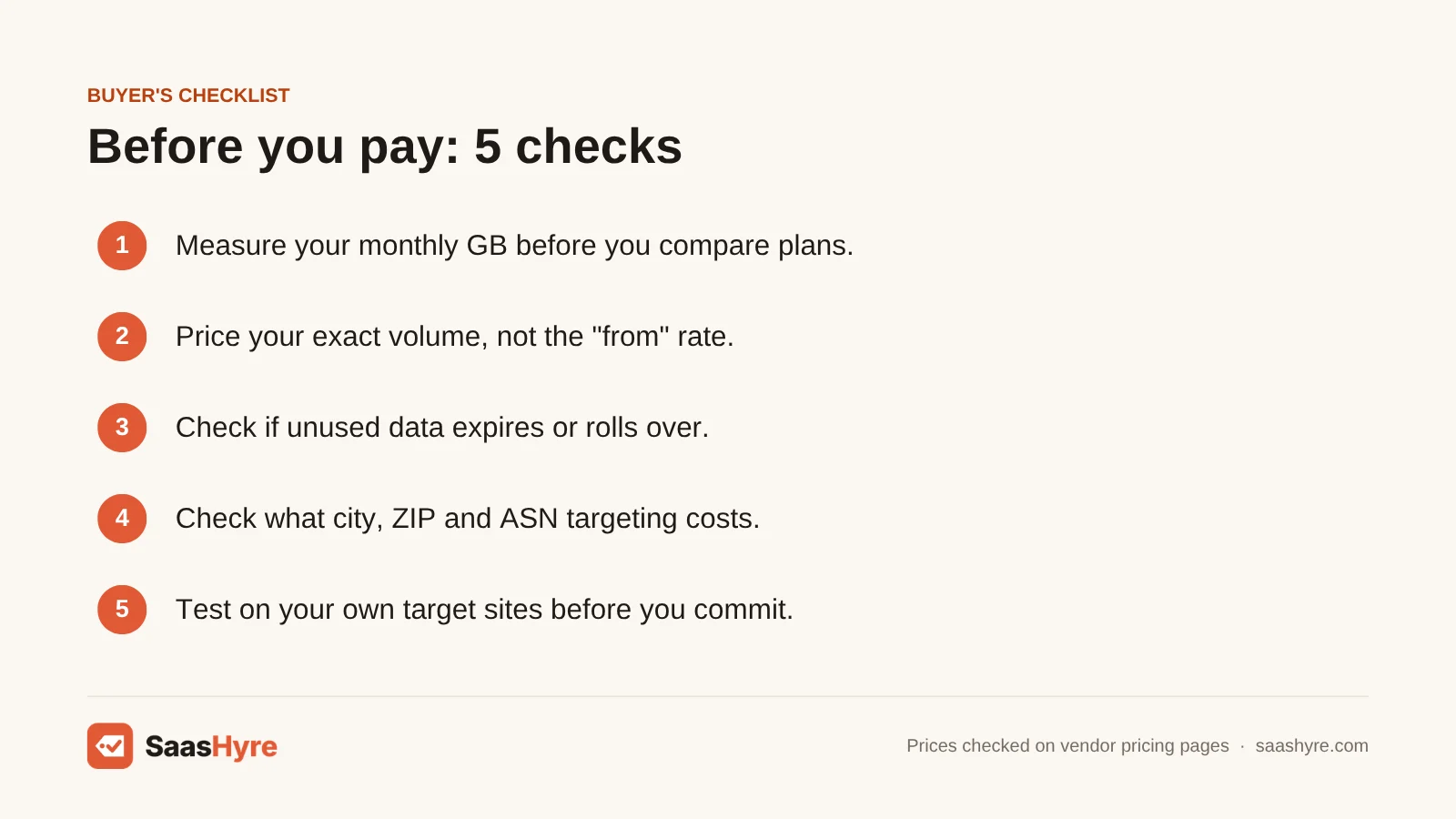
Work through this list before you buy residential proxies from anyone.
- Measure your GB. Run a small job and note the data used. Multiply it by your monthly page count.
- Price your exact volume. Ignore the “from” rate, and start with the cost table above.
- Check if data expires. Irregular work fits traffic that never expires, like IPRoyal or DataImpulse. Steady work fits a monthly plan.
- Check what targeting costs. City, ZIP and ASN targeting can cost more or need a bigger plan.
- Check the ID rules. A solo buyer with a Gmail address can’t use Bright Data’s residential network.
- Test on your own targets. DataImpulse’s Intro plan costs $5, and Oxylabs gives a $5 credit with no card.
If you only want to track search rankings, you may not need rotating residential proxies at all. Ready-made rank tracking software collects the data for you.
How We Researched This Guide
We read every price on the vendor’s own rendered pages on October 7, 2026, with tabs and toggles opened.
We could not confirm IPRoyal’s prices between 10 GB and 10 TB, SOAX’s minimum top-up or whether Decodo plan GB roll over. SOAX’s product page also shows a $1.99 trial that its pricing page doesn’t offer. An older Oxylabs FAQ still describes a 3-day refund, which its help center rules out.
We did not test these proxies ourselves. Performance figures come from Proxyway’s 2026 research, which is funded by affiliate links. The cost tables are our math.
We capped the list at eight. Rayobyte missed the cut because its prices relaunched on October 1 and its trial size isn’t published. PacketStream, Geonode and Proxy-Seller also publish prices, but Proxyway’s 2026 test didn’t cover them.
We earn a commission if you buy NodeMaven through our link, at no extra cost to you. You can read more in our editorial policy.
Prices last checked: October 7, 2026.
The Bottom Line
Here is what to take away. Price your own volume, because 50 GB runs from $49 to $400 across these eight providers. Big numbers also shrink in real use. A 175 million IP pool showed about 3.2 million unique IPs in Proxyway’s test. And always read the terms on expiry and refunds before you pay.
For most buyers, I’d start with Decodo at $4 per GB. Want the lowest bill? Try Evomi or DataImpulse. Running big jobs? Look at Oxylabs.
Your next step is simple. Measure one week of traffic, then test two providers on your real targets. You’ll soon know which pool fits your work.
Prices move fast in this space. Before you decide, read our cheap residential proxies guide, and use our residential vs datacenter proxies and best mobile proxies guides to build a shortlist.
Frequently Asked Questions
What is a residential proxy?
A residential proxy sends your web requests through an IP address that an internet provider gave to a real home. Websites see a normal household visitor and not a server. Most residential proxy providers bill per GB of traffic.
How much do residential proxies cost per GB?
Residential proxies cost $0.49 to $8 per GB to start across the eight providers here, as of October 7, 2026. For comparison, Proxyway’s 2026 research found an average of $3.00 per GB at 50 GB.
Are residential proxies legal?
Proxies are a common business tool for jobs like price monitoring and ad verification. Rules differ by country and by site. This is not legal advice, so check the site’s terms and your local law.
How do providers get residential IPs?
Google’s Threat Intelligence Group lists three routes. They are code kits inside apps, software loaded on devices and apps that pay users for spare bandwidth. Google also says ethical sourcing claims need auditable proof of user consent.
Which residential proxy provider has the biggest pool?
Bright Data advertises the biggest pool at 400M+ monthly IPs. In Proxyway’s 2026 test, Oxylabs returned the most unique IPs, with 3,241,404 across 3.6 million requests.