

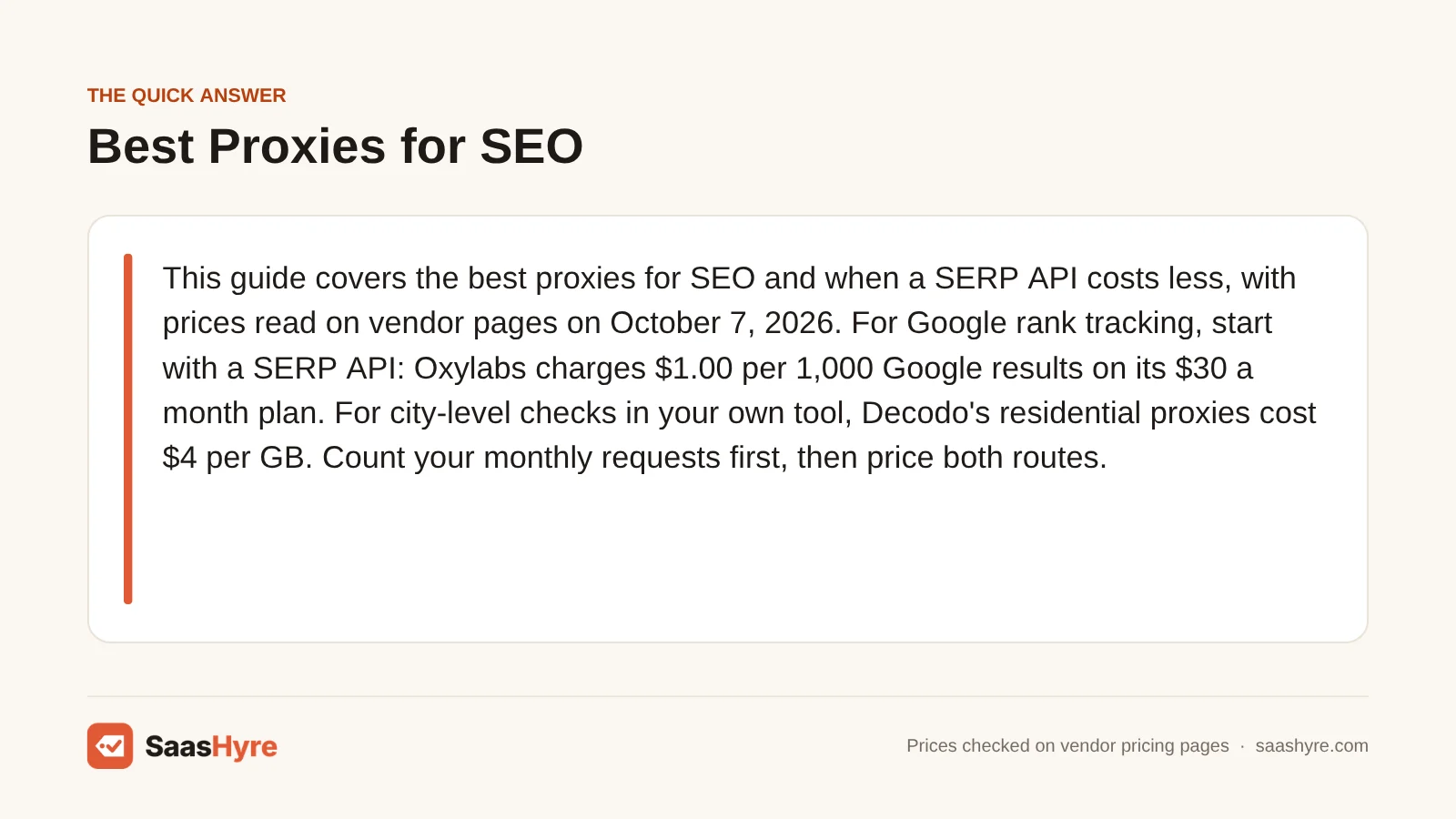
TL;DR: This guide covers the best proxies for SEO and when a SERP API costs less, with prices read on vendor pages on October 7, 2026. For Google rank tracking, start with a SERP API: Oxylabs charges $1.00 per 1,000 Google results on its $30 a month plan. For city-level checks in your own tool, Decodo’s residential proxies cost $4 per GB. Count your monthly requests first, then price both routes.
Looking for the best proxies for SEO? The math changed in 2025. That September, Google stopped honoring a setting that let tools pull 100 results in one request. Search Engine Land reported that rank trackers now pay 10 times as much for the same data.
First, a few quick terms. A proxy is a middle server that sends your requests from a different IP address. An IP address is the number that identifies a device online. SEO tools use proxies to check rankings from many places without getting blocked.
A SERP is a search engine results page. A SERP API is a service that fetches that page for you and bills you per request.
I read every price on the vendor’s own page on October 7, 2026, and priced both routes for the same job.
One thing to know up front. We didn’t test these proxies. Every performance figure comes from a named third party. We sell nothing, and no vendor pays to be ranked.
This guide is part of our best proxy providers series, which covers every proxy type.
What Are the Best Proxies for SEO in 2026?
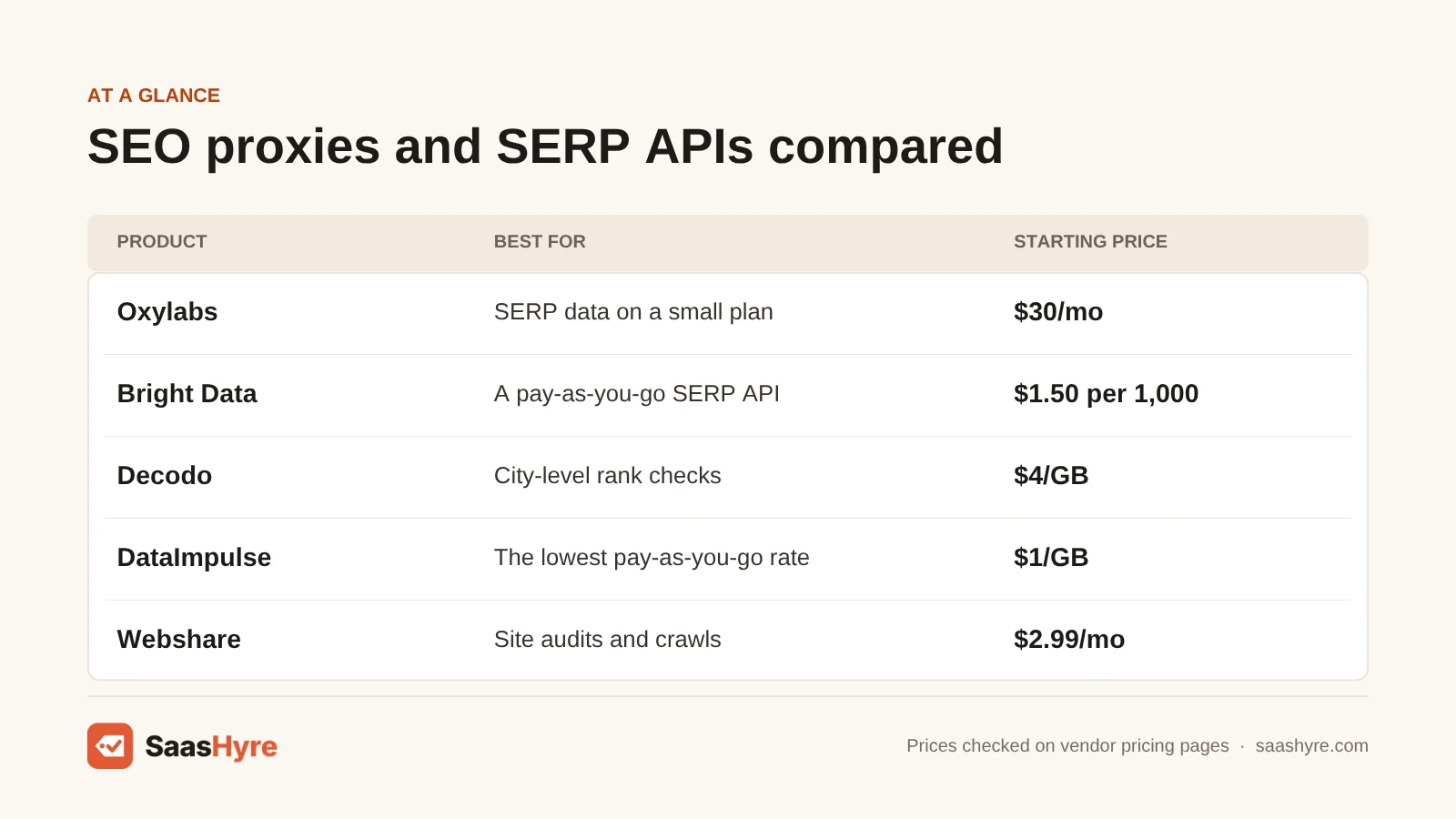
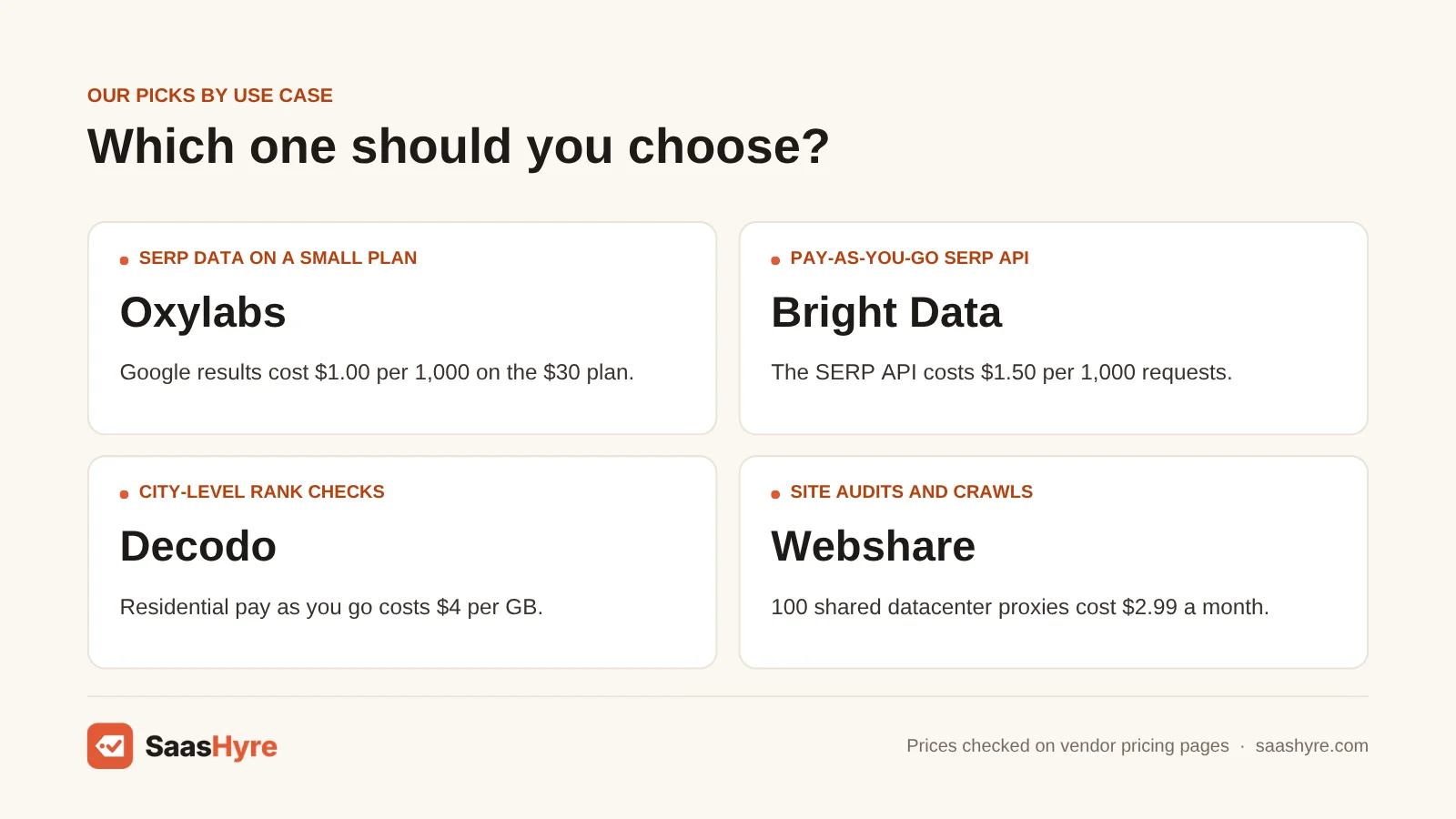
The best proxies for SEO in 2026 depend on the job. For Google rank tracking, a SERP API from Oxylabs or Bright Data costs $1.00 to $1.50 per 1,000 requests. For city-level checks in your own tool, Decodo’s residential proxies cost $4 per GB. For site crawls, Webshare sells 100 datacenter proxies for $2.99 a month.
| Provider | Best for | Starting price | Trial or refund |
|---|---|---|---|
| Oxylabs | SERP data on a small plan | $30/mo credit plan. Google results at $1.00 per 1,000 | $5 welcome credit, no card |
| Bright Data | A pay-as-you-go SERP API | $1.50 per 1,000 requests | 5,000 free requests a month |
| Decodo | City-level rank checks | $4/GB pay as you go | 3-day, 100 MB trial, card needed |
| DataImpulse | The lowest pay-as-you-go rate | $1/GB. $5 for 5 GB for new users | No free trial. Limited 7-day refund |
| Webshare | Site audits and crawls | $2.99/mo for 100 datacenter proxies | Free plan with 10 proxies |
Residential proxies use IPs from real home internet connections. Datacenter proxies use IPs from cloud servers, and they cost far less.
What changed in 2026: NetNut’s domains were seized on July 2, 2026, according to Krebs on Security’s report on the FBI action, so it is not on this list. Oxylabs moved every product to one credit subscription.
For the overall ranking, see our best proxy providers guide.
Why Did Rank Tracking Get More Expensive in 2025?
Rank tracking got more expensive in 2025 because Google made two changes. In January, Google began requiring JavaScript to load search results. In September, Google stopped honoring the num=100 setting, so a top 100 check now takes 10 requests instead of one.
JavaScript is the code a browser runs to build a page. TechCrunch reported that Google began requiring JavaScript for Search in January 2025. Several rank-checking tools had problems around that time.
In court papers, Google says its SearchGuard system sends a JavaScript challenge to check that a search comes from a real user.
Then came num=100. Tools used to add it to a Google address to get 100 results on one page. Since September 2025, that no longer works. A top 10 check still takes one request per keyword, but a top 100 check takes 10.
Google is a hard target in general. Proxyway, a review site that earns affiliate commissions, wrote that Google “has become a tough nut to crack” for its own test scraper in 2026.
Google sued SerpApi, a SERP API seller, in December 2025. Search Engine Roundtable reported that a judge dismissed that lawsuit in July 2026 and gave Google 21 days to refile part of it. Check Google’s terms and your local law. This guide is not legal advice.
How Do You Choose the Best Proxies for SEO?
To choose the best proxies for SEO, match the proxy type to the task. Use a SERP API or residential proxies for Google rank tracking. Use residential proxies with city targeting for local checks, and datacenter proxies for site crawls. Then count your monthly requests and price each route before you pay.

- Google rank tracking. Use a SERP API or rotating residential proxies. Rotating means you get a new IP on each request. In Proxyway’s 2026 tests, the median residential network succeeded on 74.43% of requests to Amazon, Google and Instagram. Our best residential proxies guide compares the pools.
- City-level checks. Local results change by city, so you need residential IPs you can aim at a city or ZIP code. One vendor in this guide doubles its rate for that.
- Site audits and crawls. Datacenter proxies cost the least here. See our best datacenter proxies list.
Don’t assume cheap datacenter IPs will open Google. Rayobyte says its rotating datacenter plans don’t cover the largest search platforms by default.
Next, size the job.
- Count requests. Multiply keywords by locations, devices, pages deep and checks per month. Checking 1,000 keywords daily in the top 10 is 30,000 requests a month. The top 100 is 300,000.
- Turn requests into GB. A GB is the unit of data most proxies bill by. Cloro, which sells a SERP API, estimates that 100,000 Google result pages use roughly 30 to 80 GB. By our math, 30,000 pages need about 9 to 24 GB.
Check these five things before you pay.
- Count your monthly requests first.
- Decide how deep you track. The top 100 costs 10 times the requests of the top 10.
- Price a SERP API next to raw proxies. Compare cost per 1,000 checks.
- Check city fees and expiry dates. Some GB and credits vanish each month.
- Test 1,000 real keyword checks.
Use proxies to read public results, not to fake clicks. Bright Data’s acceptable use policy bans SEO manipulation such as fake clicks.
Should You Buy Proxies or a SERP API for Rank Tracking?
A SERP API is the cheaper and simpler choice for most Google rank tracking. Oxylabs charges $1.00 per 1,000 Google results on its $30 plan, and Bright Data charges $1.50 per 1,000 requests. Raw residential proxies at $4 per GB cost about $1.20 to $3.20 per 1,000 result pages before retries, by our math.
With raw proxies, you run the browser, pass Google’s checks and retry failed requests yourself. With a SERP API, the vendor does that work.
| Your job | Better pick | Why |
|---|---|---|
| Daily Google rank tracking | SERP API | One price per request, and the vendor handles blocks |
| City or ZIP checks in your own script | Residential proxies | You control location and timing |
| An SEO tool that asks for a proxy list | Proxies | The tool can’t call an API |
| Site audits and competitor crawls | Datacenter proxies | Lowest cost for sites with light blocking |
No developer on your team? Compare AI rank tracking software before you buy any proxy.
Here is the cost of 1,000 keyword checks at two depths.
| Method | Top 10 (1,000 requests) | Top 100 (10,000 requests) |
|---|---|---|
| Oxylabs Web API, Google results, $30 Starter plan | $1.00 to $1.35 | $10.00 to $13.50 |
| Bright Data SERP API, pay as you go | $1.50 | $15.00 |
| ScraperAPI, $49 plan, 25 credits per Google request | $12.25 | $122.50 |
| Raw residential proxy at $1/GB | $0.30 to $0.80 | $3.00 to $8.00 |
| Raw residential proxy at $4/GB | $1.20 to $3.20 | $12.00 to $32.00 |
This table is our math. We assumed one request returns one page of about 10 results. The proxy rows use Cloro’s estimate of 0.3 to 0.8 GB per 1,000 result pages, which we didn’t measure ourselves.
The Oxylabs range is its rate without and with JavaScript rendering.
The proxy rows leave out retries. At Proxyway’s 74.43% median, you would send about 1,344 requests to land 1,000 good pages. That adds roughly a third to each proxy figure. Bright Data says you pay only for successful requests.
So a $1 per GB proxy can beat an API on paper. But you do the blocking work, and your success rate decides the real bill. Watch credit plans too, since ScraperAPI’s Google requests cost 25 credits each.
For other targets, see our guide to proxies for web scraping.
The 5 Best SEO Proxies and SERP APIs, Reviewed
Google’s threat team says claims of ethical sourcing need transparent, auditable proof of user consent. So read each vendor’s sourcing line as a claim.
1 Oxylabs: Best for SERP data on a small plan
If you want Google results without running proxies yourself, start with Oxylabs.
What it does well. Oxylabs sells a Web API that fetches search results for you. In Proxyway’s late 2025 test of 11 scraping APIs, it was one of four that opened protected sites more than 80% of the time.
Key features:
- One credit balance for the API and every proxy type
- Google results with or without JavaScript rendering
- $5 welcome credit with no card
Pricing. Oxylabs sells one monthly credit plan, from $30 for Starter to $500 for Flexible. On Starter, Google results cost $1.00 per 1,000 without JavaScript rendering and $1.35 with it. Residential traffic costs $6 per GB. See Oxylabs pricing.
Best for: You, if you track rankings every month and will use the full $30 of credit.
Limitations. There’s no pay as you go, and unused credit expires at the end of each billing cycle. The help center says self-service purchases are non-refundable. Oxylabs says every customer answers a KYC questionnaire, a check on who you are. See our Oxylabs pricing guide.
2 Bright Data: Best for a pay-as-you-go SERP API
If your keyword count jumps around, pick an API with no monthly plan.
What it does well. Bright Data’s SERP API has no monthly commitment. Its pricing page says you pay only for successful requests. Bright Data was not in Proxyway’s 2026 test, and we found no independent test of this API.
Key features:
- SERP API billed per successful request
- 5,000 free requests a month
- Monthly spend limits
Pricing. The SERP API costs $1.50 per 1,000 requests, pay as you go. Residential proxies cost $8 per GB, or $4 with promo code RESIGB50. See Bright Data pricing.
Best for: You, if you want SERP data with no plan and a bill that follows your usage.
Limitations. The free tier covers the APIs but not the proxies. Bright Data’s docs say residential access is only for registered companies. It says its home IPs come from users who opt in.
3 Decodo: Best for city-level rank checks
If you check local rankings in your own tool, look at Decodo.
What it does well. Decodo, the old Smartproxy, lets you aim residential IPs at a city or ZIP code. In Proxyway’s 2026 residential test, it connected 99.92% of the time on a test server. Proxyway also named it Best All-Rounder in its 2026 awards.
Key features:
- Country, state, city and ZIP code targeting
- Sticky sessions up to 24 hours. A sticky session keeps one IP for a set time.
- Pay as you go or monthly plans
Pricing. Residential pay as you go costs $4 per GB. Monthly plans run from $11.25 for 3 GB to $275 for 100 GB, plus VAT. See Decodo pricing.
Best for: You, if you need rankings by city and want to start with a few GB.
Limitations. The free trial covers monthly plans only, needs a card and turns into a paid plan unless you cancel. Using it also cancels the 14-day refund, which ends at 20% of your data or 1 GB. Decodo calls its pool “ethically-sourced”. Standard plans need no ID check.
4 DataImpulse: Best for the lowest pay-as-you-go rate
If you want the cheapest raw proxy and can handle blocks yourself, try DataImpulse.
What it does well. In Proxyway’s 2026 test, DataImpulse connected 99.74% of the time on a test server. On real sites, Proxyway measured its response at 2.58 seconds, the fastest in the group.
Key features:
- Residential traffic at $1 per GB
- Traffic that never expires
- Country targeting at no extra cost
Pricing. New users can buy 5 GB for $5. After that, the minimum top-up is $50, which buys 50 GB. See DataImpulse pricing.
Best for: You, if you run your own rank checker and your volume changes month to month.
Limitations. DataImpulse bills state, city, ZIP and ASN targeting at double the standard rate, so local checks cost $2 per GB. There’s no SERP API and no free trial. The 7-day refund covers only a first purchase of the Intro plan. Its terms don’t require an ID check at signup.
5 Webshare: Best for site audits and crawls
If you crawl sites more than you check Google, start with Webshare.
What it does well. Webshare sells datacenter proxies by the proxy, not by the GB. In Proxyway’s US datacenter test, it reached 99.93% success on a test server. There’s also a free plan with 10 shared proxies and 1 GB a month.
Key features:
- Free plan with 10 shared proxies
- 250 GB a month included in listed prices
- About 30% off with yearly billing
Pricing. 100 shared datacenter proxies cost $2.99 a month. Rotating residential starts at $3.50 a month for 1 GB. See Webshare pricing.
Best for: You, if you audit sites or crawl competitor pages and want a tiny bill.
Limitations. We found no independent test of these IPs on Google, so don’t buy them for rank tracking alone. Unused bandwidth does not roll over, and refunds need a request within 2 days. Webshare says some targets open up only after a short KYC check.
How Much Do SEO Proxies Cost?
SEO proxies cost $1 to $8 per GB for residential traffic at the five vendors in this guide. SERP APIs cost $1.00 to $1.50 per 1,000 requests. Tracking 1,000 keywords daily in the top 10 takes about 30,000 requests a month, which costs $30 to $45 with an API, by our math.
| Provider and plan | Price to start | Unit price | Billing basis | What you get |
|---|---|---|---|---|
| Oxylabs Starter, Web API | $30/mo | $1.00 per 1,000 Google results | Monthly credit plan | One balance for the API and proxies |
| Bright Data SERP API | No commitment | $1.50 per 1,000 requests | Pay as you go, billed monthly | Search results, billed on success |
| Decodo residential, 3 GB | $11.25/mo plus VAT | $3.75/GB | Monthly. Pay as you go is $4/GB | Home IPs with city and ZIP targeting |
| DataImpulse residential | $5 for new users, then $50 | $1/GB. $2/GB with city targeting | Pay as you go | Traffic that never expires |
| Webshare datacenter, 100 proxies | $2.99/mo | $0.0299 per proxy | Monthly or yearly | 100 shared IPs, 250 GB a month |
No price in this table is a promo. Bright Data’s $4 residential rate is one, and its page shows no end date.
What is not in the sticker price:
- Minimum spend. Oxylabs needs a $30 plan. DataImpulse’s standard top-up is $50.
- Credits and GB that expire. Oxylabs credit expires every billing cycle. Webshare’s bandwidth doesn’t roll over.
- Targeting surcharges. DataImpulse doubles the rate for city or ZIP targeting.
- Tax and ID checks. Decodo adds VAT. Bright Data’s residential proxies need a company review.
- Refund limits. Decodo’s refund ends at 20% of your data or 1 GB. Webshare gives you 2 days.
Now the monthly bill for three rank tracking jobs, by our math.
| Route | 100 keywords daily, top 10 (3,000 pages) | 1,000 keywords daily, top 10 (30,000 pages) | 1,000 keywords daily, top 100 (300,000 pages) |
|---|---|---|---|
| Oxylabs Web API, Google results | $30 (plan minimum) | $30 | $270 |
| Bright Data SERP API | $4.50, or free under 5,000 requests | $45 | $450 |
| DataImpulse proxies at $1/GB | $0.90 to $2.40 | $9 to $24 | $90 to $240 |
| Decodo proxies at $4/GB | $3.60 to $9.60 | $36 to $96 | $360 to $960 |
The proxy rows use the 30 to 80 GB estimate from earlier, before retries. Decodo’s 100 GB plan cuts its rate to $2.75 per GB.
The Oxylabs row uses its rate without JavaScript rendering. The first job uses only $3 of credit, but the smallest plan is $30. The $270 figure is the $100 Basic plan at $0.90 per 1,000, plus $170 in top-ups. We assumed top-ups use your plan’s rate.
Depth drives the bill. The top 100 costs about 10 times the top 10 on every row.
How We Researched This Guide
We read every price on the vendor’s own pricing page, help center or docs on October 7, 2026. We opened the rendered pages, with their tabs and toggles.
We could not confirm a few things. Neither Oxylabs nor Bright Data says how many listings one request returns. Oxylabs has refund texts that disagree. We also couldn’t confirm what happened in the SerpApi case after July.
We did not test these proxies ourselves. Success and speed figures come from Proxyway, which earns affiliate commissions. The data-per-page estimate comes from Cloro, a SERP API seller.
The cost tables are our math. No vendor pays to be listed or ranked. You can read more in our editorial policy.
Prices last checked: October 7, 2026.
The Bottom Line
Here is what to take away. First, Google’s 2025 changes multiplied the requests behind every deep rank check. Second, a SERP API at $1.00 to $1.50 per 1,000 requests is the cheaper default for Google. Third, raw proxies still win for site crawls, and for buyers who can handle blocks at $1 per GB.
For most rank tracking, I’d start with Oxylabs at $30 a month. Is your volume uneven? Try Bright Data’s SERP API. Need rankings by city in your own tool? Look at Decodo at $4 per GB.
Your next step is simple. Count your monthly requests, then run 1,000 real keyword checks on two options. You’ll soon know which one fits your SEO work.
If this one is not quite the right fit, start with our best SOCKS5 proxies guide, then compare our cheap residential proxies and residential vs datacenter proxies guides.
Frequently Asked Questions
Do I need proxies for rank tracking?
Only if you build or run your own rank checker. A finished rank tracker or a SERP API handles the IPs for you. Rank tracking proxies make sense when your tool asks for a proxy list.
What type of proxy works best for Google SERPs?
The usual SEO proxies for Google are rotating residential ones, because they use home IPs. Even so, Proxyway’s 2026 tests put the median residential success rate at 74.43% across Amazon, Google and Instagram. SERP proxies on datacenter IPs cost less but may not cover Google at all.
How many proxies do I need to track 1,000 keywords?
With rotating plans you buy GB, not a set number of proxies. Checking 1,000 keywords daily in the top 10 is about 30,000 requests a month. By our math, that needs roughly 9 to 24 GB, based on Cloro’s estimate.
Is a SERP API cheaper than buying proxies?
For most Google rank tracking, yes. Oxylabs charges $1.00 per 1,000 Google results and Bright Data charges $1.50 per 1,000 requests. Proxies for rank tracking at $4 per GB cost about $1.20 to $3.20 per 1,000 pages before retries, by our math.
Are free proxies safe for rank tracking?
Be careful with free proxy lists from unknown sources, because you can’t tell where the IPs come from. A free plan from a named vendor is safer. Webshare’s gives you 10 shared datacenter proxies, though it says some sites may block them.