

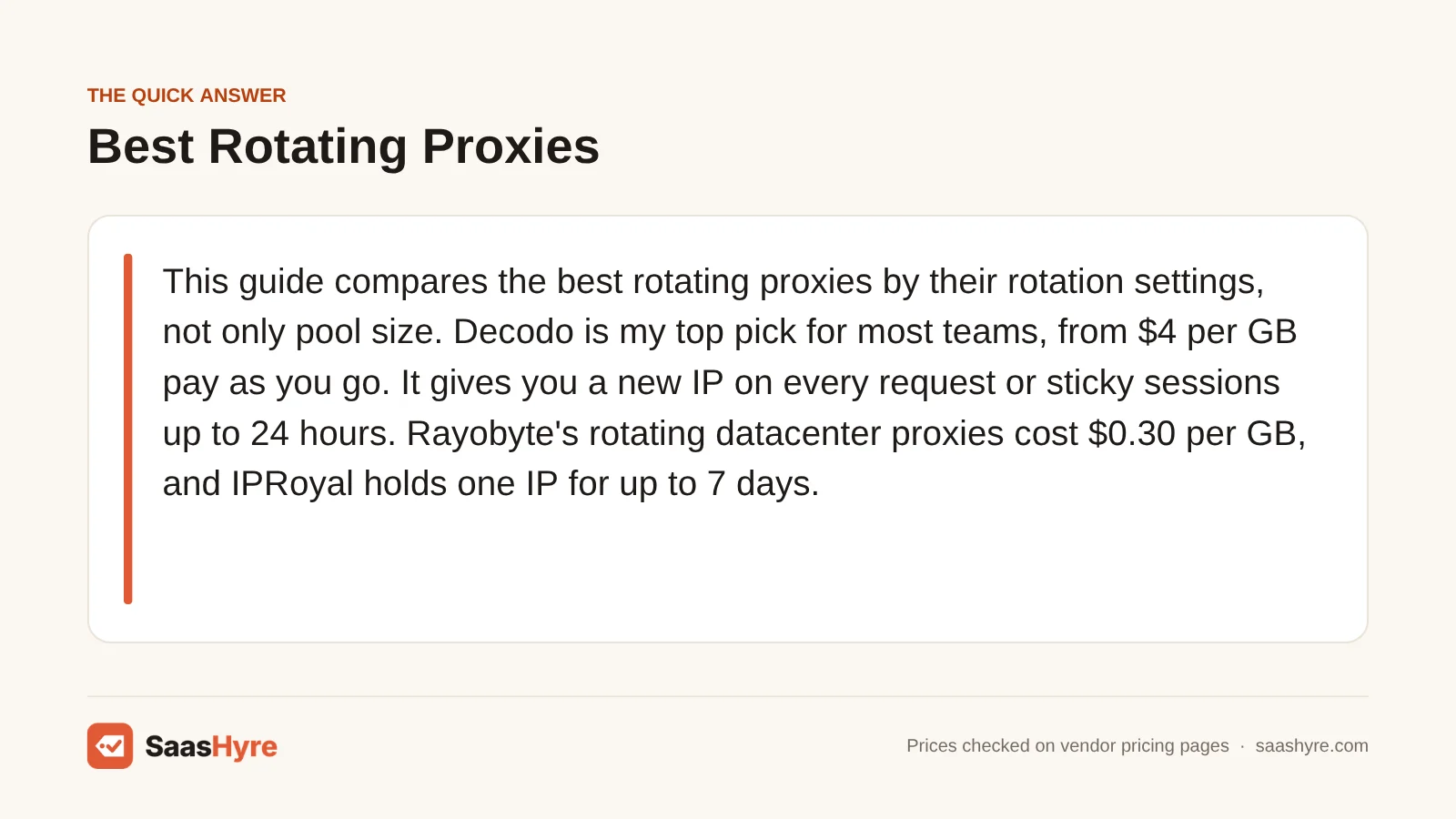
TL;DR: This guide compares the best rotating proxies by their rotation settings, not only pool size. Decodo is my top pick for most teams, from $4 per GB pay as you go. It gives you a new IP on every request or sticky sessions up to 24 hours. Rayobyte’s rotating datacenter proxies cost $0.30 per GB, and IPRoyal holds one IP for up to 7 days. Match the sticky length to your job first, then compare price per GB.
Looking for the best rotating proxies? Most lists rank them by pool size. That number tells you less than you’d think.
Proxyway sent 3.6 million requests through each provider’s residential pool in 2026. Oxylabs advertises 175 million IPs. The most unique IPs Proxyway saw from it was 3,241,404, the best result in the test. Proxyway earns affiliate commissions and says so.
So compare the rotation settings. A proxy is a middle server that sends your web requests for you. A rotating proxy swaps the IP address, the number that identifies your connection, as you work.
Some jobs need a new IP on every request. Others need one IP held for ten minutes or a full day. That held IP is called a sticky session.
I read each provider’s pricing page and docs on October 7, 2026. Below you’ll see the longest sticky session each one allows and what each plan costs. We didn’t test these proxies. We sell nothing, and no vendor pays to be ranked here.
For the full picture across residential, ISP, datacenter and mobile, see our best proxy providers guide.
What Are the Best Rotating Proxies in 2026?
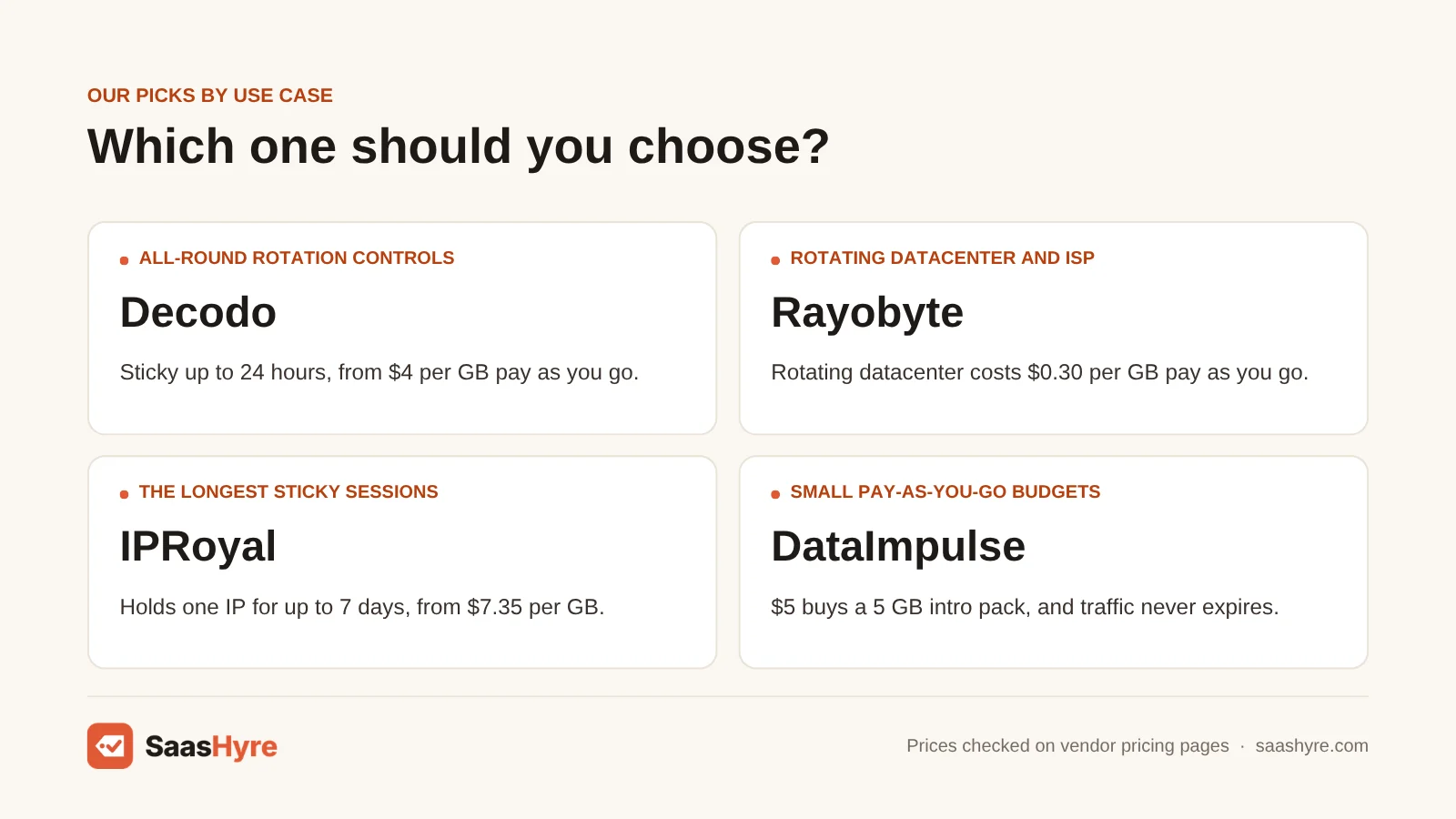
The best rotating proxies for most teams come from Decodo, at $4 per GB pay as you go. Decodo gives you a new IP on every request or holds one IP for up to 24 hours. Rayobyte is the pick for rotating datacenter proxies at $0.30 per GB. IPRoyal offers the longest sticky sessions, up to 7 days.
| Provider | Best for | Starting price | Trial or refund |
|---|---|---|---|
| Decodo | All-round rotation controls | $4 per GB, pay as you go | 3-day free trial, payment details needed. 14-day refund with limits |
| Rayobyte | Rotating datacenter and ISP | $0.30 per GB, pay as you go (rotating datacenter) | Free trial, no card. Size not published |
| IPRoyal | The longest sticky sessions | $7.35 per GB, pay as you go (1 GB) | No free trial published |
| Evomi | Low cost on three networks | $49 a month for 100 GB ($0.49 per GB) | Free trial with a card. 30-day refund with limits |
| DataImpulse | Small pay-as-you-go budgets | $5 for 5 GB ($1 per GB), new users | No free trial. 7-day refund on first Intro pack |
| Oxylabs | Big scraping teams | $30 a month in credit ($6 per GB residential) | $5 welcome credit, no card |
| Webshare | Rotating a list you control | $2.99 a month for 100 shared datacenter proxies | Free plan with 10 proxies and 1 GB a month |
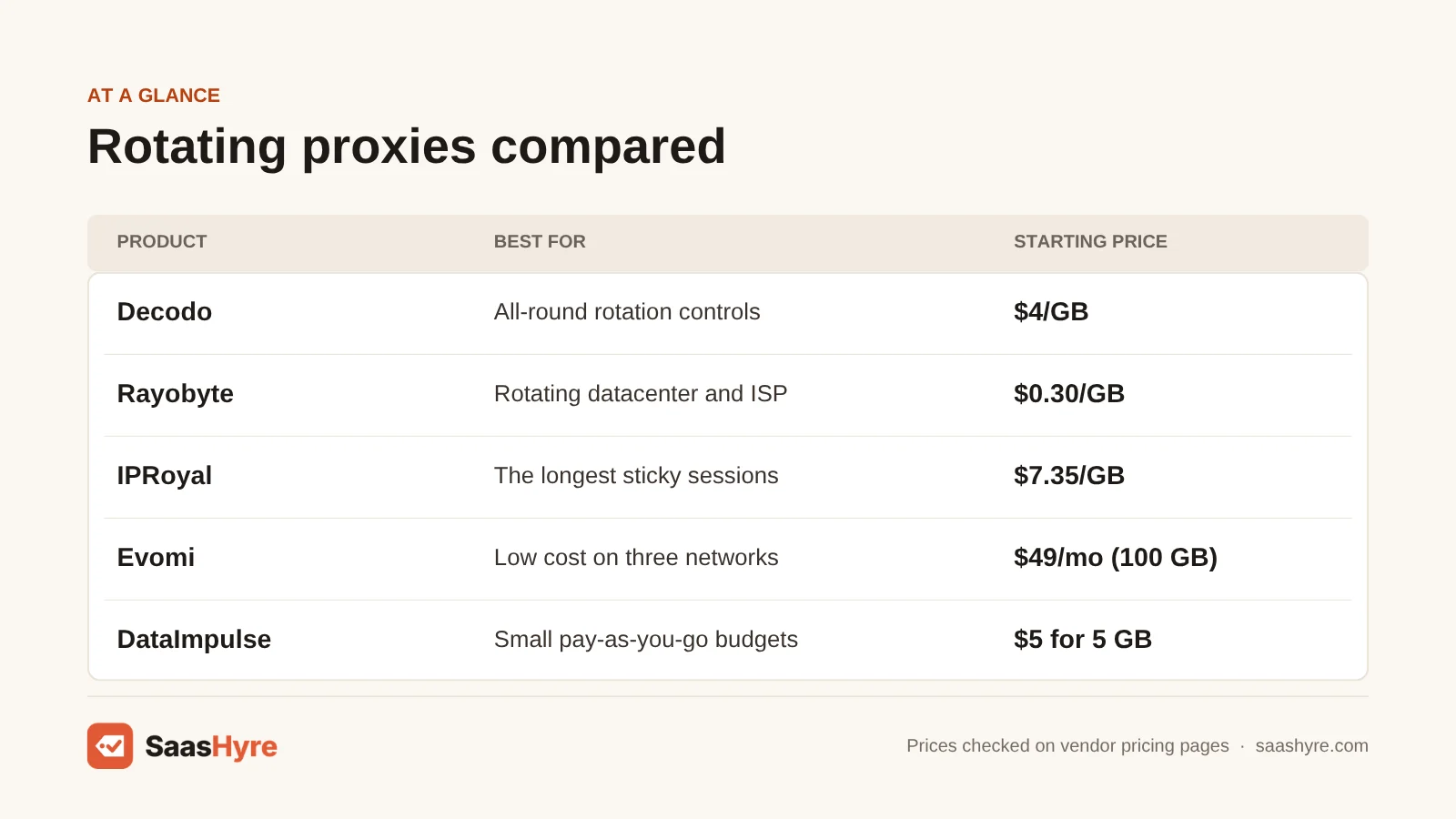
Each starting price is the provider’s cheapest rotating plan, before tax. GB means gigabyte, the unit of traffic. An ISP proxy is a server IP registered to a home internet provider.
This list ranks rotation controls and published prices, not pool quality. For the pool comparison, read our guide to the best residential proxies. For the overall ranking, see the best proxy providers.
How Does Proxy Rotation Work, and What Can You Set?
Proxy rotation works through a gateway, which is one address you connect to that hands out IPs from a pool. Rotating mode gives you a new IP on every request. Sticky mode holds one IP for a set time. That time runs from 1 minute to 24 hours at most providers here, and up to 7 days at IPRoyal.
Pick the mode by the job. To collect thousands of separate public pages, use a new IP per request. For a job with several steps, like paging through search results or testing a checkout flow in another country, use a sticky session.
Here is what each rotating proxy service lets you set, linked to its own docs.
| Provider | New IP per request | Default or preset sticky time | Longest sticky session | Rotating datacenter | Rotating mobile |
|---|---|---|---|---|---|
| Decodo | Yes | 1, 10, 30 or 60 minutes | 24 hours | Yes, $6 a month for 10 GB | Yes, sticky up to 24 hours |
| Oxylabs | Yes, by default | 10 minutes, or 60 seconds idle | 24 hours | Yes, shared pool sold per GB | Yes, 24-hour sessions |
| IPRoyal | Yes | You set a lifetime | 7 days | No. Datacenter IPs are dedicated | Yes, from $6.80 per GB |
| Rayobyte | Yes | Not published | 120 minutes on residential | Yes, $0.30 per GB. Rotating ISP is $3.75 per GB | Yes, monthly plans from $250 |
| Evomi | Yes, by default | 30 minutes | 24 hours | Yes, sticky up to 24 hours | Yes, sticky up to 24 hours |
| DataImpulse | Yes | 30 minutes | 120 minutes | Yes, sticky up to 30 minutes | Yes, sticky up to 120 minutes |
| Webshare | Yes | You set a timer | 24 hours | It rotates through your own proxy list | No mobile product |
Three kinds of IP can rotate. Residential IPs belong to home internet connections. Datacenter IPs belong to servers, so they cost less. Mobile IPs come from phone carriers. We cover the best datacenter proxies and the best mobile proxies in their own guides.
A sticky session is a request, not a promise. Decodo’s docs warn that a longer residential session has more chance to rotate early, when the home device goes offline.
What changed in 2026: NetNut’s domains were seized on July 2, 2026, as Krebs on Security reported. Proxyway reports that Bright Data ended its mobile proxy product in April 2026. Oxylabs moved to one credit subscription for every proxy type. Rayobyte’s new site and pricing went live on October 1. SOAX’s pricing page now lists residential and mobile proxies only.
The 7 Best Rotating Proxies, Reviewed
Every price below comes from the vendor’s own page. Success rates come from Proxyway’s 2026 tests on a simple test server, not from us.
1 Decodo: Best for all-round rotation controls
If you want one account for rotating residential, datacenter and mobile IPs, start with Decodo.
What it does well. Decodo’s rotating port changes your IP on every request. Sticky sessions come in presets of 1, 10, 30 or 60 minutes, or any length up to 1,440 minutes. Proxyway named Decodo its Best All-Rounder for 2026 and measured 99.92% success on its residential pool.
Key features:
- New IP per request, or sticky up to 24 hours
- Residential, datacenter and mobile pools
- City, ZIP and ASN (network) targeting on residential
Pricing. Residential pay as you go costs $4 per GB, and monthly plans start at $11.25 for 3 GB, plus VAT. Shared datacenter traffic costs $6 a month for 10 GB. Mobile is $4 per GB on a 50% promo, down from a regular $8. See Decodo pricing.
Best for: You, if you run mixed jobs and want every rotation mode in one place.
Limitations. The 3-day free trial needs payment details and turns into a paid plan. The 14-day refund ends once you use 20% of your data or 1 GB. Decodo says its IPs are ethically sourced, which is its own claim.
2 Rayobyte: Best for rotating datacenter and ISP proxies
If your target sites accept datacenter IPs, Rayobyte is the low-cost way to rotate.
What it does well. Rotating Datacenter gives you a new IP on every request or a sticky session. Rotating ISP does the same with addresses registered to home internet providers. Premium Residential lets you set a sticky time from 1 to 120 minutes. Rayobyte scored 99.88% success in Proxyway’s US datacenter test.
Key features:
- Four rotating products in one account
- Pay-as-you-go balance with no monthly expiry
- Free trial on self-serve products, no card
Pricing. Rotating Datacenter costs $0.30 per GB up to 50 GB, and Rotating ISP starts at $3.75 per GB. Premium Residential costs $3.50 per GB for 1 to 49 GB and $2.00 from 50 GB. Mobile comes on monthly plans from $250 for 83 GB. See Rayobyte pricing.
Best for: You, if you collect public pages at volume and want the lowest rotating price per GB.
Limitations. Rotating Datacenter and Rotating ISP have no location targeting. Rayobyte says the largest search, shopping and social sites are “premium domains” that those two plans don’t cover by default. Its docs say the duration setting works on residential only.
3 IPRoyal: Best for the longest sticky sessions
If you need the same IP for days and not minutes, look at IPRoyal.
What it does well. IPRoyal lets you set a session lifetime from 1 second to 7 days. That is the longest limit in this guide. Its randomize mode gives you a new IP on each request.
Key features:
- Sticky lifetime from 1 second to 7 days
- Traffic that never expires
- Rotating mobile pool sold per GB
Pricing. Residential pay as you go costs $7.35 per GB for 1 GB and $5.51 per GB at 10 GB. A monthly subscription takes 5% off, so 1 GB costs $7.00. Rotating mobile starts at $6.80 per GB for 2 GB. See IPRoyal pricing.
Best for: You, if your job runs over hours or days and must keep one IP.
Limitations. IPRoyal has the highest starting price per GB here. It scored 96.11% in Proxyway’s residential test, the lowest of the providers here that Proxyway tested. Its datacenter proxies are dedicated, not a rotating pool.
4 Evomi: Best for low cost on three networks
If price per GB matters most and you still want long sticky sessions, try Evomi.
What it does well. Evomi rotates on every request by default. Sticky sessions last 30 minutes unless you extend them, up to 1,440 minutes. A “hardsession” option holds the IP for as long as the network can. Proxyway named Evomi its Best Value Provider for 2026.
Key features:
- Sticky up to 24 hours on all three networks
- Hardsession mode for the longest hold
- City targeting on residential at no extra charge
Pricing. Core Residential costs $49 a month for 100 GB, or $0.49 per GB. Pay as you go is $0.99 per GB from 15 GB, so $14.85 to start by our math. Rotating datacenter costs $0.45 per GB and mobile costs $3.98 per GB, both pay as you go. See Evomi pricing.
Best for: You, if you send 50 GB or more a month through rotating residential IPs.
Limitations. ZIP, ISP and ASN filters multiply the traffic you’re billed for, up to 15 times. The free trial needs a card and renews at the plan price unless you cancel.
5 DataImpulse: Best for small pay-as-you-go budgets
If you want to try rotation for $5 with no subscription, pick DataImpulse.
What it does well. DataImpulse sells rotating residential, datacenter and mobile traffic by the GB, with no monthly plan. Sticky ports hold an IP for 1 to 120 minutes, and the default is 30. Proxyway named it Most Flexible Provider for 2026 and measured 99.74% success on its residential pool.
Key features:
- $5 intro pack on each product for new users
- Sticky time from 1 to 120 minutes
- Traffic that never expires
Pricing. Residential costs $1 per GB, so the intro pack is $5 for 5 GB and the next pack is $50 for 50 GB. Datacenter costs $0.50 per GB, or $5 for 10 GB. Mobile costs $2 per GB, or $5 for 2.5 GB. See DataImpulse pricing.
Best for: You, if your jobs are small or uneven and you don’t want GB to expire.
Limitations. State, city, ZIP and ASN targeting is billed at double the standard rate, so $1 per GB becomes $2. Datacenter sticky sessions stop at 30 minutes. After the intro pack, the smallest top-up is $50.
6 Oxylabs: Best for big scraping teams
If you run millions of requests and want one balance for every proxy type, look at Oxylabs.
What it does well. Oxylabs rotates on every request by default. A sticky session lasts 10 minutes, or ends after 60 seconds with no requests. You can stretch it to 1,440 minutes. In Proxyway’s 2026 test, Oxylabs had the top residential success rate at 99.93% and showed the most unique IPs.
Key features:
- Sticky sessions up to 24 hours
- One credit balance for residential, mobile and datacenter
- $5 welcome credit with no card
Pricing. Oxylabs sells one monthly credit subscription, and Starter costs $30 a month. At that tier, residential is $6 per GB, mobile is $7.5 per GB and shared datacenter is $0.6 per GB. Our Oxylabs pricing guide covers every tier. See Oxylabs pricing.
Best for: You, if you need a very large pool and will use your credit every month.
Limitations. There is no pay-as-you-go option, and unused credit expires at the end of each cycle. Oxylabs’ own pages disagree on refunds, and its help center says self-service purchases are non-refundable. Oxylabs says every customer answers a KYC questionnaire, which is an identity check.
7 Webshare: Best for rotating a list you control
If you’d like to rotate through a fixed set of low-cost IPs, try Webshare.
What it does well. On datacenter plans, Webshare’s rotating endpoint cycles through the proxies already in your account, so you know every IP in the rotation. On rotating residential plans, you choose a new IP per request or a sticky timer from 1 minute to 24 hours.
Key features:
- Free plan with 10 shared datacenter proxies
- Sticky timer from 1 minute to 24 hours
- Up to 10,000 sticky endpoints
Pricing. A plan of 100 shared datacenter proxies costs $2.99 a month and includes 250 GB a month. Rotating residential costs $3.50 a month for 1 GB and $27.50 for 10 GB. Yearly billing takes 30% off residential plans. See Webshare pricing.
Best for: You, if you want a small, known set of IPs to rotate.
Limitations. Residential is a monthly or yearly plan with no pay as you go, and unused GB don’t roll over. Webshare has no mobile proxies. The free plan is capped at 1 GB a month.
How Much Do Rotating Proxies Cost?
Rotating proxies cost $0.49 to $7.35 per GB for residential IPs on the starting plans in this guide. Rotating datacenter proxies cost less, from $0.30 per GB at Rayobyte. Rotating mobile proxies start at $2 per GB at DataImpulse. Rotating plans bill you per GB of traffic, not per IP.
The table lists each provider’s cheapest rotating residential plan. The last two rows show the lowest datacenter and mobile prices.
| Provider and plan | Price to start | Unit price | Billing basis | What you get |
|---|---|---|---|---|
| Evomi Core Residential | $49 a month | $0.49 per GB | Monthly plan, 100 GB | No rollover |
| DataImpulse residential | $5 one time | $1 per GB | Pay as you go, 5 GB intro pack | Traffic never expires |
| Webshare rotating residential | $3.50 a month | $3.50 per GB | Monthly plan, 1 GB | No rollover. Yearly billing is 30% off |
| Rayobyte Premium Residential | $3.50 one time | $3.50 per GB (1 to 49 GB) | Pay as you go | No monthly expiry |
| Decodo residential | $4 one time | $4 per GB | Pay as you go, 1 GB at a time | Monthly plans from $11.25 for 3 GB |
| Oxylabs Starter | $30 a month | $6 per GB | Monthly credit plan | Credit expires each cycle |
| IPRoyal residential | $7.35 one time | $7.35 per GB (1 GB) | Pay as you go | Traffic never expires |
| Rayobyte Rotating Datacenter | Under $1 | $0.30 per GB (up to 50 GB) | Pay as you go | No location targeting |
| DataImpulse mobile | $5 one time | $2 per GB | Pay as you go, 2.5 GB intro pack | Traffic never expires |
What is not in the sticker price:
- Minimum spend. Evomi’s pay as you go starts at 15 GB. Rayobyte mobile starts at $250 a month.
- Expiry. Oxylabs credit expires each cycle. Webshare and Evomi plan GB don’t roll over.
- Targeting fees. DataImpulse doubles its rate for state, city, ZIP and ASN targeting.
- Promo end. Decodo mobile at $4 per GB is a 50% promo on a regular $8, with no end date shown.
- Trials that convert. Decodo and Evomi free trials ask for payment details and roll into a paid plan unless you cancel.
- Refund limits. Decodo’s refund ends at 20% of your data or 1 GB.
- ID checks. Most providers block some site categories until you verify your identity.
Now the cost per job. Say you load 100,000 pages a month. HTTP Archive’s 2024 report found the median mobile page weighs 2,311 KB, while its HTML is about 18 KB.
I priced three page sizes. A 50 KB page uses 5 GB in total, 500 KB uses 50 GB and 5 MB uses 500 GB. This is our math, with 1 GB counted as 1,000,000 KB.
| Plan | 5 GB (50 KB pages) | 50 GB (500 KB pages) | 500 GB (5 MB pages) |
|---|---|---|---|
| Rayobyte Rotating Datacenter, pay as you go | $1.50 | $15.00 | $115.00 |
| Evomi rotating datacenter | $2.25 pay as you go | $22.50 pay as you go | $175.00 (500 GB plan) |
| Evomi Core Residential | $14.85 (15 GB pay as you go) | $49.00 (100 GB plan) | $245.00 (100 GB plan plus extra GB) |
| DataImpulse residential, pay as you go | $5.00 (intro pack) | $50.00 | Not published |
| Rayobyte Premium Residential, pay as you go | $17.50 | $100.00 | $750.00 |
| Webshare rotating residential, monthly plan | $15.00 | $122.50 | $875.00 |
| Decodo residential | $20.00 pay as you go | $150.00 (50 GB plan) | No 500 GB plan |
At 50 GB, rotating datacenter costs $15.00 at Rayobyte. Rotating residential runs from $49.00 to $150.00. If your target accepts datacenter IPs, that gap is your saving.
Decodo’s plans add VAT, and its next sizes up are 250 GB for $625 and 1,000 GB for $2,000. DataImpulse lists no price between 50 GB and 1 TB, which costs $800. Oxylabs bills from a shared credit balance, and IPRoyal shows mid-size prices only in its dashboard.
How Do You Choose a Rotating Proxy?
Choose a rotating proxy by matching the sticky session length to your longest task first. Then pick the cheapest IP type your target site accepts, starting with rotating datacenter. Last, check what happens to unused GB, what targeting costs, and whether you can test with a small pack or a trial.

- Match sticky length to your longest task. A 10-minute price check fits any provider here. Need one IP for weeks? Buy static ISP proxies.
- Start with the cheapest IP type that works. Try rotating datacenter first. Move to residential or mobile only if the site blocks you.
- Check what happens to unused GB. Some traffic never expires, and some is gone in a month.
- Price your targeting before you buy. City, ZIP or ASN filters can double your rate.
- Test on your real target with a small pack. A $5 pack is enough for a first run.
On Amazon, Google and Instagram, Proxyway measured a median success rate of 74.43% for residential proxies and 75.26% for mobile. No rotation setting fixes every block.
Ask where the IPs come from too. Google’s threat team writes that claims of ethical sourcing need auditable proof of user consent. When a provider here calls its IPs ethically sourced, that is the vendor’s own word.
Use rotating proxies for public data only, and check each site’s terms and your local law first.
Providers We Left Out, and Why
- NetNut. Its domains were seized on July 2, 2026, per Krebs on Security. We don’t recommend it.
- Bright Data. Its docs say a session IP is kept for up to 7 minutes of idle time and give no maximum session length. Its mobile price isn’t published.
- SOAX. Its residential page doesn’t state a maximum sticky length.
- Geonode. It sells rotating residential traffic from $7.92 a month for 10 GB, with sticky sessions up to 24 hours. It wasn’t in Proxyway’s 2026 tests, so we had no outside performance data.
How We Researched This Guide
We read every price on the vendor’s own rendered pages on October 7, 2026, with tabs and toggles opened. Rotation limits come from each vendor’s docs or product page, checked the same day.
Some things we could not confirm. Rayobyte doesn’t publish its trial size, and two reads of its page gave a 2 GB and a 3 GB minimum for Rotating Datacenter. Oxylabs’ refund pages disagree with each other.
We did not test these proxies ourselves. Performance figures come from named third parties, mainly Proxyway. No vendor pays to be listed or ranked. Our editorial policy explains how we work.
Prices last checked: October 7, 2026.
The Bottom Line
Rotation settings matter more than the pool size on the sales page. Decodo covers the most ground, with sticky sessions up to 24 hours from $4 per GB. Rayobyte’s rotating datacenter proxies cost $0.30 per GB. IPRoyal is the one to pick when a session must last days.
Watch the fine print too. Expiring credit, targeting fees and trials that convert all change your real cost.
Here is your next step. Write down your longest task in minutes. Pick two providers above that cover it. Then run 1,000 requests at your real target on the smallest pack. You’ll soon know which one fits.
Frequently Asked Questions
What is a rotating proxy?
A rotating proxy is a service that sends your web requests through a pool of IP addresses and changes the address as you go. You connect to one gateway, and the provider picks the IP.
How often do rotating proxies change IP?
Rotating proxies change IP on every request by default at providers like Oxylabs and Evomi. Sticky sessions at Decodo, Oxylabs, Evomi and Webshare last up to 24 hours. DataImpulse and Rayobyte allow 120 minutes on residential, and IPRoyal allows 7 days.
What is the difference between rotating and sticky sessions?
A rotating session gives you a new IP for each request, which suits collecting many separate pages. A sticky session keeps the same IP for a set time, which suits tasks with several steps.
How much do rotating proxies cost?
Rotating residential proxies cost $0.49 to $7.35 per GB on the starting plans we checked on October 7, 2026. Rotating datacenter proxies start at $0.30 per GB, and rotating mobile proxies start at $2 per GB. By our math, 50 GB a month costs $15.00 on Rayobyte’s datacenter pool and $49.00 to $150.00 on residential plans.
Are rotating proxies the same as residential proxies?
No. Rotating describes how the IP changes, and residential describes where the IP comes from. Most residential proxies rotate, but datacenter and mobile proxies can rotate too. Rayobyte, Evomi and DataImpulse all sell rotating datacenter pools at a lower price per GB.