

TL;DR: This guide compares residential vs datacenter proxies on price, speed and success rates. Datacenter proxies are cheap and fast, and 100 shared IPs cost $2.99 a month at Webshare. Residential proxies average $4.16 per GB at 5 GB, per Proxyway, but sites are less likely to ban them. Start with datacenter proxies and test them on your target. Move to residential only for the pages that block you.
Residential vs datacenter proxies looks like a simple choice. One type is cheap and fast. The other gets blocked less. Pick the wrong one, and you pay for it either way.
First, two quick terms. A proxy is a server that sends your web requests through a different IP address. An IP address is the number that identifies a device online.
Here is the number most guides skip. In Proxyway’s 2026 tests, the median residential proxy pool succeeded 99.28% of the time on a simple test page. On Amazon, Google and Instagram, that median dropped to 74.43%. So even the pricier type fails about one request in four on hard sites.
Price is the other half. By our math, 50 GB of traffic costs $28.50 on one datacenter plan and about $150 at the average residential rate.
I pulled every price in this guide from vendor pages on October 7, 2026. We didn’t test any proxy ourselves, so every speed and success figure comes from a named third party. No vendor pays to be listed here.
New to proxies? Our best proxy providers guide compares every proxy type and price first.
What Is the Difference Between Residential and Datacenter Proxies?
Residential proxies send your traffic through IP addresses that internet providers assign to homes. Datacenter proxies use IP addresses that belong to servers at hosting companies. Datacenter proxies are faster and far cheaper. Residential proxies cost more per GB, but websites are less likely to ban them.
A datacenter proxy runs on a server at a hosting or cloud company. Its IP address is registered to that company, not to a home internet provider.
Websites can treat the two groups differently. Proxyway says websites are much more likely to ban datacenter IPs than residential or mobile ones. Blocking a server IP carries little risk of blocking a real customer.
A residential proxy works the other way. Google’s Threat Intelligence Group describes these networks as selling traffic routed through IP addresses owned by internet providers and used by home or small business customers. Your request leaves through a real person’s device.
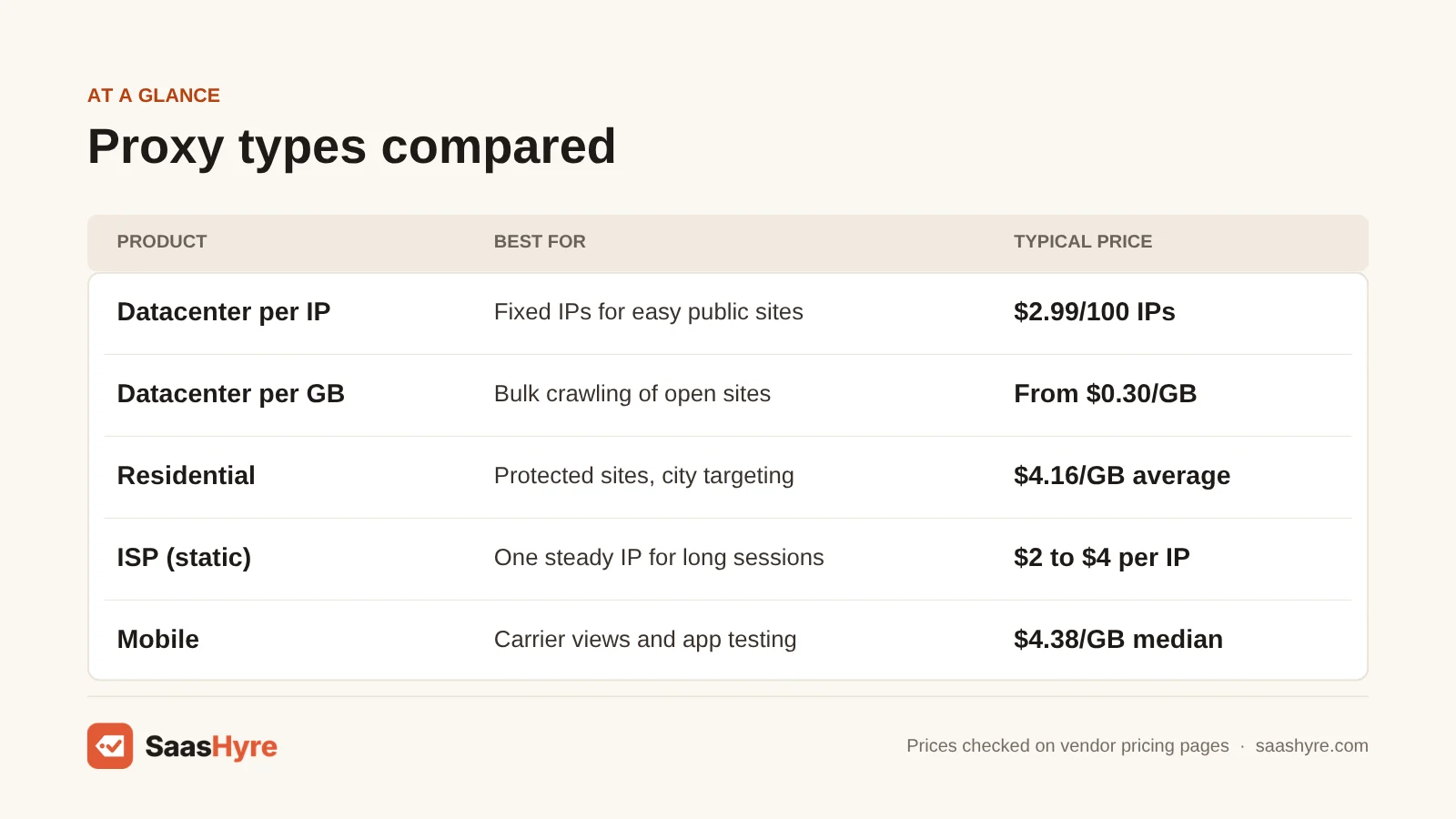
Here is how the main options compare. A rotating pool gives you a new IP on each request or after a set time. ISP and mobile proxies each get a short section further down.
| Proxy type | Where the IP comes from | Best for | Typical price |
|---|---|---|---|
| Datacenter per IP | Servers at hosting companies, as a fixed list of IPs | Fixed IPs for easy public sites | $2.99 per 100 shared IPs a month at Webshare |
| Datacenter per GB | The same servers, as a shared rotating pool | Bulk crawling of open sites | From $0.30 per GB at Rayobyte |
| Residential | Home connections, through real people’s devices | Protected sites and city targeting | $4.16 per GB on average at 5 GB, per Proxyway |
| ISP (static) | Internet provider IPs hosted on servers | One steady IP for long sessions | $2 to $4 per dedicated IP, per Proxyway |
| Mobile | Phone carrier networks | Carrier views and app testing | $4.38 per GB median at 5 GB, per Proxyway |
Where do residential IPs come from?
Someone has to enroll real people’s devices, and Google lists three routes. Some devices come pre-loaded with proxy software. Some join when users unknowingly download apps with proxy code inside. And some users install the software on purpose to earn money from spare bandwidth.
Many providers call their pools “ethically sourced.” Decodo, for example, advertises 115M+ ethically-sourced IPs. That is a vendor claim. Google’s view is that such claims need transparent, auditable proof of user consent.
What changed in 2026: NetNut’s domains were seized on July 2, 2026, according to Krebs on Security, so we don’t list it anywhere. Proxyway reports that Bright Data ended its mobile proxy product in April 2026. And SOAX’s pricing page now lists only residential and mobile proxies, with no datacenter or ISP plans.
Residential vs Datacenter Proxies: What Independent Tests Show
We didn’t run these tests. The figures come from Proxyway’s 2026 market research and its datacenter proxy benchmark. Keep in mind that Proxyway earns affiliate commissions from proxy vendors.
| Proxy type | What Proxyway tested | Success rate | Response time |
|---|---|---|---|
| Datacenter, best US pool (Oxylabs) | 70,000 connection requests over 7 days | 99.98% | 0.22 s |
| Residential, median pool | 3.6 million requests over 21 days to a simple test page | 99.28% | 0.93 s |
| Residential, median on real targets | Amazon, Google and Instagram | 74.43% | 3.21 s |
| Mobile, median on real targets | Amazon, Google and Instagram | 75.26% | 3.67 s |
Read the first two rows together. In basic connection tests, both types work almost every time, and datacenter is faster.
Now look at row three. On Amazon, Google and Instagram, the residential median fell to 74.43%, and the median response took 3.21 seconds. So when a vendor quotes 99% success, ask which kind of test it means.
One caution. These are separate tests, not a head-to-head race. Proxyway’s page doesn’t name the target for the datacenter run. The real-target medians cover residential and mobile pools only.
What about datacenter proxies on hard sites? Proxyway says they may struggle with heavily protected targets such as search engines, social media platforms and e-shops. It adds that they stay effective for many easier tasks.
One vendor says much the same about its own product. Rayobyte states that the largest search, shopping and social platforms are “premium domains”. Its rotating datacenter plans don’t cover them by default, and its premium residential plans do.
How Much Do Residential and Datacenter Proxies Cost?
Datacenter proxies cost $2.99 a month for 100 shared IPs at Webshare. Shared datacenter pools run from $0.30 per GB at Rayobyte to $0.60 per GB at Decodo. Residential proxies are billed per GB, from $1 at DataImpulse to $8 at Bright Data’s regular rate. Proxyway puts the residential average at $4.16 per GB for 5 GB.
The two types are sold in different units. With per-IP pricing, you rent a set number of addresses for a month. With per-GB pricing, you pay for each gigabyte of data you move.
The table below shows real starting plans that cover the range. It is not a ranking.
| Proxy type and plan | Price to start | Unit price | Billing basis | What you get |
|---|---|---|---|---|
| Datacenter IPs: Webshare, 100 shared proxies | $2.99 a month | $0.0299 per proxy | Monthly, or yearly at about 30% off | 250 GB a month for the whole plan. A free plan gives 10 proxies and 1 GB. |
| Datacenter pool: Decodo, 10 GB | $6 a month plus VAT | $0.60 per GB | Monthly | A rotating shared pool. You pay for traffic, not IPs. |
| Datacenter pool: Rayobyte rotating | $0.90 for the 3 GB minimum (our math) | $0.30 per GB | Pay as you go | No country choice. The largest search, shopping and social sites are not covered by default. |
| Residential: DataImpulse Intro | $5 for 5 GB, new users only | $1 per GB | Prepaid, pay as you go | Traffic never expires. Country targeting is free. |
| Residential: Decodo, 3 GB | $11.25 a month plus VAT | $3.75 per GB | Monthly. Pay as you go is $4 per GB. | Targeting down to city and ZIP code. |
| Residential: Bright Data pay as you go | No commitment | $8 per GB regular. Promo: $4 with code RESIGB50. | Pay as you go, billed monthly | Access after a KYC (identity or business) check, which Bright Data says may include a short video call. |
| ISP: Decodo, 3 dedicated IPs | $9.99 a month plus VAT | $3.33 per IP | Monthly | 3 static IPs that only you use. |
| Mobile: Decodo, 2 GB | Promo: $7.50 a month plus VAT. Regular: $15 (our math). | Promo: $3.75 per GB. Regular: $7.50. | Monthly | 2 GB with city-level targeting. |
Two of those prices are promos. Bright Data’s $4 rate needs a coupon code, so budget on its $8 regular rate. Decodo’s mobile cards carry a “SAVE 50%” label with no end date shown.
Already know your type? See our guides to the best datacenter proxies and the best residential proxies for full provider comparisons.
What is not in the sticker price:
- Minimum spend. Rayobyte’s rotating datacenter pool starts at 3 GB. After DataImpulse’s $5 Intro plan, its next plan is $50 for 50 GB.
- Traffic that expires. Bright Data says unused traffic on a monthly plan does not roll over.
- Targeting surcharges. DataImpulse bills state, city, ZIP and network-level (ASN) targeting at double the standard rate. So $1 per GB becomes $2 (our math).
- Bandwidth caps. Webshare’s listed prices include 250 GB a month for the whole plan. Raising 100 shared proxies to 1,000 GB costs $5.49 a month.
- KYC. That stands for “know your customer.” Bright Data runs this check before you can use residential proxies.
- Refund limits and tax. Decodo’s 14-day money-back option does not apply if you start with its 3-day free trial. Its prices are shown before VAT.
Now the real bill. This table is our math, built only from published rates.
| Option | 5 GB a month | 50 GB a month | 500 GB a month |
|---|---|---|---|
| Datacenter, 100 shared IPs (Webshare) | $2.99 | $2.99 | $5.49 |
| Datacenter pool per GB (Decodo plans, before VAT) | $6.00 | $28.50 | $240.00 |
| Residential (Webshare monthly plans) | $15.00 | $122.50 | $875.00 |
| Residential (Proxyway average rate) | $20.80 | $150.00 | $1,140.00 |
| Mobile (Proxyway median rate) | $21.90 | $175.00 | $1,240.00 |
Here is how we got there. Webshare’s 100 shared proxies include 250 GB, so 5 GB and 50 GB both cost $2.99. For 500 GB you need the 1,000 GB setting at $5.49. Decodo’s smallest datacenter pool plan is 10 GB for $6, so that is what 5 GB costs.
The last two rows use Proxyway’s rates. Residential averaged $4.16, $3.00 and $2.28 per GB at 5, 50 and 500 GB. The mobile medians were $4.38, $3.50 and $2.48.
What stands out? At 50 GB, the average residential bill is about 5 times the Decodo datacenter pool and about 50 times the Webshare per-IP plan. Both vendors are examples, not picks.
One warning on the cheapest row. A per-IP plan gives you a fixed list of shared addresses. If your target bans those IPs, the low price won’t help.
Where Do ISP and Mobile Proxies Fit?
ISP proxies are static IP addresses registered to internet providers but hosted on servers, so they land between residential and datacenter proxies. Proxyway prices dedicated ones at $2 to $4 per IP. Mobile proxies use phone carrier IPs and cost the most, with a median of $4.38 per GB at 5 GB.
ISP proxies: one steady IP at server speed
An ISP proxy is also called a static residential proxy. Static means the IP doesn’t change.
Speed is the draw. In Proxyway’s 2026 ISP proxy test, ISP proxies were nearly eight times faster than residential proxies on a small page.
There is one catch. An ISP proxy is not always seen as residential. Proxyway checked US test IPs against IP databases. All of them were classed as residential at four providers, but only 22% were at Webshare.
Our guide to the best ISP proxies compares the providers.
Mobile proxies: carrier IPs at the highest price
A mobile proxy sends your traffic through a phone carrier’s network. Proxyway’s 2026 research puts the median mobile rate at $4.38 per GB at 5 GB, with a median starting spend of $30.
The extra money doesn’t buy much more success on big sites. On Amazon, Google and Instagram, Proxyway’s mobile median was 75.26%, against 74.43% for residential. So buy mobile proxies only when you need a carrier IP, like checking mobile ads or testing an app.
Need one? Start with our guide to the best mobile proxies.
Residential vs Datacenter Proxies: Which Should You Use?
Use datacenter proxies for bulk work on public sites with light protection, because they are the cheapest and fastest option. Use residential proxies for heavily protected sites or when you need city-level locations. Pick ISP proxies for one steady IP, and mobile proxies only when you need a phone carrier IP.
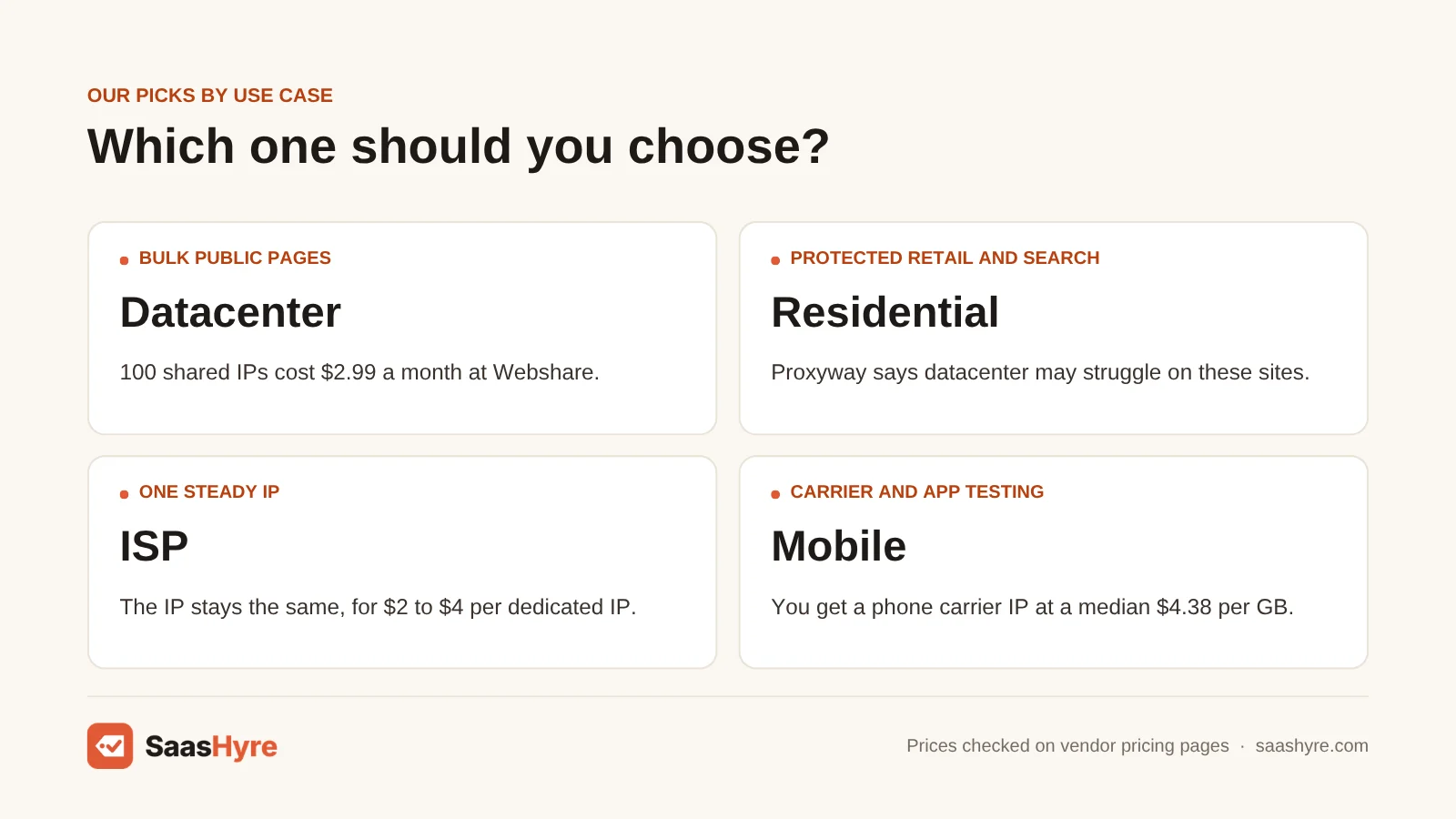
This table matches each type to common business uses.
| Use case | Pick | Why |
|---|---|---|
| Bulk public pages, such as market research or AI data collection | Datacenter | 100 shared IPs cost $2.99 a month at Webshare. |
| Protected retail and search sites, such as price or SEO monitoring | Residential | Proxyway says datacenter proxies may struggle on search engines and e-shops. |
| Ad verification and localization testing by city | Residential | Decodo’s residential plans target down to city and ZIP code. |
| One steady IP for long sessions, such as QA on your own site | ISP | The IP stays the same, for $2 to $4 per dedicated IP. |
| Carrier and app testing, such as checking mobile ads | Mobile | You get a phone carrier IP at a median $4.38 per GB. |
Can you use both together? Yes. Send requests through datacenter proxies first. Then route only the pages that fail through a residential pool.
Collecting public data at scale? Our guide to proxies for web scraping goes deeper on that job. For an overall ranking across all types, see the best proxy providers.
A Short Checklist Before You Buy

Run these five checks before you pay for any plan.
- Test datacenter proxies on your target first. They cost the least, and Webshare’s free plan gives you 10 proxies and 1 GB a month.
- Price your real volume in both units. Work out your monthly GB and how many IPs you need. Then compare per-GB and per-IP plans.
- Check minimum spend, expiry and bandwidth caps. A low rate can hide a $50 minimum or traffic that expires each month.
- Ask how the provider sources its residential IPs. Google says sourcing claims need auditable proof of user consent.
- Read the site’s terms and your local law. Stick to public data and lawful business uses. This guide is not legal advice.
How We Researched This Guide
We read every price from the vendor’s own pricing page on October 7, 2026. We opened the rendered pages, tabs and toggles to see each tier.
We could not confirm a few things. Decodo’s pay-per-IP datacenter cards don’t print a traffic allowance, so we left them out. Bright Data publishes no mobile proxy price.
We did not test these proxies ourselves. Success rates and speeds come from Proxyway, a named third party. The cost tables are our math, based on published rates.
No vendor pays to be listed or ranked. You can read more in our editorial policy.
Prices last checked: October 7, 2026.
The Bottom Line
Here is what to take away. First, datacenter proxies are the cheap, fast default, and 100 shared IPs cost $2.99 a month at Webshare. Second, residential proxies are for protected sites and local views, at an average $4.16 per GB for 5 GB. Third, a 99% success claim tells you little. On Amazon, Google and Instagram, Proxyway’s residential median was 74.43%.
Your next step is simple. Take a small datacenter plan and run it against your real target for a day. Count how many requests succeed. If most do, you just saved a lot of money. If they don’t, move those pages to a small residential plan and test again.
You’ll know your answer within a week.
Frequently Asked Questions
What is the difference between residential and datacenter proxies?
Residential proxies route your traffic through IP addresses that internet providers assign to homes. Datacenter proxies use IP addresses on servers at hosting companies. Datacenter proxies cost less, while Proxyway says websites are more likely to ban datacenter IPs.
Are residential proxies better than datacenter proxies?
Not always. Residential proxies are the safer pick for heavily protected sites, but they cost far more per GB. In Proxyway’s connection test, the best datacenter pool reached 99.98% success.
Why are residential proxies more expensive?
Residential IPs come from real people’s devices, which a provider has to enroll. Datacenter IPs run on servers. Proxyway reports that residential rates fell by up to 75% between 2023 and 2025, yet they still average $4.16 per GB at 5 GB.
When should I use datacenter proxies?
Use datacenter proxies for bulk work on public sites with light protection, such as market research or AI data collection. At Webshare, 100 shared datacenter IPs cost $2.99 a month with 250 GB included.
What are ISP proxies, and where do they fit?
ISP proxies are static IP addresses registered to internet providers but hosted on servers. Proxyway found that a dedicated ISP proxy typically costs $2 to $4 per IP and runs nearly eight times faster than a residential proxy on a small page.