
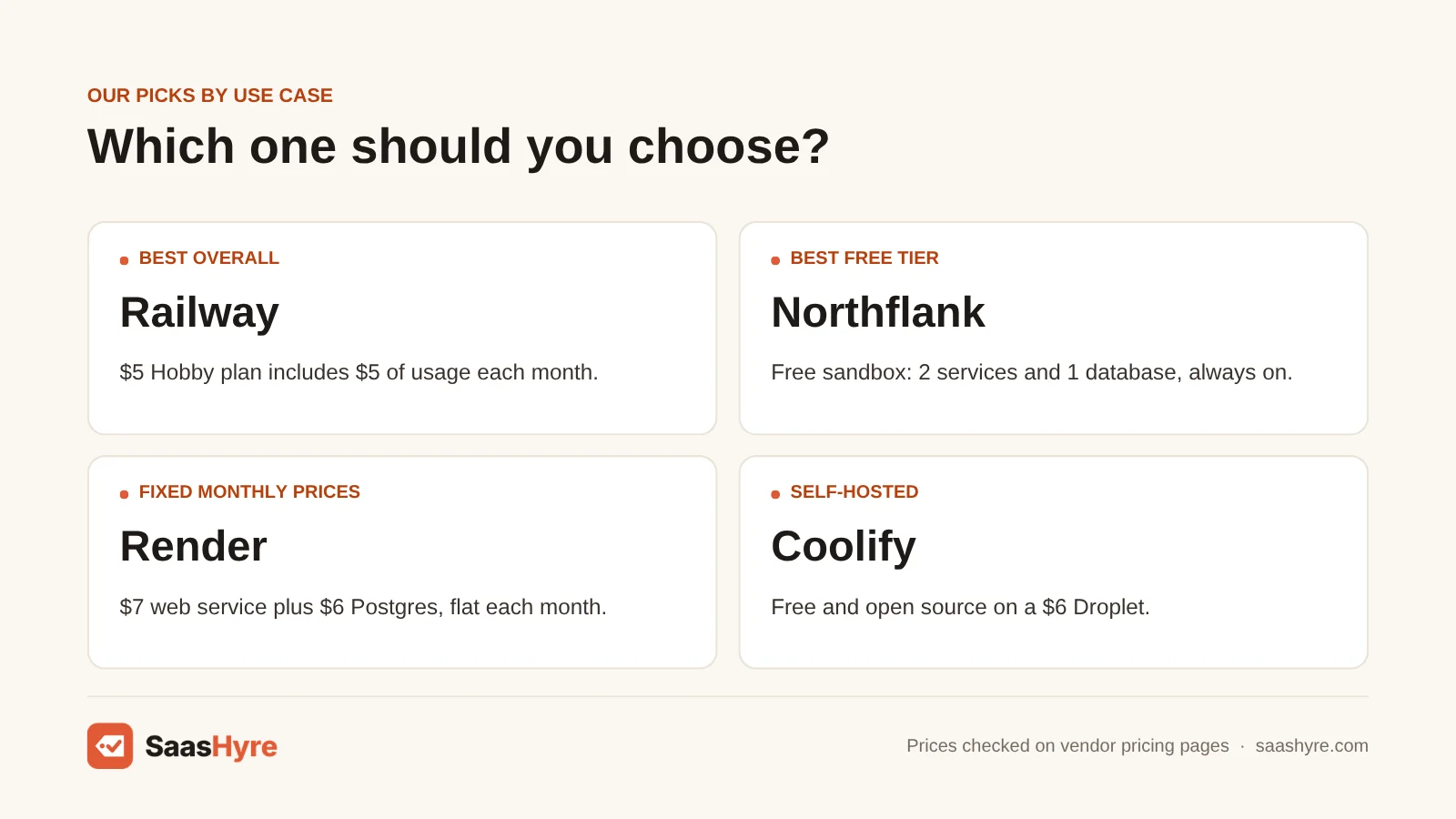
The best PaaS platform for most small apps is Railway. You pay only for the memory and CPU you use, and the $5 Hobby plan covers your first $5 of it. Pick Render for fixed monthly prices and Northflank for the best free tier. Pick Google Cloud Run for scale-to-zero, and Coolify to run your own PaaS on a cheap server.
A PaaS takes your code and runs it for you. You push to Git, and it builds, deploys and keeps your app online. The catch is price. Some platforms charge a flat fee per server. Others charge for every second of CPU and memory. And the database is often where the bill jumps.
I pulled every price from each vendor’s own pricing page in October 2026. Then I priced the same small app on each one, so you can see what you would really pay.
For every other hosting type, start with our main web hosting comparison.
Quick Comparison: 9 Best PaaS Platforms at a Glance
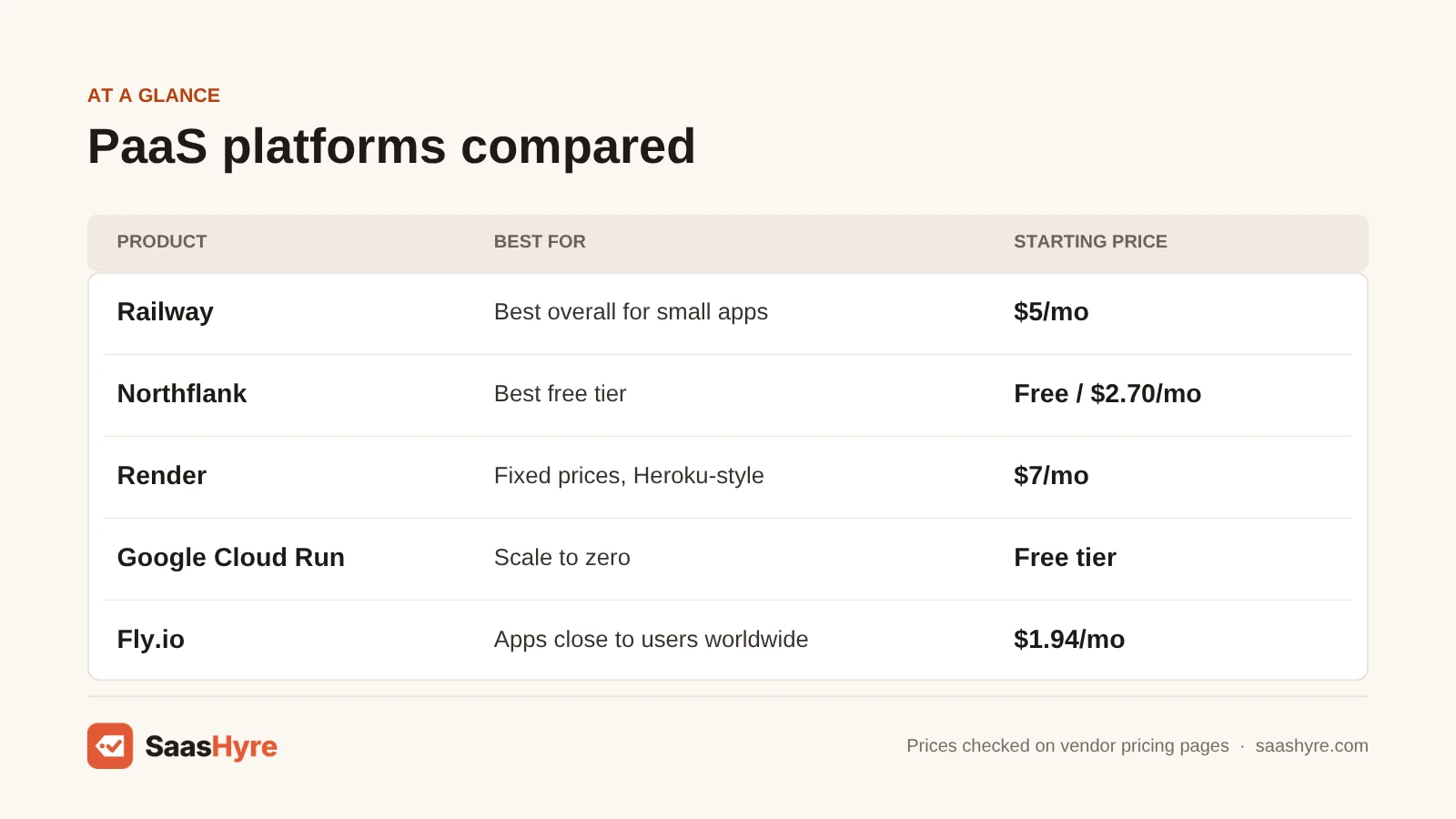
| Tool | Best for | Starting price | Billing model | Free plan or trial |
|---|---|---|---|---|
| Railway | Best overall for small apps | $5/mo (includes $5 of usage) | Per second of CPU and RAM | 30-day trial with $5 credit, then $1 credit a month |
| Northflank | Best free tier | $2.70/mo per small service | Per second, no seat fees | Free sandbox, always on |
| Render | Fixed prices, Heroku-style | $7/mo per web service | Flat price per instance | Free services that sleep |
| DigitalOcean App Platform | Low fixed prices | $5/mo per container | Flat price per container | 3 free static sites |
| Google Cloud Run | Scale to zero | $0 inside the free tier | Per second of use, plus requests | Monthly free tier |
| Fly.io | Apps close to users worldwide | $2.19/mo per small machine | Per second while running | Trial: 2 hours or 7 days |
| Vercel | Next.js and front ends | $20/mo (Pro) | Platform fee plus usage credit | Free Hobby plan, personal use only |
| Coolify | Self-hosted PaaS | Free self-hosted, Cloud $5/mo | You pay for your own server | Self-hosted is free |
| Heroku | Teams already on Heroku | $5/mo (Eco dyno) | Flat price per dyno | No free plan |
What Is a PaaS Platform?
A PaaS (platform as a service) runs your app code without you managing servers. You connect a Git repo or a container image. The platform builds it, gives it a web address, adds HTTPS and restarts it if it crashes. Most also sell a managed database. You pay more per unit of computing, but you skip most of the setup and upkeep.
You are really buying two things. First, compute for your app, sold as fixed sizes or by the second. Second, extras like a database, storage and data transfer. The extras are where most surprise costs come from.
What Makes the Best PaaS Platform?
The best PaaS platform lets you deploy from Git in minutes, gives you a managed database and charges a price you can predict. Check four things. How is compute billed? What does the smallest real database cost? Does the free plan sleep or expire? And can you set a spending limit so a traffic spike does not surprise you?
Watch for old info. Several top reviews still say Fly.io has a free tier and Render charges $19 per user. Fly.io now offers only a short trial, and Render Pro is a flat $25 a month.
Best PaaS Platform Overall
Railway is the best PaaS platform for most small apps. You pay per second for the memory and CPU your services use, at $10 per GB of RAM and $20 per vCPU each month. The $5 Hobby plan includes $5 of usage, so a small app with a database often costs under $10 a month.
1 Railway: Best for simple, usage-based pricing
If you want something close to old-school Heroku with a smaller bill, start here.
What it does well. Railway turns a Git repo into a running service with very little setup. You add Postgres or Redis in a few clicks. Since you pay for real use, an idle app costs less than a fixed-size server.
Key features:
- Deploy from GitHub or a Docker image
- One-click databases like Postgres and Redis
- Billed by the second
- Up to 6 replicas per service on Hobby
Pricing. New users get a 30-day trial with a one-time $5 credit. After that, the Free plan gives you $1 of credit a month, with 0.5 GB of RAM per service. Hobby is $5 a month and includes $5 of usage. Pro is $20 a month and includes $20 of usage. Enterprise is by quote. Extra usage costs $10 per GB of RAM and $20 per vCPU a month. Outbound data is $0.05 per GB, and volumes are $0.15 per GB a month. There is no yearly billing, and I found no refund terms on the pricing page. See Railway pricing.
Best for: You, if you run side projects or small apps and want to pay only for what they use.
Limitations. Usage pricing is harder to predict than a flat fee. An app using a full vCPU and 2 GB of RAM around the clock costs about $40 a month in compute.
Best Free PaaS Platform
Northflank has the best free PaaS tier. Its Developer Sandbox gives you 2 services, 1 database and 2 cron jobs that stay on and never go to sleep. When you outgrow it, paid compute starts at $2.70 a month for a tiny service, with no charge per team member.
2 Northflank: Best for a free tier that stays awake
If you want a real free tier and room to grow, look at Northflank.
What it does well. Northflank runs services, jobs and databases. It can also deploy into your own cloud account, which is called bring your own cloud (BYOC).
Key features:
- Free sandbox that does not sleep
- Managed databases as add-ons
- BYOC on your own cloud account
- GPUs from $0.80 an hour
Pricing. The sandbox is free. Pay-as-you-go costs $0.01667 per vCPU per hour and $0.00833 per GB of memory per hour. Fixed plans start at $2.70 a month (0.1 vCPU, 256 MB). Next come $5.40 (0.2 vCPU, 512 MB) and $12 (0.5 vCPU, 1 GB). Disk is $0.11657 per GiB a month, and outbound data is $0.06 per GB. Enterprise is by quote. See Northflank pricing.
Best for: You, if you want to test a real app for free, or you may need BYOC or GPUs later.
Limitations. There are a lot of settings, so it takes longer to learn than Railway or Render. The sandbox is for testing, not a busy app. Outbound data at $0.06 per GB costs more than on Fly.io.
Best PaaS Platforms for Fixed Monthly Prices
Render and DigitalOcean App Platform are the best picks if you want a bill that does not change. Render charges $7 a month for a 512 MB web service and $6 for its smallest paid Postgres. DigitalOcean charges $5 for a 512 MiB container and $7 for a development database.
3 Render: Best for Heroku-style fixed pricing
If you liked how Heroku worked, Render is the easiest move.
What it does well. Each service has a fixed size and price, so you know your bill ahead of time. Render runs web services, workers, cron jobs, Postgres and Key Value stores.
Key features:
- Git deploys with automatic HTTPS
- Managed Postgres and Key Value
- Preview environments
- 750 free instance hours a month
Pricing. The Hobby workspace is free, and you pay only for what you run. Pro is $25 a month flat with unlimited seats. Scale is $499 a month. Web services cost $7 (512 MB), $25 (2 GB) or $85 (4 GB) a month, plus a free option. Postgres costs $6, $19 or $40 a month, plus $0.30 per GB of storage. Hobby includes 5 GB of bandwidth, and extra is $0.15 per GB. See Render pricing.
Best for: You, if you want steady costs and a setup that feels like Heroku.
Limitations. Free web services spin down after 15 minutes without traffic, so the next visit is slow. Free Postgres expires after 30 days. And 5 GB of bandwidth on Hobby is small for a public app.
4 DigitalOcean App Platform: Best for low fixed prices
If you want the lowest flat price for an always-on container, try DigitalOcean.
What it does well. App Platform builds from GitHub or GitLab and redeploys when you push.
Key features:
- 3 free static sites
- Rollbacks to earlier deploys
- 99.95% uptime SLA
- Managed Postgres, MySQL and Redis
Pricing. Up to 3 static sites are free. Shared containers cost $5 a month (512 MiB, 50 GiB transfer), $10 (1 GiB), $25 (2 GiB) and $50 (4 GiB). A 512 MiB development database costs $7 a month. A full managed Postgres node starts at $15.15 a month. Extra transfer is $0.02 per GiB. See DigitalOcean App Platform pricing.
Best for: You, if you want a low, flat bill and lots of included bandwidth.
Limitations. Shared containers run one instance only, so autoscaling needs a dedicated plan. The $7 database is meant for small apps and testing. A production Postgres node costs $15.15.
Best PaaS Platform for Scale-to-Zero Apps
Google Cloud Run is the best pick if your app gets traffic in bursts. It charges only while requests run. Each month, the first 180,000 vCPU-seconds, 360,000 GiB-seconds and 2 million requests are free. A low-traffic app can run for $0, but a Cloud SQL database adds about $9 a month.
5 Google Cloud Run: Best for pay-per-use and scale to zero
If your app is quiet most of the day, Cloud Run can cost far less than an always-on server.
What it does well. Cloud Run runs any container. It drops to zero instances when nobody is using your app and scales up when traffic comes in.
Key features:
- Runs any container image
- Scales to zero when idle
- Monthly free tier
- Request-based or instance-based billing
Pricing. Active CPU costs $0.000024 per vCPU-second. Memory costs $0.0000025 per GiB-second. Requests cost $0.40 per million. The free tier covers the amounts above plus 1 GiB of North America data transfer each month. For a database, the smallest Cloud SQL for PostgreSQL machine (db-f1-micro) costs $0.0105 an hour. SSD storage costs $0.000232877 per GiB per hour. See Cloud Run pricing.
Best for: You, if your traffic comes in waves and you are fine working in Google Cloud.
Limitations. You set up billing, access rules and the database yourself. After scaling to zero, the next request waits for a cold start. Google says shared-core Cloud SQL machines are not covered by its SLA.
Best PaaS Platform for Global Apps
Fly.io is the best pick if you want your app to run close to users in many regions. Small machines start at $2.19 a month and are billed by the second. But Managed Postgres starts at $38 a month, so a small app with a database costs more here than on most rivals.
6 Fly.io: Best for running apps near your users
If your users are spread around the world and speed matters, look at Fly.io.
What it does well. Fly.io runs your container as small virtual machines. You can run copies in several regions, and each user reaches the closest one. Machines can stop when idle.
Key features:
- Deploy to many regions
- Machines billed by the second
- Volumes at $0.15 per GB a month
- Startup credit up to $15,000 for eligible companies
Pricing. A shared-cpu-1x machine costs $2.19 a month with 256 MB, $3.69 with 512 MB, $6.70 with 1 GB and $12.70 with 2 GB. Outbound data in North America and Europe is $0.02 per GB. A dedicated IPv4 address is $2 a month. Managed Postgres costs $38 (Basic, 1 GB), $72 (Starter) or $282 (Launch) a month, plus $0.28 per GB of storage. New users get a trial of 2 machine hours or 7 days, whichever comes first. See Fly.io pricing.
Best for: You, if you need low latency in several regions and like working in the command line.
Limitations. There is no ongoing free tier, despite what older reviews say. Managed Postgres is pricey for a small app. You need to be at ease with its CLI and config files.
Best PaaS Platform for Next.js and Front Ends
Vercel is the best pick if you build with Next.js or another frontend framework. Pro costs $20 a month and includes one deploying seat, $20 of usage credit, 1 million CDN requests and 1 TB of data transfer. It has no database of its own, so you add one from its Marketplace.
7 Vercel: Best for Next.js and frontend teams
If your app is mostly a Next.js or React front end, Vercel gives you the smoothest deploys.
What it does well. Vercel makes Next.js, so new Next.js features tend to work there first. Every pull request gets a preview link your team can comment on.
Key features:
- Preview deploys for every pull request
- Built-in CDN and firewall
- Free viewer seats
- Spend alerts and limits
Pricing. Hobby is free but only for personal, non-commercial projects. Pro has a $20 monthly platform fee that includes one deploying seat and $20 of usage credit. Each extra deploying seat is $20 a month. Pro has a free trial. Enterprise is by quote. See Vercel pricing.
Best for: You, if your team ships a Next.js app and wants great previews.
Limitations. It is not built for long-running backend workers. Your database is a separate bill from a third party. Each extra developer who deploys adds $20 a month.
Best Self-Hosted PaaS Platform
Coolify is the best self-hosted PaaS. It is open source and free to run on your own server, with no feature limits. You get Git deploys, databases, S3 backups and free SSL. A small app plus Postgres can run on a $6-a-month DigitalOcean Droplet with 1 GiB of RAM.
8 Coolify: Best for running your own PaaS
If you can handle a Linux server and want the lowest bill, Coolify gives you a Heroku-like dashboard on your own box.
What it does well. You install Coolify on a server you control. It deploys apps from GitHub, GitLab, Bitbucket or Gitea. It also runs databases and more than 280 one-click services.
Key features:
- Free and open source
- 280+ one-click services
- Automatic Let’s Encrypt SSL
- Backups to S3-compatible storage
Pricing. Self-hosted Coolify is free with every feature. Coolify Cloud, where Coolify runs the dashboard for you, is $5 a month for 2 servers plus $3 for each extra server. Paying yearly saves 20%. You still pay for your servers. A DigitalOcean Basic Droplet costs $4 a month with 512 MiB or $6 with 1 GiB. See Coolify pricing.
Best for: You, if you can manage a Linux server and want to cut your hosting bill.
Limitations. You are the ops team. Updates, security and outages are your job. One small server has no failover unless you set it up.
Best PaaS Platform If You Already Use Heroku
Heroku is still a fine choice if your apps already run there. Basic dynos cost $7 a month, and the smallest Postgres costs $5. But in February 2026, Heroku moved to a sustaining engineering model. That means no new features and no new Enterprise contracts for new customers.
9 Heroku: Best for teams already on Heroku
If your Heroku app works fine today, you do not have to move yet.
What it does well. Heroku made the modern PaaS popular. Its buildpacks, add-ons and Git deploys are still simple. Heroku says credit card customers keep the same pricing and service.
Key features:
- Buildpacks for major languages
- Large add-on marketplace
- Heroku Postgres and Key-Value Store
- Git push deploys
Pricing. Eco dynos are $5 a month for personal accounts and sleep after 30 minutes idle. Basic is $7, Standard-1X is $25, Standard-2X is $50 and Performance-M is $250 a month. Heroku Postgres costs $5 (1 GB), $9 (10 GB), $20 (32 GB) and $50 for Standard-0. There is no free plan. See Heroku pricing.
Best for: You, if your apps already run on Heroku and you have no urgent reason to move.
Limitations. Per Heroku’s February 6, 2026 update, it now focuses on stability, not new features. Standard dynos at $25 each add up fast as you add workers.
Tools We Left Out, and Why
- Netlify. It is great for static sites, with plans at $0, $9 and $20 a month. But it uses a credit system and is not built for an always-on backend. Vercel covers front ends on this list.
- Dokku. It is a free, open source Heroku-like tool for one server. Coolify gives you a web dashboard, so it is easier for most people.
- AWS Elastic Beanstalk and Azure App Service. They suit big teams already on those clouds. For a small app, they take much more setup than any pick above.
What a Small App Really Costs Each Month
For one small web service plus a small Postgres database, the cheapest managed options are Northflank at $8.25 a month and Railway at about $9. Heroku and DigitalOcean cost $12, and Render costs $13.30. Fly.io costs $41.97 because its Managed Postgres starts at $38. Self-hosting Coolify on a $6 server is cheapest.
I priced one always-on web service with about 512 MB of RAM and a small Postgres database with about 1 GB of storage. Railway bills by use, so its number assumes 0.75 GB of RAM and 0.07 vCPU used on average.
| Platform | What I priced | Per month | Per year |
|---|---|---|---|
| Coolify (self-hosted) | $6 Droplet running app and Postgres | $6.00 | $72.00 |
| Northflank | $5.40 service + $2.70 Postgres + $0.15 disk | $8.25 | $99.00 |
| Railway (Hobby) | $7.50 RAM + $1.40 CPU + $0.15 volume | $9.05 | $108.60 |
| Google Cloud Run | $0 Cloud Run + $7.67 db-f1-micro + $1.70 for 10 GiB SSD | $9.37 | $112.44 |
| Heroku | $7 Basic dyno + $5 Essential-0 | $12.00 | $144.00 |
| DigitalOcean App Platform | $5 container + $7 dev database | $12.00 | $144.00 |
| Render (Hobby) | $7 Starter + $6 Basic-256mb + $0.30 storage | $13.30 | $159.60 |
| Fly.io | $3.69 machine + $38 Managed Postgres + $0.28 storage | $41.47 | $497.64 |
Cloud SQL is priced at 730 hours a month. Cloud Run is $0 only inside its free tier. Vercel is left out because it has no database of its own.
How to Choose a PaaS Platform Without Overpaying
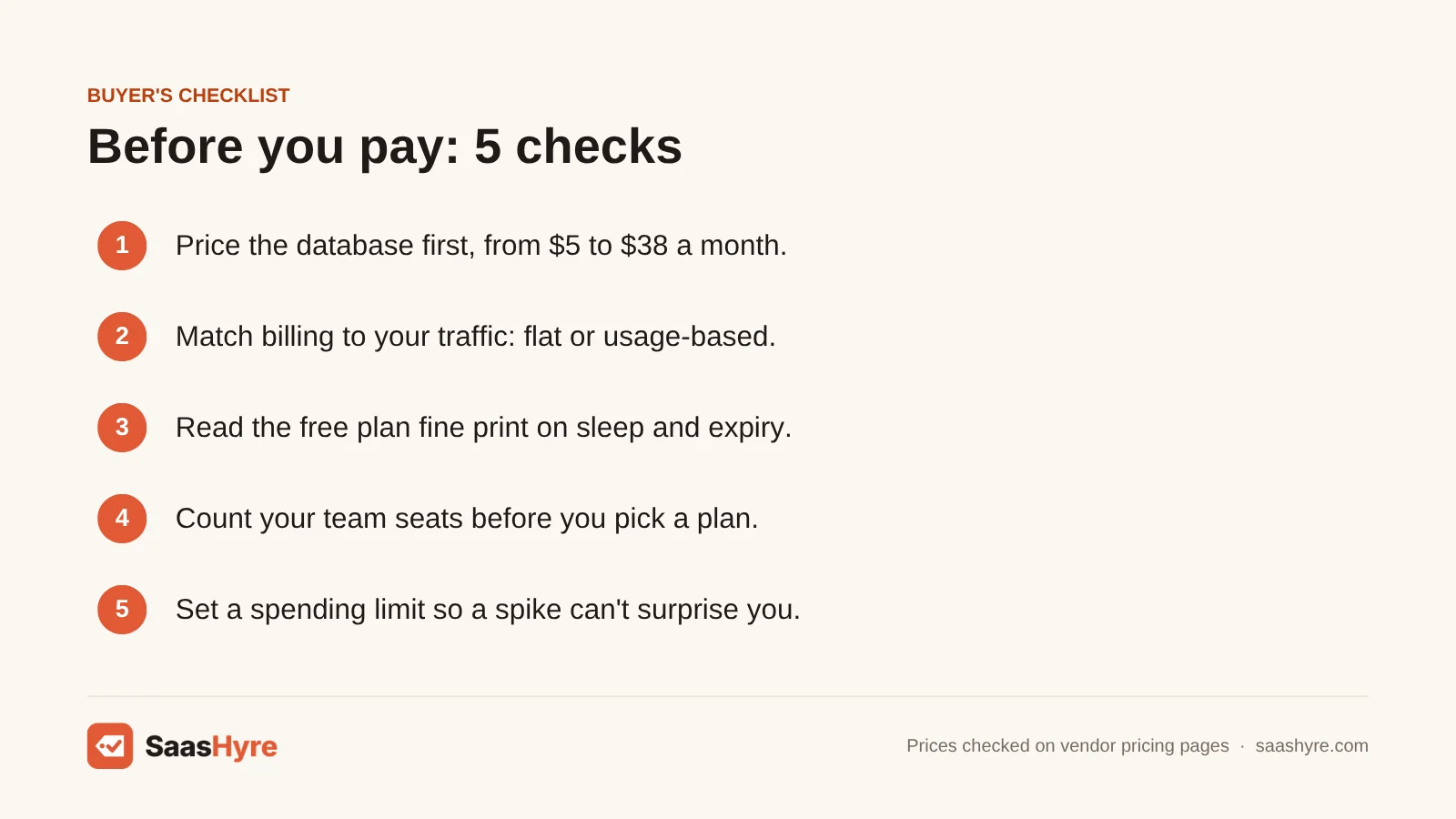
- Price the database first. Managed Postgres ranges from $5 on Heroku to $38 on Fly.io. Check that line before anything else.
- Match billing to your traffic. Steady traffic suits flat prices like Render. Spiky traffic suits usage billing like Railway or Cloud Run.
- Read the free plan fine print. Render’s free services sleep after 15 minutes, and its free Postgres expires after 30 days.
- Count your team seats. Vercel charges $20 per deploying seat. Render Pro and Northflank do not charge per person.
- Set a spending limit. Usage billing can surprise you after a traffic spike. Turn on spend alerts on day one.
- Plan your exit. Use Docker images and plain Postgres, so you can move later with a simple dump and restore.
How We Evaluated These Tools
We compared each platform using its own pricing page, docs and product pages, checked in October 2026. We also read the top-ranking reviews of PaaS platforms and Heroku alternatives to find stale prices and gaps. We looked at how compute is billed, the cost of the smallest real database, free plan limits and seat pricing. We did not run our own speed or uptime tests, and feature claims come from the vendors. No vendor pays to be listed. Read our editorial policy to learn more.
Keep comparing: Hosting guides · Best Node.js Hosting · Best VPS Hosting
The Bottom Line
For most small apps, start with Railway. A small app with a database often lands under $10 a month. If you want a fixed bill, pick Render or DigitalOcean App Platform. Want a free tier that stays awake? Try Northflank. Choose Cloud Run for bursty traffic, Fly.io for users around the world and Vercel for Next.js. If you can manage a server, Coolify on a $6 Droplet is the cheapest path. On Heroku today? You can stay for now, but plan your next move. For bigger workloads, see our guide to the best cloud hosting.
If this one is not quite the right fit, start with our Bluehost alternatives guide, then compare our best ecommerce hosting and WP Engine alternatives guides.
Frequently Asked Questions
What is the best PaaS platform?
For most small apps, Railway is the best PaaS platform. You pay only for the memory and CPU you use, and the $5 Hobby plan includes $5 of usage. Render is the best pick for fixed prices, and Northflank has the best free tier.
What is the best free alternative to Heroku?
Northflank has the best free tier. Its sandbox gives you 2 services and 1 database that stay awake. Render is free too, but its services sleep after 15 minutes and its free Postgres expires after 30 days. Coolify is free if you host it yourself.
Is Heroku shutting down?
No. On February 6, 2026, Heroku said it is moving to a sustaining engineering model. It will focus on stability, security and support instead of new features. Credit card customers keep the same pricing. New customers can no longer sign Enterprise contracts.
Is Railway cheaper than Render?
Often, for small apps. In my example, a web service with Postgres costs about $9.05 a month on Railway and $13.30 on Render. But Railway bills by use, so a busy app can cost more. Render’s flat prices are easier to predict.
Does Fly.io still have a free tier?
No, not an ongoing one. New users get a trial of 2 machine hours or 7 days, whichever comes first. After that, you pay for what you use. The smallest machine costs $2.19 a month, and Managed Postgres starts at $38 a month.
Is Vercel a PaaS?
Yes, but it is built mainly for front ends like Next.js. It handles builds, previews, a CDN and serverless functions. It does not sell its own database and is not meant for long-running workers. Pro costs $20 a month per deploying seat.
What is the difference between a PaaS and a VPS?
A VPS is a bare server you set up and maintain yourself. A PaaS runs your code for you and handles builds, HTTPS, restarts and often the database. A VPS is cheaper, like $6 a month for a 1 GiB Droplet. A PaaS saves you time.
Is Google Cloud Run free?
It can be for small apps. Each month, the free tier covers 180,000 vCPU-seconds, 360,000 GiB-seconds of memory and 2 million requests. Beyond that, you pay per second of use. A database is extra. The smallest Cloud SQL machine costs $0.0105 an hour.