
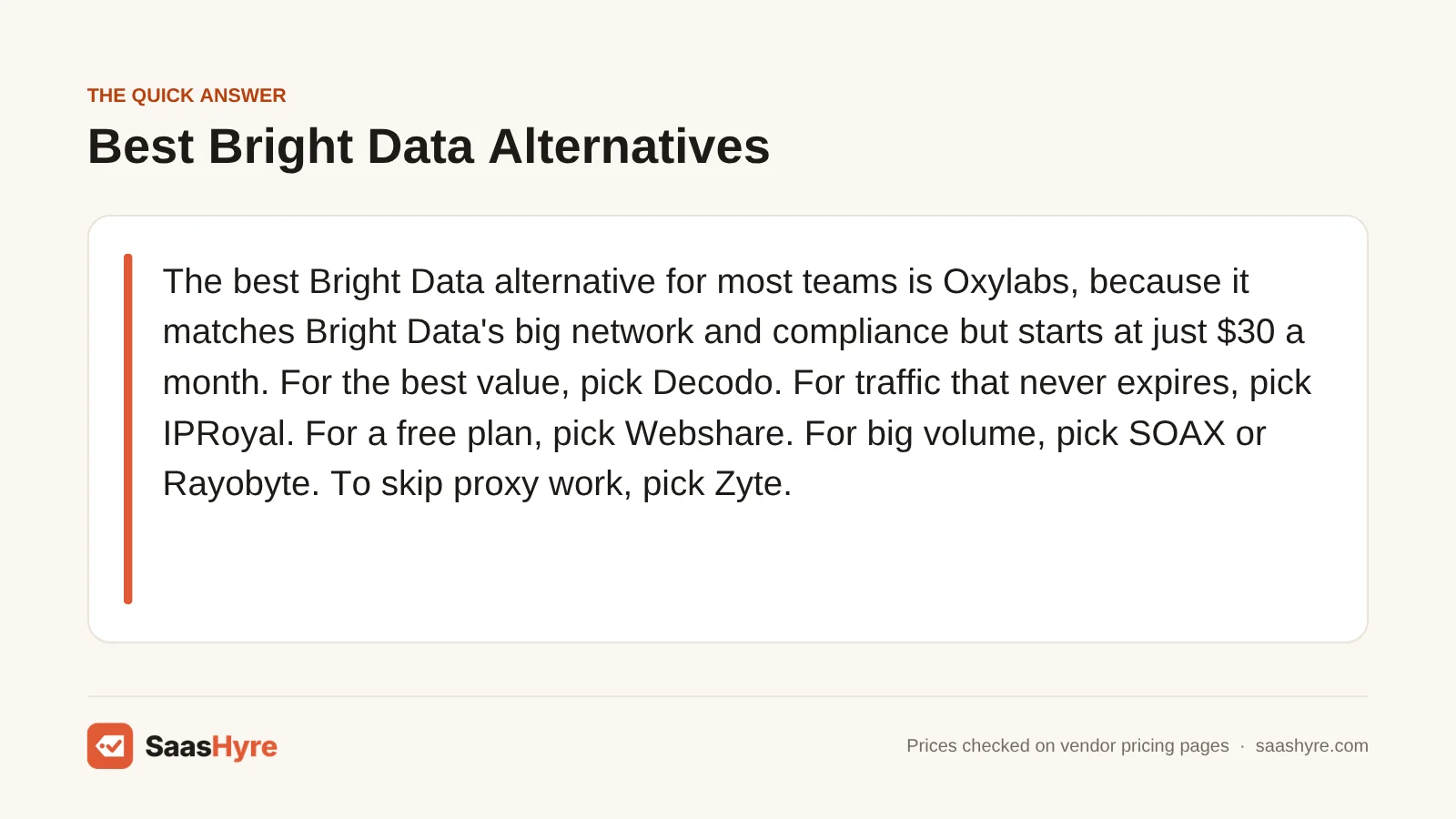
The best Bright Data alternative for most teams is Oxylabs, because it matches Bright Data’s big network and compliance but starts at just $30 a month. For the best value, pick Decodo. For traffic that never expires, pick IPRoyal. For a free plan, pick Webshare. For big volume, pick SOAX or Rayobyte. To skip proxy work, pick Zyte.
Here is why so many people shop around. Bright Data is one of the biggest proxy and web data companies. But its residential plans start at $499 a month, and its per-GB price changes with promos. If you run price checks, track rankings or verify ads, you may not need that much. Most of the providers below let you start small and still get a large, ethically sourced IP pool.
I pulled every price below from each company’s own pricing page in October 2026. Proxy prices change often, and some are promo prices, so check the final price before you pay. This guide covers legal business uses only, like price monitoring, SEO, ad checks and public data collection.
This guide is part of our best proxy providers series, which covers every proxy type.
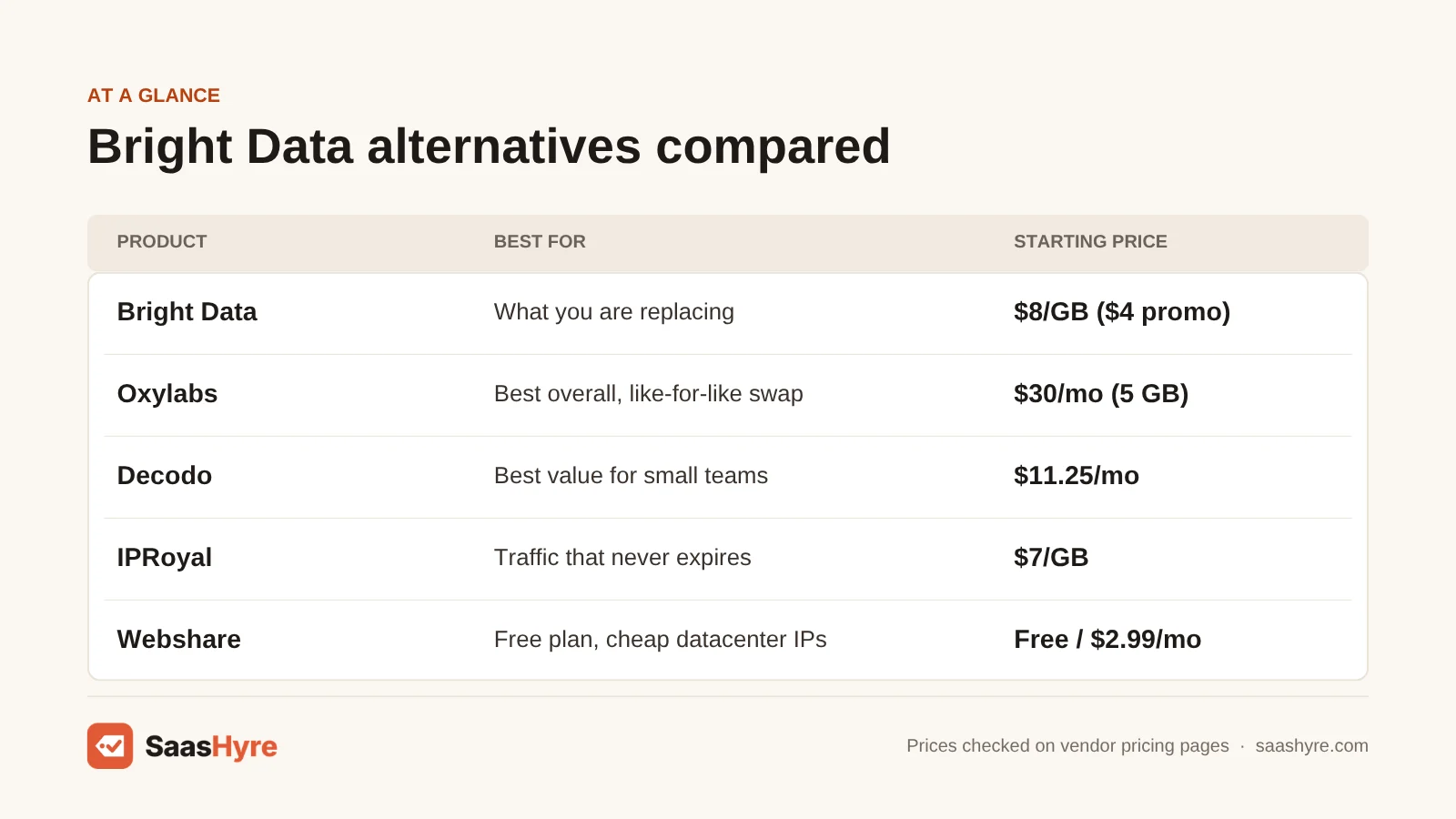
Quick Comparison: 7 Bright Data Alternatives at a Glance
| Tool | Best for | Monthly billing | Yearly billing | Free plan or trial |
|---|---|---|---|---|
| Bright Data (baseline) | What you are replacing | $4/GB pay as you go (promo, $8 regular), or $499/mo for 141 GB | Not listed | Free trial, no card needed |
| Oxylabs | Best overall, like-for-like swap | $30/mo credit plan ($6/GB) | Not listed | Free $5 welcome credit |
| Decodo | Best value for small teams | $11.25/mo for 3 GB, or $4/GB pay as you go | Not listed | 100 MB for 3 days, 14-day money-back |
| IPRoyal | Traffic that never expires | $7/GB (1 GB plan), $7.35/GB pay as you go | Not listed | No free trial listed |
| Webshare | Free plan and cheap datacenter IPs | $2.99/mo for 100 datacenter proxies, $3.50 for 1 GB residential | Yearly option marked “save 30%” | Yes, 10 proxies and 1 GB a month |
| SOAX | Residential and mobile at one rate | $5/GB on free Sandbox, or $200/mo Builder at $3/GB | Enterprise only, 12-month agreement | Free Sandbox plan, no free trial |
| Rayobyte | Low per-GB rates at volume | $3.50/GB (1 to 49 GB) | Not listed | Residential trial when you sign up |
| Zyte | Scraping API, no proxy setup | $0.13 to $1.27 per 1,000 requests pay as you go | Not listed | $5 free credit for 30 days |
Why People Look for a Bright Data Alternative
Most people switch because of cost and size. Bright Data’s residential plans start at $499 a month, and its regular pay-as-you-go rate is $8 per GB. Small and mid-size teams often need far less traffic. Others find the dashboard and strict sign-up checks slow. A smaller provider can cost less and still cover most business jobs.
Bright Data is still a strong choice. It claims over 400 million monthly residential IPs in 195 countries. It offers ZIP code and ASN targeting, and it holds ISO 27001 and SOC 2 certifications. It also sells datasets and scraping APIs, so it is more than a proxy company.
When we checked, Bright Data was running a 50% promo with code RESIGB50. That cut pay-as-you-go traffic to $4 per GB. The promo also brought the Starter plan to $499 a month for 141 GB. Promo prices end, though. So plan your budget on the regular rate, not the sale rate. You can see how Bright Data compares with the full market in our best proxy providers guide.
What Makes the Best Bright Data Alternative?
The best Bright Data alternative gives you real residential IPs from a clean, consented source at a price that fits your traffic. Check five things. How big and where is the IP pool? What does 1 GB cost at your volume? Can you start small or test for free? Does unused traffic expire? And how does the company check its users?
We compared each provider on those five points using its own pricing pages, product pages and help docs. We also read the top-ranking reviews. Many still quote old Bright Data prices, like $10.50 per GB. Almost none mention that NetNut, a Bright Data rival, had its domains seized by the FBI in July 2026. We cover gaps like that below so you don’t buy from the wrong company.
Best Overall Bright Data Alternative
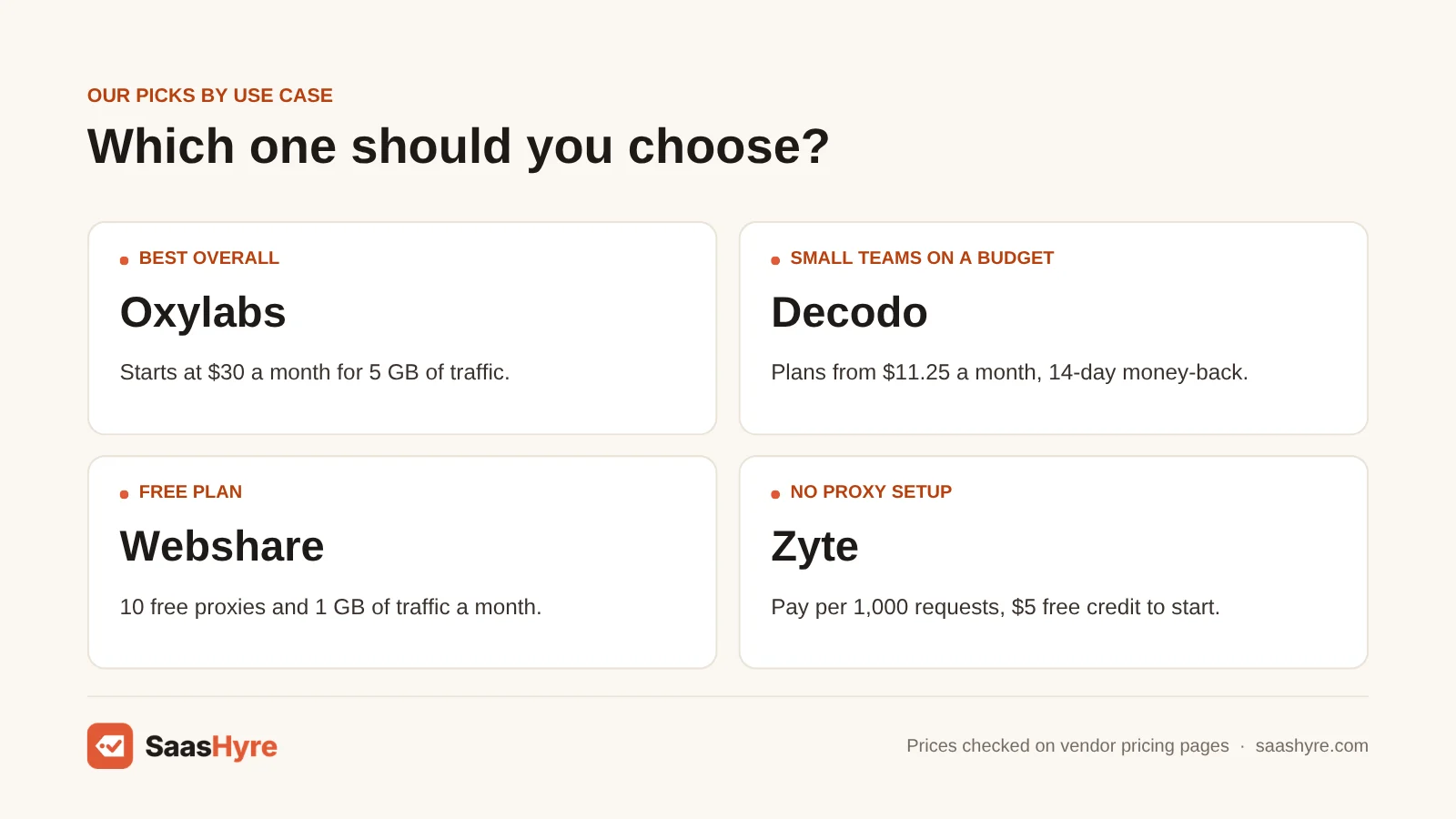
Oxylabs is the best overall Bright Data alternative. It is the closest match in size and compliance, with over 175 million residential IPs in 195 countries and ISO 27001 certification. But you can start at $30 a month for 5 GB, far below Bright Data’s $499 Starter plan.
1 Oxylabs: Best like-for-like swap
If you want Bright Data’s scale without its $499 starting bill, start here.
What it does well. Oxylabs runs one of the largest residential networks. You can target by country, state, city, ZIP code and ASN. You can keep the same IP for up to 24 hours with sticky sessions. It also sells datacenter, ISP and mobile proxies, plus a Web Scraper API. So you can move most Bright Data jobs to one account.
Key features:
- 175M+ residential IPs in 195 countries
- ZIP code, ASN and city targeting
- Sticky sessions up to 24 hours
- HTTP(S), HTTP/3 and SOCKS5
- ISO 27001:2022 certified
Pricing. Oxylabs now sells one monthly credit subscription that works across every product. Starter is $30 a month, Basic is $100, Flexible is $500 and Enterprise starts at $2,500. Residential traffic costs $6 per GB on Starter, $5 on Basic, $4 on Flexible and $2.50 on Enterprise. On Starter, shared datacenter proxies cost $1 per IP and shared ISP proxies cost $1.50 per IP. New accounts get a free $5 welcome credit, and unused credit expires at the end of each billing cycle. Oxylabs’ own pages disagree on refunds, so treat a purchase as non-refundable. See Oxylabs pricing.
Best for: You, if you run a data team and want Bright Data-level coverage with a smaller starting plan.
Limitations. The free trial is for verified companies, so solo users have to pay first. The 3-day refund window is short. And the small plans cost more per GB than Decodo or Webshare.
Best Cheap Bright Data Alternatives for Small Teams
Decodo is the best cheap Bright Data alternative. Plans start at $11.25 a month for 3 GB, with a 14-day money-back guarantee. IPRoyal is the best pick if you buy traffic now and then, because its residential traffic never expires. Its 1 GB subscription costs $7.
2 Decodo: Best value for small teams
If you want a big, easy residential network at a small-team price, Decodo is your pick.
What it does well. Decodo used to be called Smartproxy. It offers over 115 million residential IPs in 195+ locations. You get ZIP code and ASN targeting at no extra cost. It works with tools like Scrapy, Postman and n8n. It also sells a Web Scraping API if you’d rather not manage proxies.
Key features:
- 115M+ residential IPs
- Free ZIP code and ASN targeting
- Scrapy, Postman and n8n integrations
- Web Scraping API from $0.09 per 1,000 requests
- ISO/IEC 27001:2022 certified
Pricing. Monthly residential plans start at $11.25 for 3 GB ($3.75 per GB). You pay $35 for 10 GB, $81.25 for 25 GB, $150 for 50 GB and $275 for 100 GB ($2.75 per GB). Enterprise plans go from $2.50 per GB down to $2 per GB at 1 TB. Pay as you go costs $4 per GB with no plan. New users get 100 MB free for 3 days. There is a 14-day money-back guarantee on first purchases if you used under 20% of the traffic. It does not apply if you already used the free trial. See Decodo pricing.
Best for: You, if you run price checks or rank tracking for a small team and want to spend under $100 a month.
Limitations. You must pick between the free trial and the money-back guarantee. You can’t use both. Monthly plans renew on their own, so cancel on time if you only need one month.
3 IPRoyal: Best for traffic that never expires
Do your jobs come and go? IPRoyal lets you use traffic whenever you like.
What it does well. Most providers reset your GB each month. IPRoyal does not. Your residential traffic never expires. It has over 64 million IPs in 195+ countries, with country, state and city targeting. You can rotate IPs on every request or keep one for up to 7 days.
Key features:
- Residential traffic that never expires
- 64M+ IPs in 195+ countries
- Sticky sessions up to 7 days
- HTTP(S) and SOCKS5
- No monthly minimum
Pricing. Subscription prices are $7 per GB for 1 GB, $5.95 per GB for 2 GB and $5.25 per GB for 10 GB. Pay as you go costs a bit more: $7.35, $6.25 and $5.51 per GB. Custom deals drop to $1.75 per GB, but only from 10 TB. ISP proxies start at $1.80 per proxy and datacenter proxies at $1.39. We found no free trial. Refunds must be asked for within 24 hours and are not given after 100 MB of use. See IPRoyal pricing.
Best for: You, if you scrape in bursts, like a monthly price report, and hate losing unused GB.
Limitations. Small plans cost more per GB than Decodo or Webshare. The low $1.75 rate needs a 10 TB order, which most teams will never reach. And the refund window is tight.
Best Free Bright Data Alternative
Webshare is the best free Bright Data alternative. Its free plan gives you 10 datacenter proxies and 1 GB of traffic a month, with no card needed and no time limit. Paid plans start at $2.99 a month for 100 datacenter proxies, and residential traffic starts at $3.50 for 1 GB.
4 Webshare: Best free plan and cheap datacenter proxies
Want to test for free? Try Webshare.
What it does well. Webshare is the easiest way to start for free. The free plan is not a short trial. You can keep it as long as you want. When you grow, the paid datacenter plans are very cheap. It also sells rotating residential proxies from a pool of over 80 million IPs in 195 countries.
Key features:
- Free plan: 10 proxies, 1 GB a month
- 100 datacenter proxies for $2.99 a month
- 80M+ residential IPs
- HTTP and SOCKS5 support
- Yearly billing option marked “save 30%”
Pricing. The free plan has 10 proxies and 1 GB of traffic a month. 100 datacenter proxies cost $2.99 a month with 250 GB of bandwidth. Residential traffic costs $3.50 for 1 GB, $27.50 for 10 GB, $225 for 100 GB and $1,500 for 1,000 GB. The lowest rate is $1.40 per GB at 3,000 GB. The pricing page shows a yearly option marked “save 30%”. Refunds must be asked for within 48 hours, with under 0.1 GB used on rotating residential plans. See Webshare pricing.
Best for: You, if you are testing a small scraper or need cheap datacenter IPs for SEO checks.
Limitations. Free and datacenter proxies get blocked more on tough sites than residential IPs. The residential pool is smaller than Bright Data’s. And the refund rules are strict.
Best Bright Data Alternatives for High Volume
SOAX is the best pick if you use residential and mobile IPs. One rate covers both, from $3 per GB on the $200 Builder plan. Rayobyte is the best pick for heavy residential use, with rates falling to $2 per GB from 50 GB and $0.50 per GB above 5,000 GB.
5 SOAX: Best for residential and mobile at one rate
Need mobile and home IPs? SOAX puts both on one bill.
What it does well. SOAX charges one rate across its residential and mobile networks. You can target by country, region, city and ISP. It covers 195+ locations and supports HTTP, HTTPS and SOCKS5. It also offers a free Sandbox plan, so you can set things up before you commit.
Key features:
- One rate for residential and mobile
- Country, region, city and ISP targeting
- 195+ locations
- Unused credits roll over for 60 days
- Published KYC and KYB policy
Pricing. Sandbox is free with no monthly fee, but you pay $5 per GB in the top price tier. Builder is $200 a month plus VAT with 500 credits and $3 per GB. SOAX says one credit is roughly $1 of use. Team is $500 a month at $2.20 per GB, and Scale is $1,500 a month at $1.50 per GB. Enterprise starts at $3,000 a month, from $0.85 per GB. Cheaper countries cost less per GB. There is no free trial, and payments are generally non-refundable. See SOAX pricing.
Best for: You, if you do ad verification or app testing and need mobile and home IPs on one plan.
Limitations. The credit and tier system takes a minute to learn. Plans are hard to compare with a simple per-GB price. And since payments are generally non-refundable, test on Sandbox before you buy.
6 Rayobyte: Best for low per-GB rates at volume
Move a lot of traffic? Look at Rayobyte.
What it does well. Rayobyte is based in Lincoln, Nebraska. It says its 40 million+ residential IPs come from real devices with full consent. Its prices drop quickly as you buy more. Pay-as-you-go bandwidth does not expire. It also sells ISP, datacenter and mobile proxies plus a scraping API.
Key features:
- 40M+ residential IPs in 163+ countries
- US-based company
- Pay-as-you-go bandwidth that does not expire
- Sticky sessions and free geo-targeting
- Web Scraping API with 5,000 free scrapes
Pricing. Residential costs $3.50 per GB from 1 to 49 GB. It drops to $2 per GB from 50 GB, $1.50 from 250 GB, $0.70 from 1,000 GB and $0.50 from 5,000 GB. Static ISP proxies start at $5 per IP. Rotating datacenter traffic starts at $0.30 per GB. Rayobyte says you get a residential trial just by creating an account. Refunds are reviewed case by case and are not guaranteed. See Rayobyte pricing.
Best for: You, if you run steady price monitoring or public data jobs above 50 GB a month.
Limitations. The pool covers fewer countries than Bright Data’s 195. The trial size is not listed on the pricing page. And refunds are up to Rayobyte, so start small.
Best Bright Data Alternative If You Don’t Want to Manage Proxies
Zyte is the best pick if you want web pages or data back, not raw proxies. Zyte API handles bans, browser rendering and IP rotation for you. You pay per 1,000 successful requests, from $0.13 on pay as you go, and new users get $5 of free credit for 30 days.
7 Zyte: Best scraping API with pay-per-success pricing
If you use Bright Data’s Web Unlocker or scraper APIs, Zyte is the closest swap.
What it does well. Zyte API sends your request, picks the right IP, renders the page if needed and deals with blocks. It can also turn pages into structured data, like product or article fields. You pay for results, not for GB.
Key features:
- Automatic ban handling
- Headless browser rendering
- AI extraction into structured data
- Residential, datacenter and mobile IP rotation
- Session and cookie handling
Pricing. Pay as you go costs $0.13 to $1.27 per 1,000 HTTP responses and $1.01 to $16.08 per 1,000 browser-rendered responses. The price depends on how hard the site is to reach. A $100 monthly commitment lowers HTTP responses to $0.10 to $0.95. A $500 commitment lowers them to $0.06 to $0.61. You get $5 free credit to try it for 30 days. See Zyte pricing.
Best for: You, if you want finished pages or data for price tracking and don’t want to tune proxies yourself.
Limitations. Hard sites cost many times more than easy ones, so estimate your mix first. It is not a plain proxy you can plug into any tool. Browser-rendered pages cost far more than simple HTTP responses.
Tools We Left Out, and Why
You will see these on other lists. Here is why they are not in our top 7.
- NetNut. On July 2, 2026, the FBI and IRS Criminal Investigation seized NetNut’s domains. Security researchers tied it to the Popa botnet of at least two million hacked devices (KrebsOnSecurity). Some older reviews still recommend it.
- Apify, ScraperAPI and Firecrawl. These are scraping tools, not proxy networks. They can replace Bright Data’s scraper APIs, but we picked Zyte for that job and did not check their prices for this guide.
What 100 GB of Residential Traffic Costs
For 100 GB of residential traffic, Bright Data costs $400 at its promo rate. At the regular $8 rate, it costs $800. Decodo costs $275, Webshare costs $225 and Rayobyte costs $200. On Oxylabs, 100 GB needs the $500 Flexible plan, which covers up to 125 GB at $4 per GB.
This math uses each vendor’s listed plan or per-GB rate for top-price countries. It leaves out taxes, promos you might not get and enterprise deals.
| Provider | How you buy it | Cost for about 100 GB |
|---|---|---|
| Bright Data (regular) | Pay as you go at $8/GB | $800 |
| Bright Data (promo) | Pay as you go at $4/GB | $400 |
| Bright Data Starter | 141 GB plan (promo price) | $499 |
| Oxylabs Flexible | $500 credit plan at $4/GB, up to 125 GB | $500 |
| Decodo | 100 GB plan at $2.75/GB | $275 |
| Webshare | 100 GB at $2.25/GB | $225 |
| Rayobyte | 100 GB at $2/GB | $200 |
At small volume, the picture changes. For 10 GB, Decodo is $35 and Webshare is $27.50. On Oxylabs, 10 GB needs the $100 Basic plan, which covers up to 20 GB at $5 per GB.
How to Choose a Bright Data Alternative
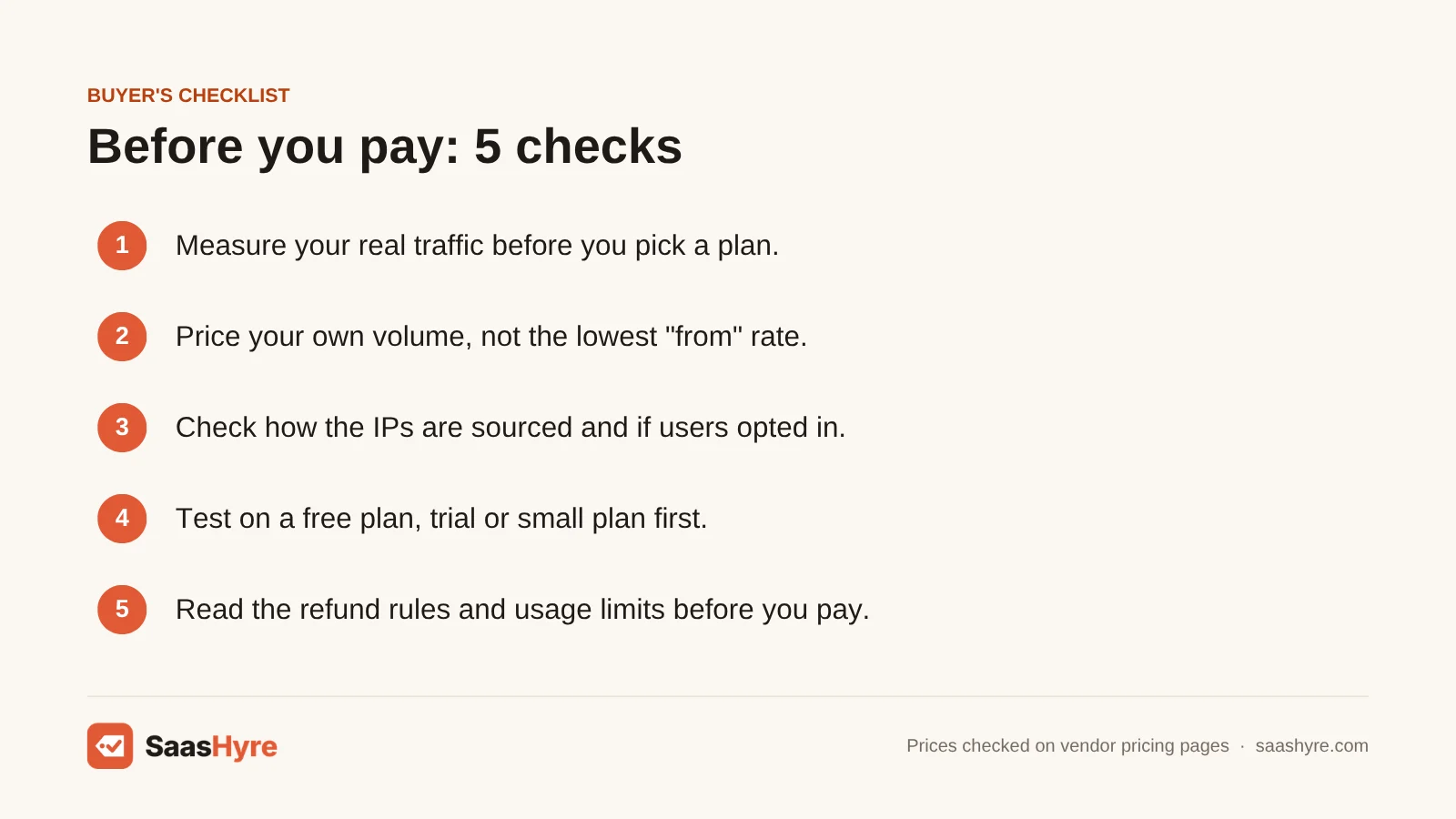
- Measure your real traffic. Run a test for a week and see how many GB you use. Most price checks and rank tracking jobs use far less than 141 GB a month.
- Price your volume, not the lowest rate. The “from” price often needs 1 TB or more. Look up the per-GB rate at the plan you will actually buy.
- Check how the IPs are sourced. Pick a provider that says its IPs come from opt-in users and that checks its own customers. The NetNut seizure shows why this matters.
- Test before you pay yearly. Use a free plan, trial or small plan first. Webshare, SOAX and Decodo all let you start with little or no money.
- Read the refund rules. Windows run from 24 hours at IPRoyal to 14 days at Decodo. Most end once you pass a small usage limit.
- Decide proxy or API. If you only want the data, a scraping API like Zyte can cost less in staff time than running proxies yourself.
How We Evaluated These Tools
We compared each provider using its own pricing pages, product pages and help docs, checked in October 2026. We also read the top-ranking reviews of Bright Data alternatives to find stale prices and missing facts. We looked at per-GB and per-IP prices, plan sizes, free plans and trials, refund rules, pool size and how each company says it sources IPs. We did not run our own speed or success-rate tests, and pool sizes and success rates come from the vendors. No vendor pays to be listed. We only cover legal uses like price monitoring, SEO, ad verification and public data. Read our editorial policy to learn more.
Keep comparing: Proxy guides · Best Residential Proxies · Best ISP Proxies
The Bottom Line
If you want one provider that feels like Bright Data but starts smaller, get Oxylabs. If you want the best price for a small team, go with Decodo. Pick IPRoyal if your traffic comes in bursts, since your GB never expire. Start with Webshare if you want to test for free. Choose SOAX for mobile and residential on one bill, or Rayobyte for cheap high-volume traffic. And if you just want the data, use Zyte. Whatever you pick, stay with ethically sourced IPs and public data. For more options, see our best residential proxies guide.
Frequently Asked Questions
What is the best alternative to Bright Data?
Oxylabs is the best overall alternative. It has over 175 million residential IPs, ZIP and ASN targeting and ISO 27001 certification, much like Bright Data. But its residential plans start at $30 a month for 5 GB, compared with $499 for Bright Data’s Starter plan.
How much does Bright Data cost per GB?
Bright Data lists residential pay-as-you-go traffic at $8 per GB. When we checked in October 2026, a 50% promo cut it to $4 per GB. Its Starter plan was $499 a month for 141 GB. Datacenter proxies start at $0.90 per IP and ISP proxies at $1.30 per IP.
Is there a cheaper alternative to Bright Data?
Yes. Decodo starts at $11.25 a month for 3 GB, and Webshare sells 1 GB of residential traffic for $3.50. For 100 GB a month, Rayobyte costs $200 and Webshare costs $225, compared with $800 at Bright Data’s regular pay-as-you-go rate.
Is there a free Bright Data alternative?
Webshare has the best free plan. You get 10 datacenter proxies and 1 GB of traffic a month, with no card and no time limit. SOAX also has a free Sandbox plan, but you pay $5 per GB for the traffic you use.
Is Oxylabs better than Bright Data?
For most teams, Oxylabs is the easier start. It offers similar coverage and compliance, and its plans start far smaller at $30 a month. Bright Data has a bigger claimed pool of 400 million+ monthly IPs and more ready-made datasets. Pick Bright Data if you need those datasets.
Is Decodo the same as Smartproxy?
Yes. Decodo is the new name for Smartproxy. Its own site says “formerly smartproxy.com.” It sells residential, datacenter, ISP and mobile proxies, plus a Web Scraping API. Residential plans start at $11.25 a month for 3 GB.
Are residential proxies legal to use?
Residential proxies are legal for many business uses, like price monitoring, SEO rank checks, ad verification and collecting public data. You must still follow each site’s terms and your local laws. Choose a provider that sources IPs with user consent and checks its customers.
What happened to NetNut?
On July 2, 2026, the FBI and IRS Criminal Investigation seized NetNut’s domains. Researchers linked the service to the Popa botnet, which had at least two million compromised devices. If you used NetNut, move to a provider with clear, consent-based IP sourcing.