
For most small businesses, the best AI bookkeeping pick is Pilot Essentials at $99 a month. It is an AI-only service that closes cash-basis books if you spend up to $100,000 a month. Puzzle is the best software you run yourself. Zeni fits funded startups that want a full finance team. Booke AI fits bookkeepers who work in QuickBooks Online.

Here is my advice before you compare anything. Don’t start by asking which AI is smartest. Ask who is on the hook when a transaction goes into the wrong account. Software is fast and cheap, but you do the review. A service costs three to eight times more, and someone else signs off on the month. Decide that first, and your list gets short fast.
I pulled every price below from the vendor’s own pricing page in September 2026. These vendors change plans often, so check the price when you check out.
Building a full stack? Our small business software guide shows the best pick for every job and what it costs.
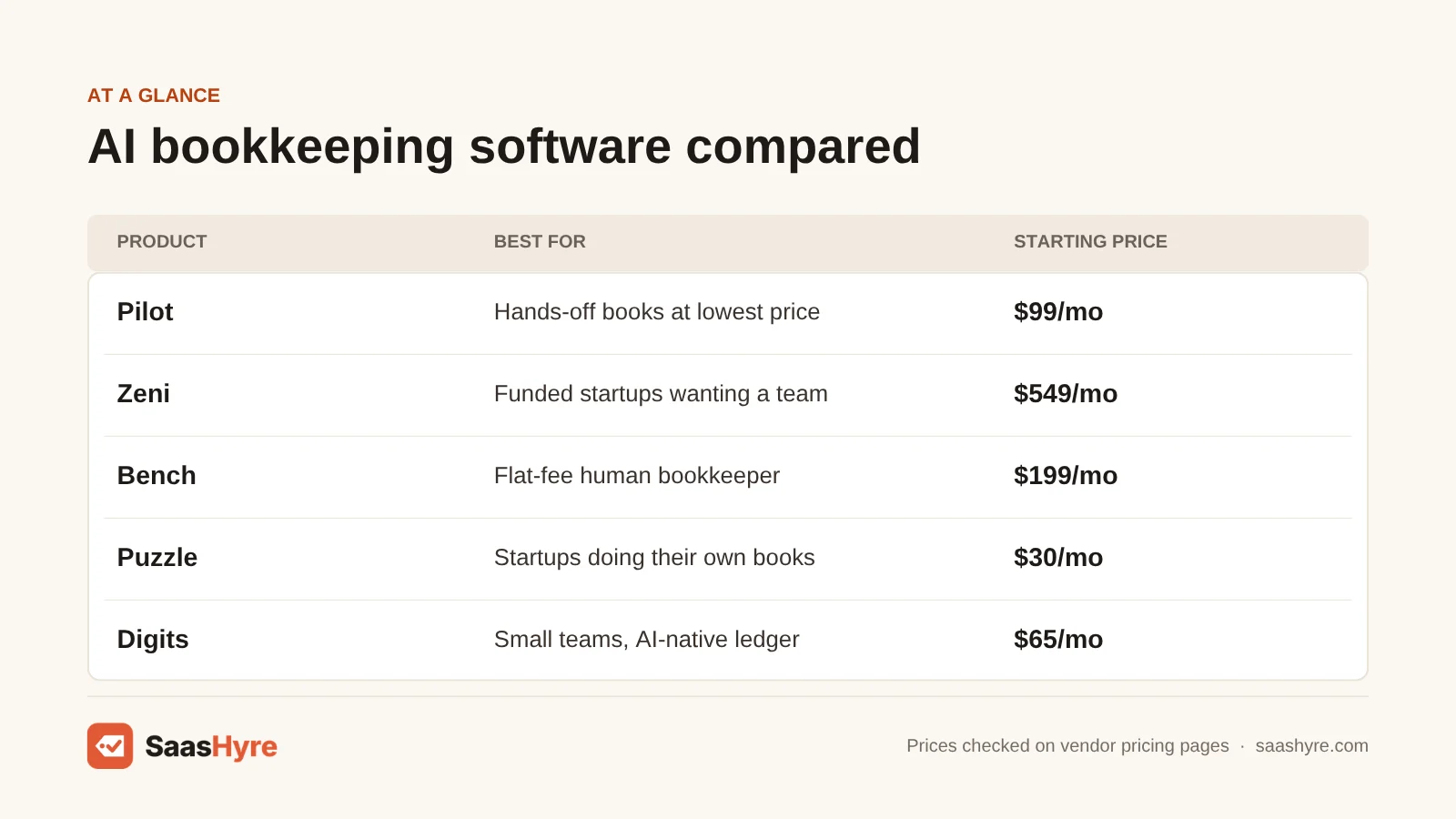
Quick Comparison: AI Bookkeeping Tools and Services
| Provider | Best for | Starting price | Billing model | Free trial or free plan |
|---|---|---|---|---|
| Pilot | Hands-off books at the lowest service price | $99/mo (Essentials, AI-only) | Flat to $100k monthly expenses; Core priced by expenses, billed annually | Not listed |
| Zeni | Funded startups that want a finance team | $549/mo ($494 billed annually) | Flat plan fee; Enterprise quoted by expenses and revenue | Not listed |
| Bench | Owners who want a human bookkeeper, flat fee | $199/mo (revenue up to $250k) | Flat plan fee; 20% off annual | Not listed |
| Puzzle | Startups doing their own books with AI | $30/mo (Starter) | Per plan; human review from $171/mo | Not listed |
| Digits | Small teams wanting an AI-native ledger | $65/mo (Essentials) | Per entity, unlimited users | 30-day trial |
| Kick | Very low volume or multi-entity DIY | $0 (250 transactions a year) | Per plan, $50/mo per extra entity after free tier | Free plan |
| Booke AI | Bookkeepers cleaning up QuickBooks Online | $129/mo per business | Per business; firm pricing on request | Not listed |
| Dext | Receipt and bill capture | $25.21/mo | Per account, sized by documents and users | Trial offered |
| Botkeeper | Accounting firms automating client books | $149 per license/mo | Per license, volume discounts | Not listed |
What AI Bookkeeping Actually Means
AI bookkeeping uses machine learning and language models to do your books. It imports bank and card transactions and sorts them into categories. It matches receipts, reconciles accounts and drafts monthly financial statements. It comes in two forms. One is software you review yourself. The other is a service where a vendor’s AI and staff close your books for a monthly fee.
Do you need invoicing, payroll and inventory in one ledger? Then you want accounting software instead, and our SaaS guides cover that. This guide asks a simpler question. Who turns your pile of transactions into a finished monthly close, and what does it cost?
Here is an easy way to sort your options:
- AI services (Pilot, Zeni, Bench). You connect your accounts, and they hand you closed books. Pilot Essentials is AI-only. The others include people.
- AI-native ledgers (Puzzle, Digits, Kick). This is a general ledger built around automation. You or your accountant does the review.
- AI layers for bookkeepers (Booke AI, Dext, Botkeeper). These tools run on top of QuickBooks or Xero. They cut the manual work for whoever keeps the books.
What AI Bookkeeping Really Costs at $10k and $100k in Monthly Expenses
If you spend $10,000 a month, DIY AI software costs $30 to $120 a month. A service with human review costs $171 to $549. At $100,000 a month, software stays around $100 to $360. Service prices either stay flat (Pilot Essentials, Zeni) or move to a custom quote. Catch-up work on old months is the fee that surprises people most.
Services charge based on your monthly expenses or revenue, not per user. Here are two example companies. One is a consultancy spending $10,000 a month. The other is a 12-person startup spending $100,000 a month.
| Option | Type | At $10k monthly expenses | At $100k monthly expenses | Who reviews the books |
|---|---|---|---|---|
| Kick Basic / Plus | DIY software | $40/mo | $40/mo (Plus $100 if you have several entities) | You |
| Digits Essentials / Core | DIY software | $65/mo | $100/mo (Core, for accrual schedules) | You or your accountant |
| Puzzle Complete / Scale | DIY software | $120/mo ($96 billed annually) | $120 to $360/mo | You, with AI accuracy review |
| Pilot Essentials | AI-only service | $99/mo | $99/mo (the $100k cap) | Pilot’s AI; cash basis only |
| Puzzle Core + Expert Reviewed | Software plus human review | $171/mo (up to $10k expenses) | Full Service, quote by expenses | Puzzle bookkeeper |
| Bench Bookkeeping Light / Bookkeeping | Human service | $199/mo (revenue up to $250k) | $399/mo | Bench bookkeeper |
| Pilot Core | AI plus human service | About $299/mo and up, billed annually | Priced on the expense slider | US-based Pilot bookkeeper |
| Zeni Starter / Growth | AI plus finance team | $549/mo (pre-revenue) | $799/mo, or Enterprise quote | Controller, manager and analyst |
A few notes on the table. Pilot’s Core price comes from a slider on its pricing page. When we checked, it showed $299 a month at $9,000 in monthly expenses. Zeni prices Enterprise on “bookkeeping complexity, monthly expenses, and annual revenue.” So if you spend $100k, you may get a quote above Growth.
Watch for two costs that never show up on the plan card:
- Catch-up fees. If you’re behind, someone has to rebuild those months. Puzzle lists catch-up bookkeeping from $300 per month of books. So six missed months starts at $1,800. Bench catches up the current year for free if you take an annual plan, and it quotes prior years. Pilot, Zeni, Digits and Kick don’t list a catch-up rate on their pricing pages. Get it in writing before you sign.
- Your time. DIY software is only cheap if the review is quick. Say you spend three hours a month fixing categories, and your time is worth $75 an hour. That is $225. Now a $40 tool costs about the same as Puzzle’s reviewed plan.
My rule of thumb is simple. If your books are cash basis with modest volume, go with DIY software. If you have investors, use accrual accounting or have a CPA who wants a finished close, go with a service.
What Makes the Best AI Bookkeeping Software?
The best AI bookkeeping software or service fits what your books really need. First, decide if you need cash or accrual books. Get a price for catch-up work before you sign. Read the expense or revenue caps on each plan. Check the billing term and how many entities you run. Last, make sure you can export your ledger and leave.
We used each provider’s pricing page and docs, checked in September 2026. We also used news coverage for company status. Investors and lenders usually want accrual statements. That rules out some low-cost plans. If you go over a cap, you can get moved up a tier in the middle of a contract. When Bench shut down in 2024, customers got days of notice, not months. So you need an exit plan.

Best AI Bookkeeping Services (Done for You)
Pilot Essentials is the cheapest hands-off option at $99 a month, but it is AI-only and cash basis. Pilot Core adds a US-based bookkeeper and accrual books. Zeni costs the most and gives you a full finance team plus banking. Bench still sells flat-fee human bookkeeping. Employer.com now owns it after its 2024 shutdown.
1 Pilot: Best for hands-off books at the lowest service price
If you want someone else to do the books for the least money, look at Pilot. It also has the widest price range here.
What it does well. Essentials uses AI to sort, reconcile and close your cash-basis books each month. It also gives you a year-end package for your tax preparer. Pilot announced this self-running “AI Accountant” in February 2026. Pilot said the AI flags big judgment calls so a person can decide.
Key features:
- Month-end close done by AI alone on Essentials
- A year-end package you hand to your tax preparer
- A US-based bookkeeper and accrual books on Core
- Up to 10 vendor bills a month, with reports by the 10th business day, on Core
- Custom plans with AP, AR, payroll admin and CFO support
Pricing. Essentials costs $99 a month if you spend up to $100,000 a month. Core is billed yearly and priced by your monthly expenses. Tax is extra. It starts at $1,000 a year for a single-member LLC and $2,450 for a C-corp. See Pilot pricing.
Best for: You, if you want someone else to close the books. Pick Essentials for simple needs and Core if investors will read your numbers.
Limitations. Essentials is AI-only and cash basis only. If you need accrual books on a tight budget, it won’t work for you.
2 Zeni: Best for funded startups that want a finance team
Zeni costs the most. In return, you get a full finance team plus banking.
What it does well. Zeni pairs AI bookkeeping with a named team. You get a controller, a bookkeeping manager and an analyst. Every plan includes AI bill pay, reimbursements and Zeni business checking.
Key features:
- A named controller, bookkeeping manager and analyst
- AI bill pay
- Reimbursements
- Zeni business checking
- Fractional CFO tier
Pricing. Starter costs $549 a month ($494 billed yearly) for companies with no revenue yet. Growth costs $799 ($719 yearly) for companies making money. Tax filing starts at $2,499 a year. The fractional CFO tier starts at $1,599 a month plus a $2,000 setup fee. See Zeni pricing.
Best for: You, if your startup has raised money and you want bookkeeping, banking and a finance team from one company.
Limitations. The extras add up. Zeni doesn’t list a catch-up rate, so ask. If you spend under $20,000 a month, paying about $5,900 a year or more is a lot for simple books.
3 Bench: Best for owners who want a human bookkeeper for a flat fee
Want a flat fee and a real person doing your books? Bench still offers that. Employer.com now owns it.
What it does well. You pay a flat fee and get a person you can message. Catch-up for the current year is free with an annual plan.
Key features:
- A human bookkeeper you can message
- Flat monthly fee
- Free catch-up for the current year on annual plans
- Bookkeeping + Tax plan
Pricing. Bookkeeping Light costs $199 a month if your business makes $250,000 or less a year. Bookkeeping costs $399, and Bookkeeping + Tax costs $649. Paying yearly saves 20%. See Bench pricing.
Best for: You, if you want a flat fee and a human bookkeeper.
Limitations. Bench shut down without warning on December 27, 2024. Employer.com bought it three days later. It started up again in January 2025 as part of Employer.com. Its pricing page doesn’t mention AI. So we list it as a price benchmark, not for automation. If the shutdown worries you, export your books every quarter. That is a smart habit with any provider.
Best AI Bookkeeping Software You Run Yourself
Puzzle is the best AI bookkeeping software for startups that want accrual books now and the option of human review later. Digits gives you unlimited users on an AI-native ledger from $65 a month. Kick is the cheapest way to start. It is free for 250 transactions a year and adds support for many entities at $100 a month.
4 Puzzle: Best for startups doing their own books with AI
Puzzle is a general ledger built for startups. It gives you accrual books now and lets you add human review later.
What it does well. The best part is how you can move up. Core + Expert Reviewed adds a bookkeeper who reviews and closes your month. Puzzle claims up to 98% auto-categorization. That is the vendor’s number, not something we measured.
Key features:
- An accrual general ledger
- Support for more than one entity from Core up
- Reconciliations and revenue recognition on Complete
- AI credits included
- Optional bookkeeper review and close
Pricing. Starter costs $30 a month with one seat. Core costs $72 with five seats and support for more than one entity. Complete costs $120 with unlimited seats, reconciliations, revenue recognition and 100 AI credits a month. Scale costs $360. Paying yearly saves 20%. Core + Expert Reviewed costs $171 a month if you spend up to $10,000 a month. See Puzzle pricing.
Best for: You, if you run a startup and want accrual books now with a path to human help later.
Limitations. Starter and Core come with 25 AI credits for life, not per month. Do you want someone accountable from day one, and do you spend over $10,000 a month? The reviewed plan stops at that limit, and Full Service is priced by quote.
5 Digits: Best for small teams wanting an AI-native ledger
Digits calls itself an AI-native ledger. It says its AI does bookkeeping and reconciliation 24/7.
What it does well. Essentials covers core accounting, bank connections, bill pay, invoicing and the “Ask Digits” assistant. Core adds dimensional accounting and automatic schedules. You pay no seat or setup fees.
Key features:
- AI bookkeeping and reconciliation, 24/7
- Ask Digits, an assistant you talk to in plain English
- Bill pay and invoicing
- Dimensional accounting and automatic schedules on Core
- Unlimited users
Pricing. Essentials costs $65 a month. Core costs $100. Pro ($250) said “coming soon” when we checked. You pay no seat or setup fees, and you get a 30-day trial. See Digits pricing.
Best for: You, if several people on your team need to see live numbers and ask questions in plain English.
Limitations. You need one subscription for each entity. If you run five entities, five subscriptions at $100 cost more than one Kick Plus plan.
6 Kick: Best for very low volume or multi-entity DIY
Kick sells “self-driving bookkeeping” with no human service. It is also the cheapest way to start.
What it does well. The free plan covers auto-categorization, receipt matching, P&L and balance sheet. Basic adds reconciliation plus MCP and CLI access for AI agents. Plus adds unlimited entities, classes, AR and AP automation and an accrual ledger.
Key features:
- Auto-categorization and receipt matching
- Auto-categorization plus receipt matching
- MCP and CLI access for AI agents, from Basic up
- Unlimited entities and an accrual ledger on Plus
- AR and AP automation on Plus
Pricing. The free plan covers 250 transactions a year. Basic ($40) removes that limit. Plus costs $100. See Kick pricing.
Best for: You, if you freelance, run a side business or own a holding company with many small entities.
Limitations. There is no human service. If you want anyone but you to own the result, skip it.
Best AI Tools for Bookkeepers and Accounting Firms
Already keep books in QuickBooks Online or Xero? Then you don’t need a new ledger. Booke AI sorts transactions and chases missing receipts for $129 per business a month. Dext captures receipts and bills from $25.21 a month. Botkeeper is sold only to accounting firms, from $149 per license.
7 Booke AI: Best for bookkeepers cleaning up QuickBooks Online
Booke AI sorts your transactions and chases missing receipts. It works on top of the ledger you already use.
What it does well. It sorts your bank feed every day and matches documents. It sends clients automatic requests for missing receipts. It also supports custom rules and exception review with an audit trail.
Key features:
- Daily bank feed categorization
- Document matching
- Automatic requests to clients for missing receipts
- Custom rules
- Exception review, with an audit trail
Pricing. The US business plan costs $129 a month per business. Firm pricing, with white-labeling, is by request. See Booke AI pricing.
Best for: You, if you’re a bookkeeper who is tired of chasing clients for receipts.
Limitations. The US pricing page lists QuickBooks Online as the supported platform. If you use Xero in the US, confirm support first.
8 Dext: Best for receipt and bill capture
Dext is a pre-accounting tool. It reads receipts, bills and statements and sends accurate data into your ledger.
What it does well. It turns paper and PDF documents into ledger-ready data. You can resize your plan with a slider as your document count changes.
Key features:
- Captures receipts, bills and statements
- Sends accurate data into your ledger
- AI Assist add-on
- Line-item extraction add-on
Pricing. The US business plan starts at $25.21 a month for 250 documents and 5 users. A slider lets you resize it. AI Assist is a $10.50 monthly add-on. Line-item extraction costs from $20.50 a month or $0.50 a document. See Dext pricing.
Best for: You, if paper and PDF bills are what slows you down.
Limitations. If most of your spending is card transactions your ledger already imports, it adds little.
9 Botkeeper: Best for accounting firms automating client books
Botkeeper only sells to accounting firms.
What it does well. Each license manages client entities. Volume discounts cut the cost per license a lot for bigger firms.
Key features:
- Sold only to accounting firms
- Each license manages client entities
- Volume discounts
Pricing. A license costs $149 a month if you buy 1 to 4. The price drops to $59 each at 25 or more ($53 billed yearly). See Botkeeper pricing.
Best for: You, if your firm wants each bookkeeper to handle more clients.
Limitations. Annual plans lock you in for a full year. Business owners can’t buy it.
How to Choose AI Bookkeeping: Six Checks Before You Sign

- Cash or accrual? Do investors or a lender want accrual statements? Then Pilot Essentials and Kick Free and Basic are out. For accrual, you need Pilot Core, Puzzle, Digits Core, Kick Plus or Zeni.
- Price the catch-up first. Six months behind at $300 per month of books is $1,800. You pay that before your first normal bill. Ask for a flat quote in writing.
- Read the expense or revenue cap. Pilot Essentials stops at $100,000 a month. Puzzle’s reviewed plan stops at $10,000. Bench Light stops at $250,000 in revenue a year. Go over one, and you move up a tier in the middle of your contract.
- Check the billing term. Pilot Core and Botkeeper annual plans lock you in for a year. Monthly billing costs more, but you can leave.
- Count entities. Digits charges per entity. Kick charges $50 a month for each extra entity after the free tier. Puzzle Core includes more than one entity.
- Plan your exit. Ask how to export the ledger and if you get to keep a QuickBooks file. When Bench shut down in 2024, customers got days of notice, not months.
How We Evaluated
We used each provider’s pricing page and docs, checked in September 2026. We also used news coverage for company status, like Bench’s shutdown and Pilot’s AI Accountant launch. We did not run our own bookkeeping tests or accuracy benchmarks. So we label accuracy figures as vendor claims. No provider pays for placement or ranking. Read our editorial policy to see how we pick and update guides.
The Bottom Line
Are your books simple and cash basis, with no one on staff to do them? Then Pilot Essentials at $99 a month is the best-value AI bookkeeping service. Need accrual books and a person to sign off? Compare Pilot Core, Puzzle’s Expert Reviewed plan and Bench on price at your spending level. If you run a funded startup and want a full finance team, look at Zeni. If you do it yourself, Puzzle, Digits and Kick serve you well at $40 to $120 a month. If you’re a QuickBooks Online bookkeeper, pick Booke AI and Dext.
Frequently Asked Questions
What is the best AI bookkeeping software?
For most small businesses, Puzzle is the best AI bookkeeping software you run yourself. Plans start at $30 a month, and bookkeeper review starts at $171. Want the work done for you? Pilot Essentials is the cheapest AI service at $99 a month, if you spend up to $100,000 a month. If you’re a bookkeeper on QuickBooks Online, look at Booke AI.
Can AI replace a bookkeeper?
For simple cash-basis books, mostly yes. Pilot Essentials runs on AI alone, and Kick is built for self-driving bookkeeping. But some work still needs a person to review it. That includes accrual accounting, revenue recognition, odd transactions and anything tied to taxes. Even Pilot says its AI Accountant hands big judgment calls to a person before it goes on. That is the right way to build it.
How much does AI bookkeeping cost per month?
DIY AI bookkeeping software costs $0 to $360 a month. Kick is free for 250 transactions a year. Digits starts at $65, and Puzzle runs from $30 to $360. Services cost more. Pilot Essentials is $99 and Puzzle’s reviewed plan is $171. Bench is $199 to $399, and Zeni is $549 to $799. Bigger companies get quotes based on their expenses.
What are the best AI tools for bookkeepers?
If you’re a bookkeeper, you get the most from tools that run on top of your client’s current ledger. Booke AI sorts transactions and sends missing-receipt requests in QuickBooks Online for $129 per business a month. Dext captures bills and receipts from $25.21 a month. If your accounting firm is growing its client work, you can license Botkeeper from $149. That drops to $59 per license at volume.
Is Bench still in business?
Yes. Bench shut down suddenly on December 27, 2024. Employer.com bought it three days later, and it started up again in January 2025. It now sells human bookkeeping from $199 a month if your business makes up to $250,000 a year. Its pricing page doesn’t mention AI, so treat it as a traditional service.
How much does catch-up bookkeeping cost?
Catch-up pricing varies more than monthly pricing. Puzzle lists catch-up bookkeeping from $300 per month of books. Bench catches up the current year for free when you sign an annual plan, and it quotes prior years. Pilot, Zeni, Digits and Kick don’t publish a catch-up rate. So get a flat quote in writing before you sign any monthly plan.