
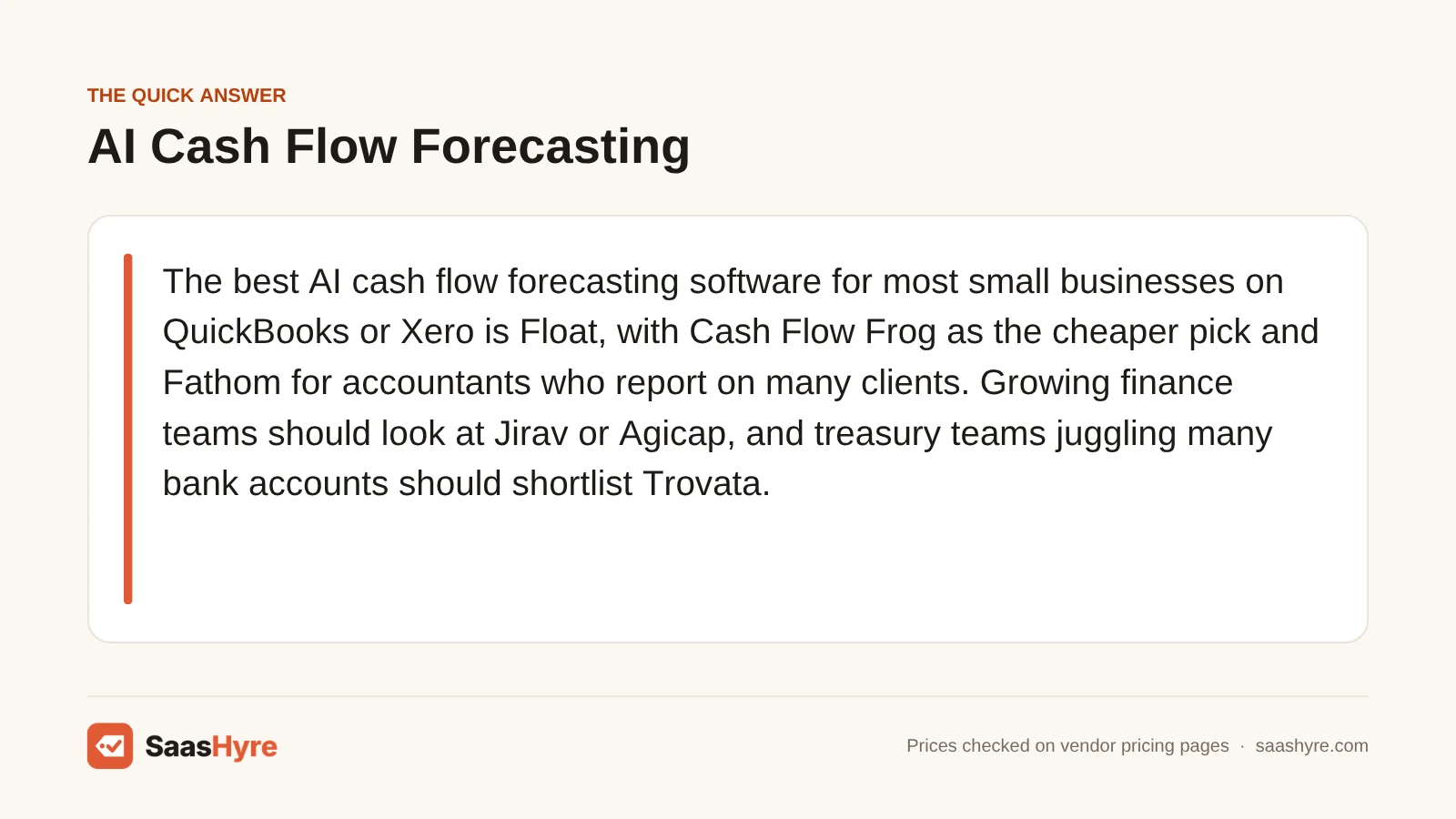
If you run a small business on QuickBooks or Xero, Float is the best AI cash flow forecasting software for most of you. Cash Flow Frog is the cheaper pick. Fathom suits accountants who report on many clients. Growing finance teams should look at Jirav or Agicap. Treasury teams with many bank accounts should shortlist Trovata.
Here is my advice before you compare anything. Don’t get hung up on the “AI” label. Ask one question first. Does the tool connect well to the accounting system you already use? A forecast is only as good as the invoices, bills and bank data behind it. And several tools here only work with QuickBooks and Xero.
I pulled every price below from each vendor’s own pricing page in September 2026. Several mid-market tools don’t publish prices at all. When that happens, I tell you so instead of guessing.
For the rest of your tools, start with our guide to the best business software for small business.
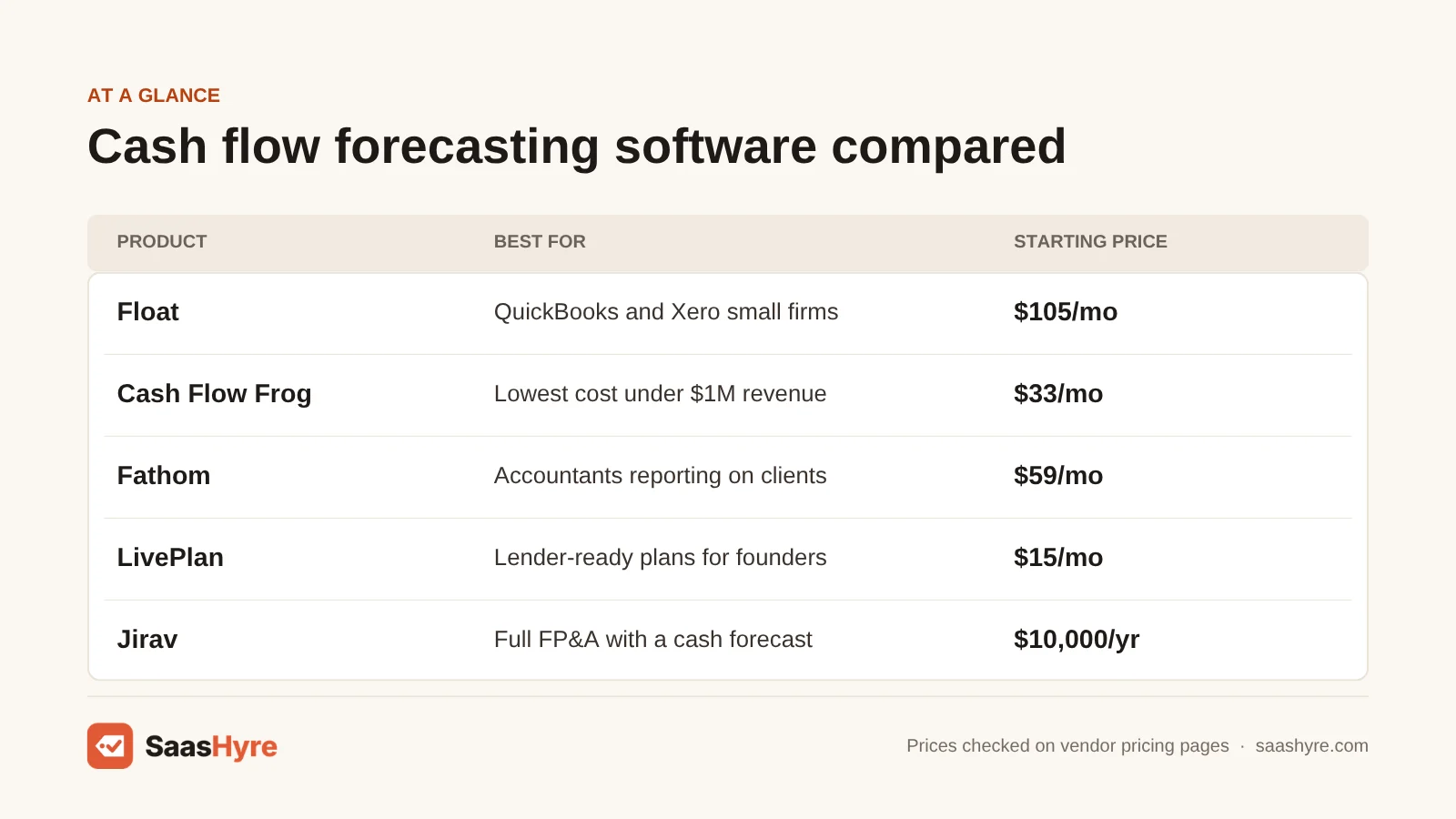
Quick Comparison: Cash Flow Forecasting Software at a Glance
| Provider | Best for | Starting price | Billing model | Free trial |
|---|---|---|---|---|
| Float | QuickBooks and Xero small businesses | $105/mo billed annually ($130 monthly) | Flat fee by revenue band, unlimited users | 14 days, no card |
| Cash Flow Frog | Lowest cost for firms under $1M revenue | $33/mo billed yearly ($55 monthly) | Revenue tiers, up to 10 users | Yes, plus 30-day money-back |
| Fathom | Accountants and multi-company reporting | $59/mo for 1 company | Per company file, unlimited users | 14 days |
| LivePlan | Founders who need a lender-ready plan | $15/mo billed annually ($20 monthly) | Per company, unlimited contributors | 35-day money-back guarantee |
| Jirav | Full FP&A with a cash forecast built in | $10,000/yr (Starter) | Annual contract, demo required | Demo only |
| Agicap | Mid-market and multi-entity groups | Quote only | Annual, 12-month minimum | Short guided test |
| Centime | 13-week forecast tied to AP and AR | Quote only (forecasting bundled with AP or AR) | Based on invoice and payment volume | Demo only |
| Trovata | Treasury teams with direct bank feeds | $24,000/yr (Base package) | Annual, scales by banks, accounts and users | Demo only |
What AI Cash Flow Forecasting Software Actually Does
AI cash flow forecasting software pulls your invoices, bills and bank transactions from your accounting system. It predicts when money will really move. Then it rebuilds your future cash position each time the data changes. In most tools, the “AI” part is not a crystal ball. It predicts when customers will pay based on how they paid before. It also spots income and costs that repeat.
You are buying three things. First, a live link to your books and bank. Second, a model that turns that data into a cash projection. Third, a scenario tool for questions like “what if we hire two people in March?” Some tools are simple cash views for owners. Others are planning platforms where cash is one output of a three-statement model. You can find the rest of our software guides in the SaaS hub.
What Cash Flow Forecasting Really Costs at Each Stage
If you run a small business on QuickBooks or Xero, you can get a basic forecast for nothing extra. A dedicated tool costs roughly $400 to $1,600 a year. A mid-market platform costs $10,000 to $24,000 a year or more. The price jumps when you need to combine several entities, connect straight to bank APIs or run a full FP&A model with budgets and headcount.
Start with what you already pay for. QuickBooks Online includes a cash flow planner on Simple Start, Essentials, Plus and Advanced. Intuit says it uses machine learning to predict when customers will pay. It looks at the invoice amount, whether the customer viewed the invoice and past payments. The catch is that it won’t work if you have multicurrency turned on. Xero includes a short-term cash flow projection on every plan. How far ahead it looks depends on your plan. You get 30 days on Early ($27/mo), 60 days on Growing ($59/mo) and 180 days on Established ($97/mo). Those prices are before any promo discount.
Maybe you only need to know “can I make payroll in three weeks?” Then the built-in view may be enough. Do you need scenarios, a 13-week view to share with a lender or a 12 to 36 month runway? Then you need a dedicated tool. Here is what that costs at list price.
| Your situation | Cheapest sensible option | Step-up option | Rough yearly cost |
|---|---|---|---|
| Owner-run business under $1M revenue on QuickBooks or Xero | Built-in QuickBooks planner or Xero projection | Cash Flow Frog Tier 1, yearly billing | $0 extra, or $396/yr |
| Small business needing scenarios and a 13-week view (under £2M revenue) | LivePlan Premium, annual | Float Essentials, annual | $360/yr or $1,260/yr |
| Growing company over £2M revenue, one entity | Float Growth, annual | Jirav Starter | $2,580/yr or $10,000/yr |
| Group with 5 entities | Fathom Starter (5 company files) | Float Scale, annual | $3,540/yr or $3,780/yr |
| Treasury team with many banks and accounts | Trovata Base package | Agicap, Kyriba or a full treasury system | $24,000/yr, or quote only |
Look at what the extra money buys you. Jirav’s lowest plan costs about four times Float Growth. That gap pays for budgets and department planning, not a better cash forecast. Per-company pricing also adds up. If you are an accountant with 10 clients, compare Fathom Silver at $315/mo. Don’t pay $590 on Starter.
What Makes the Best AI Cash Flow Forecasting Software?
The best AI cash flow forecasting software connects well to the accounting system you already use. Its price should be fair for your revenue level and number of entities. The contract should let you leave if the forecast doesn’t help. Most of all, it should stay accurate on your own messy data, not just a polished demo.
We compared each product using its own pricing page and help docs, checked in September 2026. Start with integration. If your books aren’t supported, nothing else matters. Pricing based on revenue or entities can jump at renewal or as you add companies. Here is my tip. Before you pay, run the free QuickBooks planner or Xero projection for a month. It may already answer your questions.
Best Cash Flow Forecasting Software for QuickBooks and Xero Small Businesses
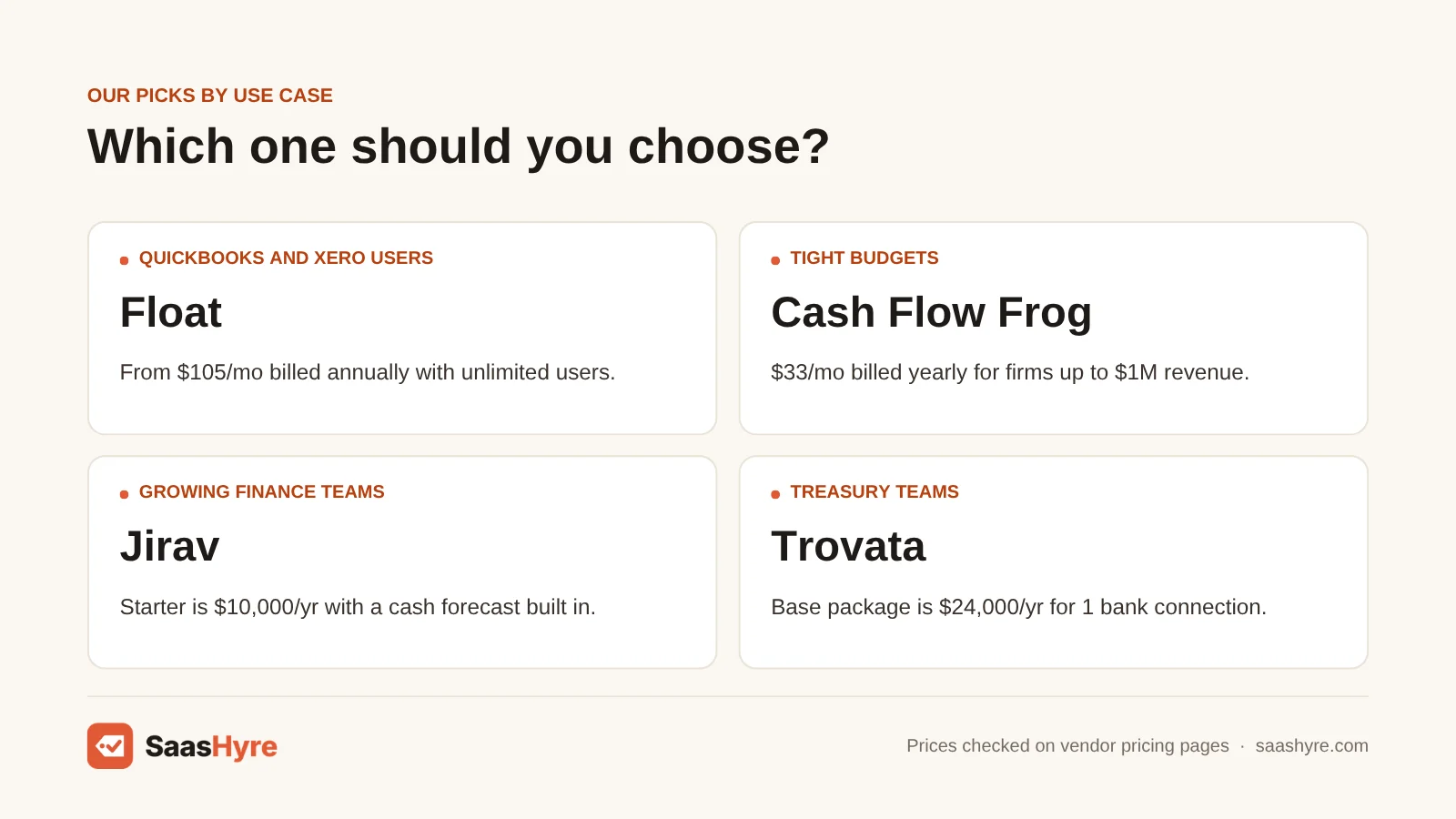
If you run your books in QuickBooks Online or Xero, Float is the strongest all-round cash tool for your small business. Cash Flow Frog is the cheapest way to get a 36-month forecast. Fathom suits accountants who report across many clients. LivePlan fits founders who need a full business plan for a lender.
1 Float: Best for QuickBooks and Xero small businesses
If you are on QuickBooks Online or Xero, Float is the strongest all-round cash tool for your small business.
What it does well. Float does one job. It shows your cash week by week and lets you test scenarios on top. You pay a flat price per company, and you get unlimited users. The forecast runs on your invoices, bills and assumptions.
Key features:
- A 13-week view of your cash flow
- 8 scenarios included on every plan
- Forecasts up to 36 months ahead on Growth
- Combine several entities into one view on Scale
- As many users as you want
Pricing. Your plan depends on your revenue. Float reads it from your last full financial year in your accounting software. Essentials is $105/mo billed annually or $130 monthly. It is for companies below £2M revenue and gives 12-month forecasts. Guided onboarding is an optional £99 one-time fee. Growth is $215/mo annually or $265 monthly for companies above £2M. Onboarding is included. Scale is $315/mo annually or $389 monthly for up to 5 entities. Each extra entity then costs $63/mo on annual billing ($78 monthly). You get a 14-day trial with no card.
Best for: You, if you run a small business on QuickBooks Online or Xero and want a visual cash forecast your team can share.
Limitations. Float only connects to Xero and QuickBooks Online. Sage Intacct is on a waitlist. Its pricing page doesn’t mention machine learning. You can’t get a refund on annual plans after 30 days. Skip it if you use QuickBooks Desktop, Sage or NetSuite. Skip it too if you want a full budget and P&L planning model.
2 Cash Flow Frog: Best for the lowest cost for firms under $1M revenue
Want the cheapest way to get a 36-month forecast? Cash Flow Frog is the budget pick.
What it does well. It connects to more small-business tools than anything else here. That means QuickBooks Online and Desktop, Xero, Zoho Books, FreshBooks, Odoo and Excel. It also pulls bank data through Plaid.
Key features:
- Forecasts as far as 36 months ahead
- Plan for “what if” scenarios
- Up to 10 users
- Works with many accounting tools, including QuickBooks Desktop
- Pulls bank data through Plaid
Pricing. Pro Tier 1 covers businesses with up to $1M in yearly revenue. It costs $55/mo billed monthly or $33/mo billed yearly. Above $1M, a revenue calculator sets your price. You get a free trial with no card and a 30-day money-back guarantee.
Best for: You, if you want the lowest yearly cost or you use QuickBooks Desktop, Zoho Books or FreshBooks.
Limitations. The pricing page doesn’t describe any AI features. If clearly explained AI matters to you, skip it.
3 Fathom: Best for accountants and multi-company reporting
Fathom is a reporting and three-way forecasting tool made for accountants and advisory firms.
What it does well. It forecasts your P&L, balance sheet and cash together. Every plan comes with every feature, unlimited users and free consolidated groups. Fathom is now owned by The Access Group, a UK software company.
Key features:
- Three-way forecasts that cover your P&L, balance sheet and cash
- Management reports
- Unlimited users
- Consolidated groups at no extra cost
Pricing. You pay per company file. Starter is $59/mo for 1 company, plus $59 for each extra one. Silver is $315/mo for 10 companies. Gold is $450/mo for 25. Platinum is $805/mo for 50. Extra companies get cheaper at each tier ($31, $17 and $13). You get a 14-day trial and no minimum term.
Best for: You, if you are an accountant, bookkeeper or fractional CFO who makes forecasts and management reports for several clients.
Limitations. Do you run one business and just want a weekly cash view? Then Float or Cash Flow Frog will be simpler for you.
4 LivePlan: Best for founders who need a lender-ready plan
LivePlan is business planning software first. It is also the cheapest paid option here.
What it does well. Standard gives you a full financial forecast, statements ready for a lender and what-if scenarios. It works with QuickBooks and Xero. Premium adds automatic financial analysis. It also adds profit and cash forecasts that update on their own.
Key features:
- Full financial forecast
- Statements ready to hand a lender
- What-if scenarios
- Works with QuickBooks and Xero
- On Premium, automatic analysis and forecasts that update on their own
Pricing. Standard costs $15/mo billed annually or $20 monthly. Premium is $30/mo annually or $40 monthly. There is no trial. You get a 35-day money-back guarantee instead.
Best for: You, if you are a founder applying for a loan or pitching investors and you want your plan and forecast in one place.
Limitations. It is built around monthly planning. So it won’t give you a day-by-day or week-by-week cash view.
Best Cash Flow Forecasting Platforms for Growing and Multi-Entity Finance Teams
Once you have a finance team, several entities or an ERP like NetSuite or Sage Intacct, the small-business tools stop fitting. Pick Jirav if you want a full planning model with cash built in. Pick Agicap for group-level cash across many banks. Pick Centime if you also want AP and AR automation.
5 Jirav: Best for full FP&A with a cash forecast built in
Jirav is FP&A software. It is one of the few mid-market tools that shows its business prices.
What it does well. It covers budgets, department plans and dashboards. It also links balance sheet and cash flow projections together. It has a feature called “Intelligent Auto-Forecast.” Every plan includes guided setup and unlimited read-only sharing.
Key features:
- Budgets and department plans
- Balance sheet and cash flow projections linked together
- Intelligent Auto-Forecast
- Guided implementation
- Unlimited read-only sharing
Pricing. Starter is $10,000/yr. It covers company-level planning, 2 active plans and 2 admin or editor users. Pro is $15,000/yr for up to 5 departments, 3 active plans and 5 admin or editor users. Enterprise is quote only, with up to 15 departments and 15 admin or editor users. Accounting firms get separate wholesale pricing from $50/mo. That is why you see such different Jirav prices around the web.
Best for: You, if your finance team wants budgets, headcount planning and the cash forecast in one linked model.
Limitations. You sign an annual contract, and you must take a demo first. If you only want to see your cash, it is more than you need.
6 Agicap: Best for mid-market and multi-entity groups
Agicap is a cash management platform for mid-market companies and groups.
What it does well. It pulls many banks and entities into one view. You can switch between group cash and cash for each entity. It offers a 13-week forecast. Agicap says it connects to more than 300 banks and more than 150 accounting and finance software packages.
Key features:
- Cash views for the whole group or each entity
- 13-week forecast
- Connects to more than 300 banks (per Agicap)
- Works with more than 150 accounting and finance tools (per Agicap)
Pricing. Agicap doesn’t publish prices. It says the offer is annual with a 12-month minimum. You get a quote after a demo.
Best for: You, if you run several entities or bank accounts across countries and want one view of your group’s cash.
Limitations. You commit for a year before you really get to use the forecast. So push for a test on your own data. If you are one small company, the 12-month commitment and quote process are too much.
7 Centime: Best for a 13-week forecast tied to AP and AR
Centime combines cash forecasting with tools that automate your payables and receivables.
What it does well. Its forecast is a rolling 13-week view. Centime says it uses AI-driven predictions that learn over time. You can drill down by customer, supplier or cash flow group. It also runs bill pay and collections. So the forecast sees upcoming payments before they hit your books.
Key features:
- Rolling 13-week forecast
- AI-driven predictions (vendor description)
- Drill down by customer, supplier or cash flow group
- AP and AR automation
- Works with QuickBooks, NetSuite and Sage Intacct
Pricing. You can’t buy the forecast by itself. It comes with an AP or AR plan priced by how many invoices and payments you process. No prices are listed.
Best for: You, if you also want to automate bill pay and collections.
Limitations. If you only want forecasting, look elsewhere.
Best Cash Forecasting Software for Treasury Teams
If your treasury team manages dozens or hundreds of bank accounts, you need direct bank links and cash positioning, not a small-business forecast. Trovata is the rare treasury platform with a public starting price. Kyriba and HighRadius are enterprise suites sold only by quote.
8 Trovata: Best for treasury teams with direct bank feeds
Trovata is one of the few treasury platforms that shows a starting price.
What it does well. It connects straight to banks through APIs. On top of that, it adds cash positioning, reconciliation, payments and forecasting based on machine learning.
Key features:
- Connects straight to bank APIs
- Cash positioning
- Reconciliation and payments
- Machine learning-based forecasting
- Trovata AI and API access
Pricing. The Base package costs $24,000/yr. That covers 1 bank connection, up to 100 accounts, 10 users, Trovata AI and API access. Sales prices any extra banks and users. The full Trovata TMS is quote only. Most ERP integrations cost extra as add-ons.
Best for: You, if your team’s big headache is pulling balances and transactions from many bank accounts every morning.
Limitations. Do you bank with just one or two banks? Then tools that connect to your accounting system cost a small part of this.
9 Kyriba and HighRadius: Best for enterprise treasury suites
Kyriba and HighRadius are enterprise treasury and receivables suites. Both have AI cash forecasting modules.
What it does well. Both are made for large companies with their own treasury team. They link cash forecasting to your ERP and banks.
Key features:
- AI cash forecasting modules
- Treasury and receivables suites
- Setup tied to your ERP and banks
Pricing. Neither one publishes prices.
Best for: You, if your company runs a large ERP and has its own treasury team.
Limitations. Both are sold as big enterprise projects, not sign-up-yourself plans. Only shortlist them if you fit that enterprise profile.
How to Choose Cash Flow Forecasting Software: 6 Checks Before You Pay
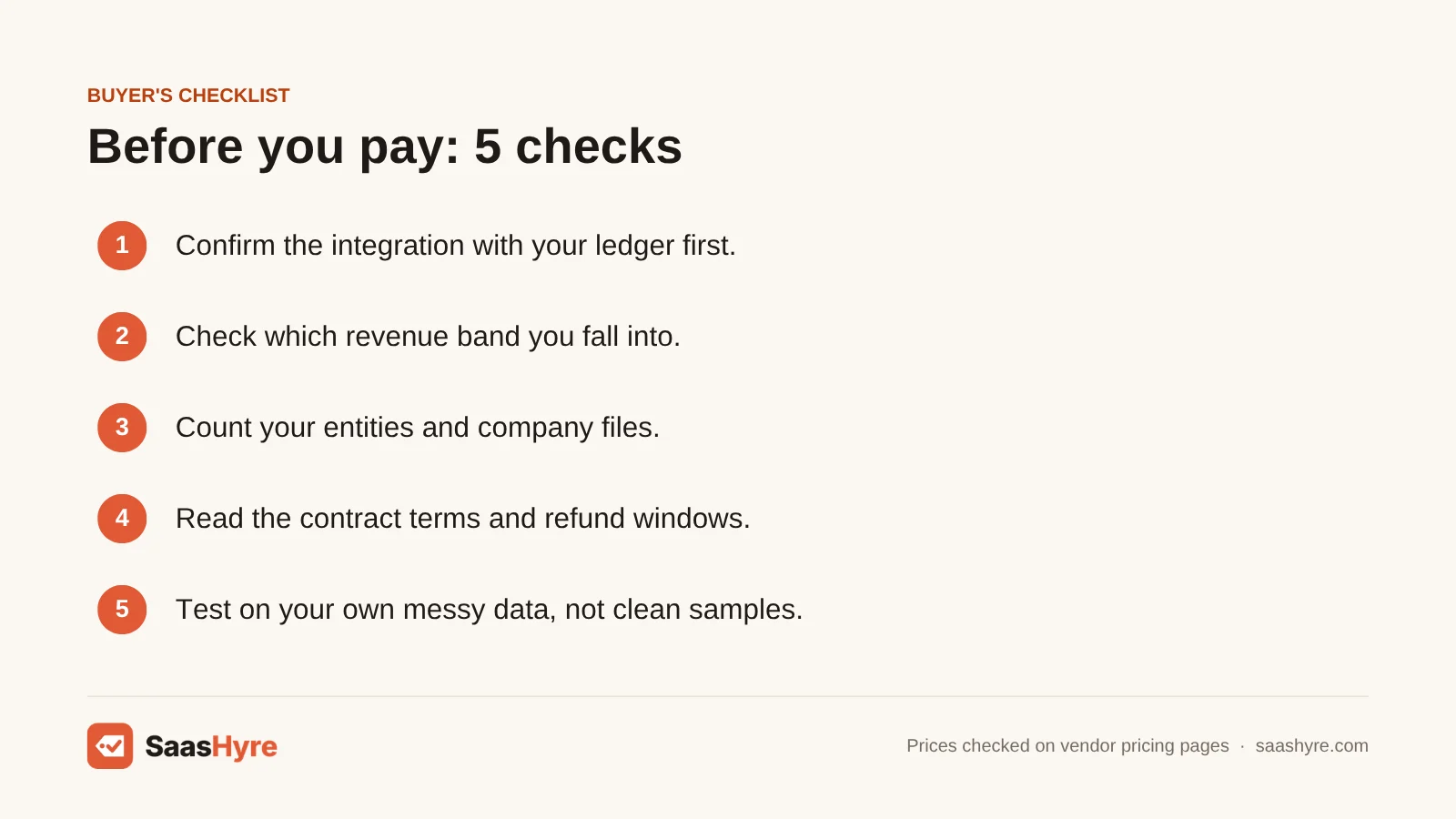
- Confirm the integration first. Float connects to Xero and QuickBooks Online only. Cash Flow Frog adds QuickBooks Desktop, Zoho Books and FreshBooks. Centime needs QuickBooks, NetSuite or Sage Intacct. If your accounting system isn’t on the list, stop there.
- Check which revenue band you fall into. Float and Cash Flow Frog both set prices by revenue. Float reads it from your last full financial year. So a strong year can move you from $105 to $215 a month at renewal.
- Count your entities and company files. Some tools charge per entity or per company (Float Scale, Fathom). That is cheap for one company. It adds up fast for five or ten.
- Read the contract terms. Agicap requires a 12-month minimum. You can’t get a refund on Float’s annual plans after 30 days. Jirav and Trovata are priced per year. Fathom, Cash Flow Frog, LivePlan and Float all let you pay monthly.
- Test on your own messy data. A demo on neat sample data tells you nothing about how accurate it will be with your late payers.
- Try what you already own. Give the QuickBooks planner or Xero projection a month first. Does it answer your questions? Then you can skip the subscription.
How We Evaluated
We compared each product using its own pricing page and product docs, checked in September 2026. We also read the top-ranking guides on this topic. We did not run our own accuracy tests. Any claims about accuracy or AI come from the vendors. No provider pays for placement or ranking. Read more in our editorial policy.
The Bottom Line
If you run a small business on QuickBooks Online or Xero, start with the free built-in forecast. Move to Float when you need scenarios and a 13-week view you can share. Pick Cash Flow Frog if cost matters most or you use QuickBooks Desktop, Zoho Books or FreshBooks. Pick Fathom if you forecast for many clients. If your growing finance team wants a full planning model, look at Jirav. If you run a group with many entities, get quotes from Agicap and Centime. Only treasury teams with many bank accounts need Trovata or an enterprise suite.
Frequently Asked Questions
What is AI cash flow forecasting?
AI cash flow forecasting uses your accounting and bank data to predict your future cash balances on its own. The AI part usually predicts when customers will pay, based on how they paid before. It also spots income and costs that repeat. The forecast updates as new invoices, bills and transactions come in. So you never rebuild a spreadsheet. But accuracy still depends on keeping your books up to date.
Can QuickBooks or Xero forecast cash flow on their own?
Yes, at a basic level. QuickBooks Online includes a cash flow planner on its main plans. Intuit says it uses machine learning to predict invoice payments. But it won’t work with multicurrency turned on. Xero includes a short-term projection of 30, 60 or 180 days, based on your plan. Dedicated tools add scenarios, longer time frames and 13-week views you can share.
How much does cash flow forecasting software cost?
Small-business tools cost about $33 to $265 a month at list price. Cash Flow Frog starts at $33/mo billed yearly. Fathom starts at $59/mo. Float starts at $105/mo billed annually. Mid-market platforms cost far more. Jirav starts at $10,000 a year and Trovata at $24,000 a year. Agicap, Centime, Kyriba and HighRadius are quote only.
What is a 13-week cash flow forecast?
A 13-week cash flow forecast shows your cash coming in and going out, week by week, for one quarter. Lenders, boards and finance teams use this standard short-term view to spot shortfalls early. Float, Agicap and Centime all offer a 13-week view. Centime keeps it rolling, so it always looks 13 weeks ahead.
Is Excel good enough for cash flow forecasting?
Excel works for a simple monthly forecast if one person keeps it updated. It falls apart when you need a weekly view, several scenarios, many entities or live data from your accounting system. The hidden cost is your time, because every update is manual. Does keeping the sheet up to date eat a few hours a week? Then a $33 to $130 a month tool is usually cheaper.
Which cash flow forecasting software works best with Xero and QuickBooks?
Float, Fathom and Cash Flow Frog all connect directly to Xero and QuickBooks Online. Float is the most focused on cash. Fathom adds three-way forecasting and management reports for many companies. Cash Flow Frog also works with QuickBooks Desktop. LivePlan and Jirav work with both too, but they are planning tools first.