

The best dynamic pricing tool depends on what you sell. Small online stores watching competitors should pick Prisync. Amazon and Walmart sellers should pick Repricer.com or Aura. Short-term rental hosts should pick PriceLabs. Large B2B pricing teams should look at Pricefx or PROS. Omnia Retail and Competera fit bigger retailers.

Here is my advice before you compare anything. Look at how each tool bills you. Some charge per SKU or per rental listing. Some take a share of your revenue. Some only give quotes. The same tool can be a bargain for one business and a costly habit for another. So the cost tables below matter more than the feature lists.
I took every price here from the vendor’s own pricing page in September 2026. If a vendor does not publish a price, we say so. We don’t guess.
For the rest of your tools, start with our guide to the best business software for small business.
Quick Comparison: Dynamic Pricing Software at a Glance
| Tool | Best for | Starting price | Billing model | Free trial |
|---|---|---|---|---|
| Prisync | Small and mid-size online stores | $99/mo (monitoring only); $199/mo with dynamic pricing | Per product count tier | 14 days |
| Omnia Retail | Growing retailers, EU-focused | From €399/mo (SMB plan) | Flat plan; enterprise by quote | Not listed |
| Competera | Retailers pricing on demand, not just competitors | Quote only | Custom contract, proof of concept | Proof of concept |
| Repricer.com | Amazon and eBay sellers with big catalogs | $99/mo (up to 3,000 SKUs) | Per SKU tier | 14 days, no card |
| Aura | Amazon and Walmart sellers | $37/mo (up to $15K monthly sales) | Tiered by monthly sales, unlimited listings | 14 days |
| PriceLabs | Short-term rental hosts and managers | $14.49 per listing/mo (US) | Per listing, sliding scale | 30 days |
| Wheelhouse | Hosts who want a flat or % choice | $19.99 per listing/mo, or 1% of revenue | Per listing or % of revenue | Free plan for market reports |
| Beyond | Hosts who prefer paying only on bookings | 1% of bookings | % of bookings | $50 credit |
| Pricefx | B2B manufacturers and distributors | Quote only | Enterprise contract | Demo |
| PROS | Large B2B sellers and airlines | Quote only | Enterprise contract | Demo |

What Dynamic Pricing Software Actually Does
Dynamic pricing software watches signals like competitor prices, demand, stock levels and seasons. Then it changes your prices on its own, inside rules you set. The “AI” part varies a lot. Some tools follow simple rules, like “stay 2% under the cheapest competitor.” Others model how demand changes when price moves. Then they suggest the price that earns the most profit.
You are really buying three things. First is data, like competitor prices, market occupancy or your own sales history. Second is a pricing engine, built on rules or models. Third is a connection that sends new prices to your store, marketplace account or booking site. For more guides to business software, see our SaaS hub.
These tools fall into three markets that rarely overlap. There are repricers for online stores and marketplaces, pricing tools for short-term rentals, and price optimization for big companies. Pick your market first.
What Dynamic Pricing Tools Really Cost at 500 and 5,000 SKUs
For online stores, per-SKU pricing stays cheap when your catalog is small. But it jumps each time you cross a tier limit. Sales-based pricing, like Aura’s, stays flat no matter how many listings you add. The table below shows the published monthly price for two common catalog sizes. We used each tool’s cheapest plan that covers that size and repricing on its own.
| Tool | 500 SKUs | 5,000 SKUs | What drives the price |
|---|---|---|---|
| Prisync (URL-based) | $199/mo (Premium, up to 1,000 products) | $399/mo (Platinum, up to 5,000 products) | Product count; API access adds 20% |
| Repricer.com | $99/mo (Core, up to 3,000 SKUs) | $299/mo (Scale, up to 50,000 SKUs) | SKU count and channels |
| Aura, $40K monthly sales | $77/mo (Essential) | $77/mo (Essential) | Monthly sales, not listings |
| Aura, $200K monthly sales | $157/mo (Plus) | $157/mo (Plus) | Monthly sales, not listings |
| Omnia Retail | From €399/mo | From €399/mo; SKU limits not listed | Plan and quote |
| Competera | Quote only | Quote only | Custom contract |
Watch out for two things. First, Prisync’s $99 Professional plan has no dynamic pricing at all. It only monitors prices. If you want prices to change on their own, you really start at $199. Second, adding a 1,001st product moves you from $199 to $399 on Prisync. If your catalog is close to 1,000 or 5,000 products, count your SKUs with care before you pick a plan.
For rental hosts: per listing vs percent of revenue
Short-term rental tools charge in one of two ways. Some charge a flat fee per listing (PriceLabs, Wheelhouse Pro Flat). Others take a share of booking revenue (Beyond, Wheelhouse Pro Flex). Finding the break-even point is simple math. A 1% fee equals PriceLabs’ $14.49 when a listing earns about $1,449 a month. That is roughly $17,400 a year. It equals Wheelhouse’s $19.99 flat fee at about $24,000 a year.
Take one listing that brings in $40,000 a year. PriceLabs costs about $174 a year. Wheelhouse Pro Flat costs $240. A 1% plan (Beyond Growth or Wheelhouse Pro Flex) costs $400. Beyond Pro at 1.25% costs $500. Now say you have 10 listings like that. Wheelhouse Pro Flat drops to $16.99 per listing, or about $2,040 a year. The 1% plans cost $4,000. PriceLabs gives a discount from the second listing on, so it comes in below $1,740. But the exact discount rates are not printed on its plans page.
Is your listing seasonal, or does it earn under $17,000 a year? Then a percentage plan can be cheaper. You also pay almost nothing in the off season.
What Makes the Best Dynamic Pricing Tools?
The best dynamic pricing tool actually changes prices on your plan and fits your catalog size with no surprise costs. Make sure repricing is included, not just monitoring. Count your SKUs or listings against tier limits. For rentals, do the percent-of-revenue math. Look for add-on fees. And make sure you can set floor and ceiling prices.
We read each vendor’s pricing page and docs in September 2026. We compared plan limits, billing models and trial terms. Many tools put monitoring and repricing on different tiers. API access, extra channels and extra syncs can add up fast. For quote-only tools, ask about contract length and setup fees before the demo.

Best Dynamic Pricing Tools for Online Stores
For an independent online store, Prisync is the easiest dynamic pricing tool to start with. Omnia Retail suits growing retailers that want AI repricing on a flat plan. Competera is for larger retailers that want pricing based on demand and can handle a custom contract. All three price your own webshop against competitor sites.
1 Prisync: Best for small and mid-size online stores
If you run an independent online store, Prisync is the easiest dynamic pricing tool to start with.
What it does well. You give Prisync links to competitor product pages, and it tracks them. That is what most stores want. URL-based plans include unlimited competitors and check prices three times a day. You can see competitor prices and set repricing rules within a day.
Key features:
- Tracks competitors from their product page links
- Unlimited competitors
- Checks prices three times a day on URL-based plans
- Channel-based plans for marketplaces
- Repricing rules, starting on the $199 plan
Pricing. URL-based plans cost $99 (up to 100 products, no dynamic pricing), $199 (up to 1,000 products) and $399 (up to 5,000 products) a month. Channel-based plans cost $199 to $599 a month and update daily. Extra channels cost $100 to $200 a month each. Hybrid plans cost $299 to $799. API access adds 20% to any plan. There is a 14-day trial. See Prisync pricing.
Best for: You, if your store has up to a few thousand products and you want competitor prices and repricing rules fast.
Limitations. The $99 plan will not change your prices. That matters if you only have a handful of products. It uses rules based on competitors, not demand forecasts.
2 Omnia Retail: Best for growing retailers, EU-focused
Want AI repricing on a flat plan as your store grows? Look at Omnia Retail.
What it does well. The SMB plan includes AI price tracking of any competitor site and AI dynamic pricing. It also has plug-and-play integrations and its Omnia Agent. Enterprise adds support for several shops, unlimited users, a customer success team just for you and pricing consultants.
Key features:
- AI price tracking of any competitor site
- AI dynamic pricing
- Plug-and-play integrations
- Omnia Agent
- Support for several shops on Enterprise
Pricing. The SMB plan starts at €399 a month for one shop with up to five users. For the Enterprise plan, you need a quote. See Omnia Retail pricing.
Best for: You, if you run a growing store, especially in Europe, and want competitor tracking and automatic pricing on one flat plan.
Limitations. It is a stretch if your budget is under about $450 a month. If you sell mostly on Amazon, a repricer made for Amazon is a better fit.
3 Competera: Best for retailers pricing on demand, not just competitors
Competera is for larger retailers that want pricing based on demand and can handle a custom contract.
What it does well. Prisync looks at competitor prices. Competera also looks at how demand reacts to price (elasticity). The vendor says its models use more than 20 pricing drivers. It also says they were trained on over 10 billion transactions. Those are the vendor’s own claims.
Key features:
- Pricing based on demand (elasticity)
- More than 20 pricing drivers (the vendor’s claim)
- Competitive Data package
- AI Pricing Platform package
Pricing. Competera sells three packages. They are Competitive Data, the AI Pricing Platform, and both together. All three are quote only. New customers usually start with a proof of concept project. See Competera plans.
Best for: You, if you are a mid-size or large retailer with thousands of SKUs and good sales data.
Limitations. It needs good, accurate sales history. You can’t sign up on your own or see a price today.
Best Repricers for Amazon, Walmart and eBay Sellers
Sell on marketplaces? Repricer.com is the best value for large Amazon and eBay catalogs, since its $99 plan covers 3,000 SKUs. Aura is better for Amazon and Walmart sellers with a huge number of listings. It charges by monthly sales, not by SKU. Both focus on winning the Buy Box without going below your floor price.
4 Repricer.com: Best for Amazon and eBay sellers with big catalogs
If you have a big Amazon and eBay catalog, Repricer.com gives you the best value.
What it does well. All plans reprice on Amazon and eBay. Premium adds a tool that copies your prices to Shopify, Walmart, BigCommerce, WooCommerce and other channels. The company says it takes no commissions.
Key features:
- Repricing on Amazon and eBay on every plan
- Aims to win the Buy Box while keeping your floor price
- A tool on Premium that copies prices to other channels
- No commissions (the company says)
Pricing. Core is $99 a month (up to 3,000 SKUs, 3 channels). Scale is $299 (up to 50,000 SKUs, 5 channels). Premium is $499 (up to 250,000 SKUs, unlimited channels). Custom plans are quote only. There is a 14-day trial with no card needed. See Repricer.com pricing.
Best for: You, if you sell on Amazon or eBay and have hundreds to tens of thousands of SKUs.
Limitations. Each plan has a limit on price changes. Once you pass it, changes wait in a queue instead of costing you more. You can pay for add-on boosters to get more. It is weaker if Walmart is your main channel and you need built-in Walmart repricing on a smaller plan.
5 Aura: Best for Amazon and Walmart sellers
Aura is better for Amazon and Walmart sellers with a huge number of listings. It charges by monthly sales, not by SKU.
What it does well. Every plan includes unlimited listings. The limit is based on sales, so Aura is cheap if you have thousands of low-priced SKUs.
Key features:
- Unlimited listings on every plan
- Repricing on Amazon and Walmart
- Aims to win the Buy Box while keeping your floor price
- Up to 6 marketplaces on Pro
Pricing. Starter is $37 a month (up to $15K monthly sales, 2 marketplaces). Essential is $77 (up to $50K, 3 marketplaces). Plus is $157 (up to $250K, 4 marketplaces). Pro is $237 (up to $1M, 6 marketplaces). If you pay yearly, they cost $451, $931, $1,891 and $2,851. There is a 14-day free trial. See Aura pricing.
Best for: You, if you sell on Amazon and Walmart with a big catalog and modest sales per SKU.
Limitations. The page does not say what happens once you pass a sales limit. Assume you move up a tier. If you sell a few high-priced products, you will land in the upper tiers fast.
Best Dynamic Pricing Tools for Short-Term Rentals
For vacation rentals, PriceLabs is the cheapest per listing and the most flexible for many properties. Wheelhouse is the only tool here that lets you choose a flat fee or a revenue share. Beyond suits hosts who want to pay only when bookings come in. All three connect to Airbnb, Vrbo and major property management systems.
6 PriceLabs: Best for short-term rental hosts and managers
If you run several rentals, PriceLabs is the cheapest per listing and the most flexible.
What it does well. Prices drop on a sliding scale from the second listing. There is no long-term contract.
Key features:
- Priced per listing, cheaper as you add more
- Connects to Airbnb, Vrbo and PMS tools
- API access as an add-on
- Extra daily syncs as an add-on
Pricing. In the US, UK, Canada, Europe, Australia, New Zealand and Israel, PriceLabs charges $14.49 per listing per month plus tax. In most other countries, it charges $9.99 per listing. Add-ons include API use at $1 per listing per month. Extra daily syncs also cost $1 per listing per month. There is a 30-day free trial. See PriceLabs plans.
Best for: You, if you manage several listings or one high-earning property and want the lowest fixed cost.
Limitations. You can’t just set it and forget it. It suits hosts who plan to tweak settings.
7 Wheelhouse: Best for hosts who want a flat or percent choice
Wheelhouse is the only tool here that lets you choose a flat fee or a revenue share.
What it does well. You can start on the revenue share while a new listing gets going. Then you can switch to flat pricing once it earns well. A free plan lets you connect your account and see market reports.
Key features:
- Pay a share of revenue or a flat fee
- Free plan with market reports
- Discounts once you have 10 listings
- Enterprise pricing for 50+ listings
Pricing. Pro Flex costs 1% of revenue, with a $2.99 monthly minimum. Pro Flat costs $19.99 per listing per month. It drops to $16.99 per listing for 10 to 49 listings. If you have 50 or more, you get custom Enterprise pricing. See Wheelhouse pricing.
Best for: You, if you want to start on a revenue share and switch to flat pricing later.
Limitations. If all you care about is the lowest fee per listing, PriceLabs is cheaper.
8 Beyond: Best for hosts who prefer paying only on bookings
Would you rather pay only when bookings come in? Then Beyond is a good fit.
What it does well. Growth includes dynamic pricing, PMS integrations, market insights and pacing reports. Pro adds pricing based on search data, custom comp sets and API access. Its screens are simpler to use.
Key features:
- Dynamic pricing
- PMS integrations
- Market insights and pacing reports
- Pricing based on search data and custom comp sets on Pro
- API access on Pro
Pricing. The Growth plan costs 1% of bookings, and you get $50 of free credit to start. The Pro plan costs 1.25% of bookings. See Beyond plans.
Best for: You, if you would rather pay only when guests book and want simpler screens.
Limitations. If your listings bring in well over $24,000 a year, flat per-listing tools cost less.
Best Enterprise Price Optimization Platforms
For large B2B companies, Pricefx is the more modular choice for manufacturers and distributors. PROS fits large enterprises and airlines with complex pricing and quoting. Neither one publishes prices. Expect a sales process and a rollout that takes months.
9 Pricefx: Best for B2B manufacturers and distributors
If you are a manufacturer or distributor, Pricefx is the more modular enterprise choice.
What it does well. It covers price management and optimization, CPQ quoting and rebate management. It also covers promotions, agreements and channel management. It advertises more than 125 AI agent templates that flag lost margin. It claims an 8.4% average margin gain, which is the vendor’s own number.
Key features:
- Price management and optimization
- CPQ quoting
- Rebate management
- Promotions, agreements and channel management
- More than 125 AI agent templates
Pricing. You need a quote. It is sold as an enterprise contract. See Pricefx.
Best for: You, if you run a B2B business in manufacturing, distribution or chemicals, with price lists, rebates and custom deals spread across spreadsheets.
Limitations. Expect a sales process and a rollout that takes months. If you sell straight to shoppers online, a retail repricer does the job for a small slice of the cost.
10 PROS: Best for large B2B sellers and airlines
PROS fits large enterprises and airlines with complex pricing and quoting.
What it does well. PROS sells AI price optimization and CPQ for B2B companies. It also sells revenue management for airlines. It can give you price suggestions for each customer right inside your CRM and ERP.
Key features:
- AI-based price optimization
- CPQ for B2B
- Revenue management for airlines
- Price suggestions for each customer inside your CRM and ERP
Pricing. You need a quote. Read the PROS acquisition announcement.
Best for: You, if you are a large company that needs price suggestions for each customer inside your CRM and ERP.
Limitations. PROS is now private. Thoma Bravo finished buying it for about $1.4 billion on December 9, 2025. PROS stock was then removed from the NYSE. The value comes from people acting on what it suggests, so you need a pricing team. Zilliant, also quote only, is worth a demo too.
How to Choose a Dynamic Pricing Tool Without Overpaying
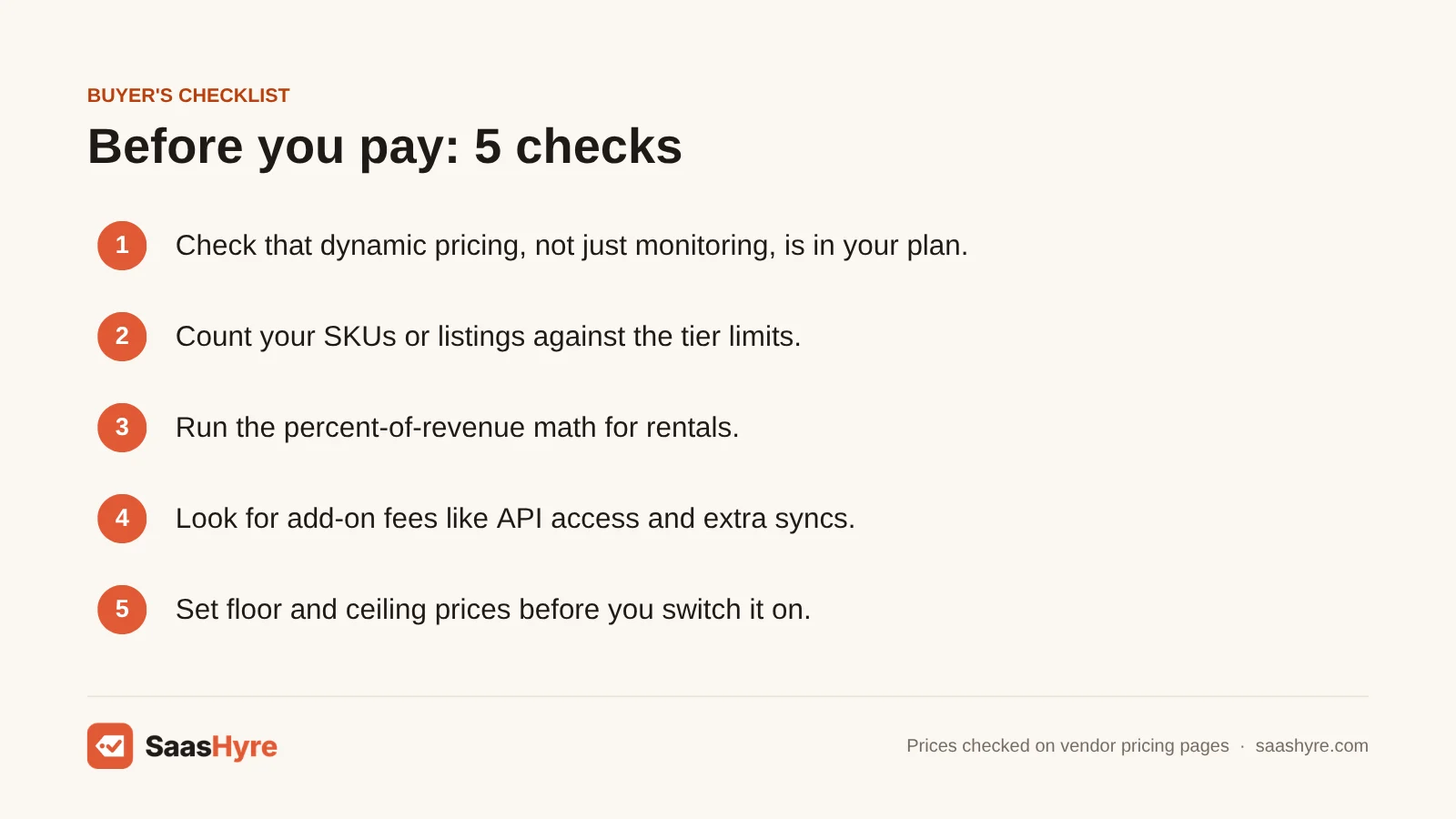
- Check that “dynamic pricing” is in your plan. Prisync’s starter plan only tracks prices. Many tools put monitoring and repricing on different tiers or modules.
- Count your SKUs or listings against the tier limits. Going past 1,000 products on Prisync doubles the bill. Going past a sales limit on Aura moves you up a plan.
- Run the percent-of-revenue math. For rentals, a 1% fee beats a flat fee when a listing earns under roughly $17,000 to $24,000 a year. Above that, it loses.
- Look for add-on fees. API access, extra channels and extra syncs can add up fast. API access is 20% extra on Prisync and $1 per listing on PriceLabs.
- Set floor and ceiling prices before you switch it on. A repricer racing a rival to the bottom can wipe out your margin in a weekend.
- For quote-only tools, ask about contract length and setup fees before the demo.
How We Evaluated These Tools
We read each vendor’s own pricing page and product docs in September 2026. We compared plan limits, billing models and trial terms. We did not run our own pricing tests. Any performance numbers here are the vendor’s claims. No vendor pays to be listed in this guide. Read more in our editorial policy.
The Bottom Line
If you run an online store, start with Prisync’s $199 plan. Move to Omnia Retail or Competera when you want pricing based on demand. Sell on marketplaces? Compare Repricer.com for large Amazon and eBay catalogs with Aura for Amazon and Walmart sellers who pay by sales. If your rentals earn well, pick PriceLabs. If they are seasonal or earn less, you may save with Beyond or Wheelhouse’s 1% plan. Large B2B pricing teams should book demos with Pricefx and PROS.
Frequently Asked Questions
What is the best dynamic pricing tool for a small online store?
Prisync is the easiest place for a small store to start. Its prices are public and setup is quick. Its $199 Premium plan covers up to 1,000 products with dynamic pricing and unlimited competitors. The $99 plan only tracks prices, so don’t buy it expecting automatic repricing. If you sell only on Amazon, look at Repricer.com instead.
How much does dynamic pricing software cost?
Here are the published prices as of September 2026. At the low end, Aura costs $37 a month (up to $15K in monthly sales) and PriceLabs costs $14.49 per rental listing (US). At the high end, Prisync’s 5,000-product plan costs $399 a month and Omnia Retail costs €399 a month. Enterprise tools like Pricefx, PROS and Competera are quote only. They are usually sold on yearly contracts.
Is a percentage-of-revenue plan cheaper than per-listing pricing?
Only for listings that earn less. A 1% revenue plan matches PriceLabs’ $14.49 monthly fee at about $17,400 in yearly bookings. It matches Wheelhouse’s $19.99 flat fee at about $24,000. Below those amounts, the percentage plan costs less. Above them, flat per-listing pricing wins. The gap grows with every extra dollar a listing earns.
How does AI dynamic pricing work?
The software collects data like competitor prices, demand, stock and seasons. Then it predicts how sales will change at different prices. Rule-based tools follow your instructions, like matching the lowest competitor. Demand-based tools like Competera estimate how price affects demand. Then they suggest the price that earns the most profit. Both kinds send new prices to your store or marketplace on their own.
Can dynamic pricing hurt my margins or brand?
Yes, if you run it with no limits. Repricers that chase the lowest competitor can start a price war and cut your margin. Always set a floor price above your full cost per item. Set a ceiling that shoppers will accept too. Review the changes each week during the first month.