
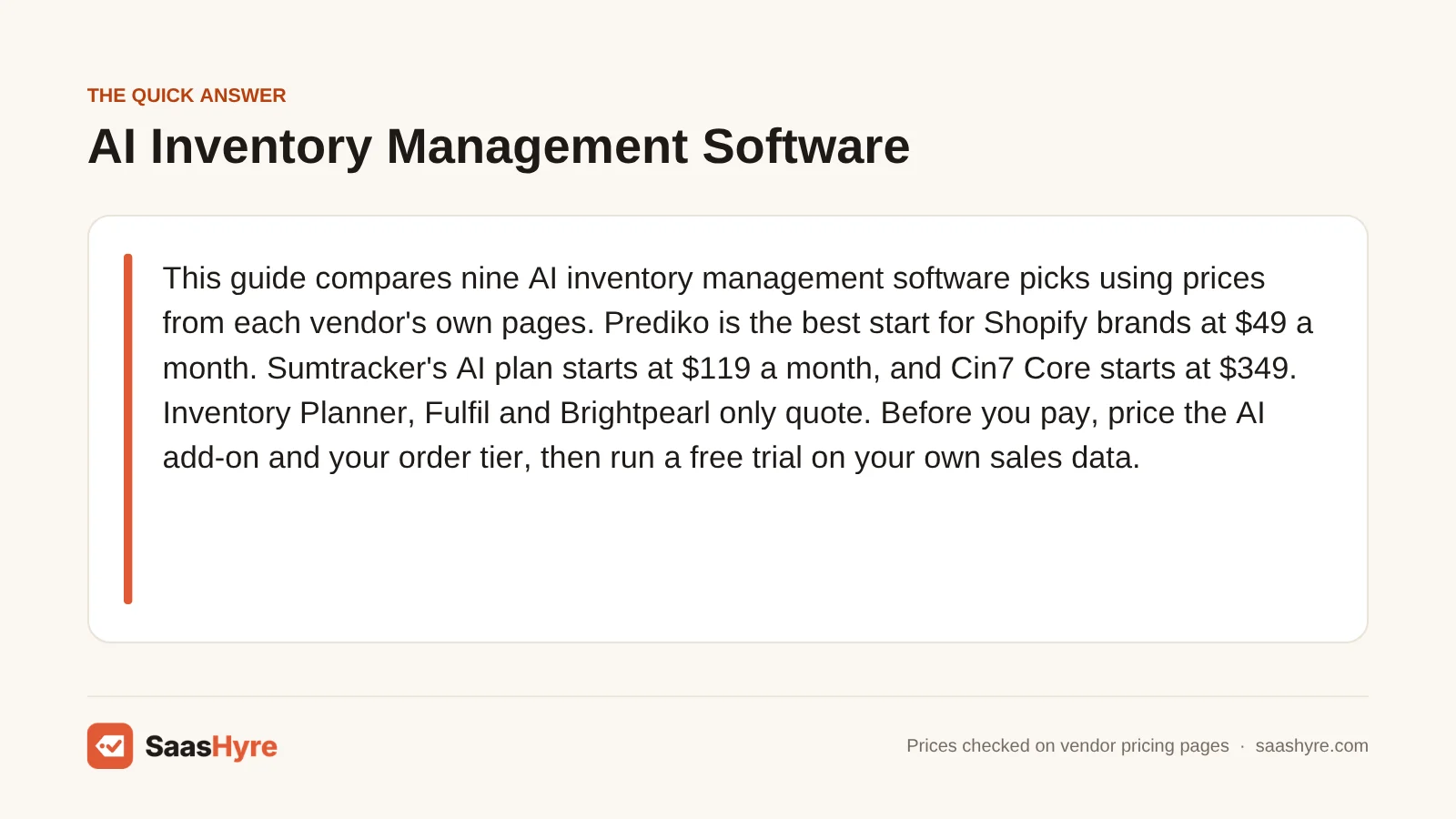
TL;DR: This guide compares nine AI inventory management software picks using prices from each vendor’s own pages. Prediko is the best start for Shopify brands at $49 a month. Sumtracker’s AI plan starts at $119 a month, and Cin7 Core starts at $349. Inventory Planner, Fulfil and Brightpearl only quote. Before you pay, price the AI add-on and your order tier, then run a free trial on your own sales data.
Stock mistakes cost real money. Retailers lose about $1.73 trillion a year to out-of-stocks and overstocks, according to IHL Group. That is 6.5% of global retail sales. AI inventory management software exists to shrink that number for your business.
Small firms have noticed. A 2025 Netstock report found that 48% of small and mid-sized businesses now use AI, about double the year before. The same report says 17% have more than a tenth of their stock unsold for over a year.
So which tool should you buy? That depends on where you sell and how much you sell. A Shopify store needs something very different from a distributor that runs an ERP. An ERP is the big system that runs your orders, stock and books.
I pulled every price below from the vendor’s own pages on October 2, 2026. Three of the nine picks don’t publish a price at all, and I say so plainly. You’ll also see what the AI part costs, because it’s often an add-on.
This guide is part of our best business software series, which maps the whole small business stack.
What Is the Best AI Inventory Management Software in 2026?
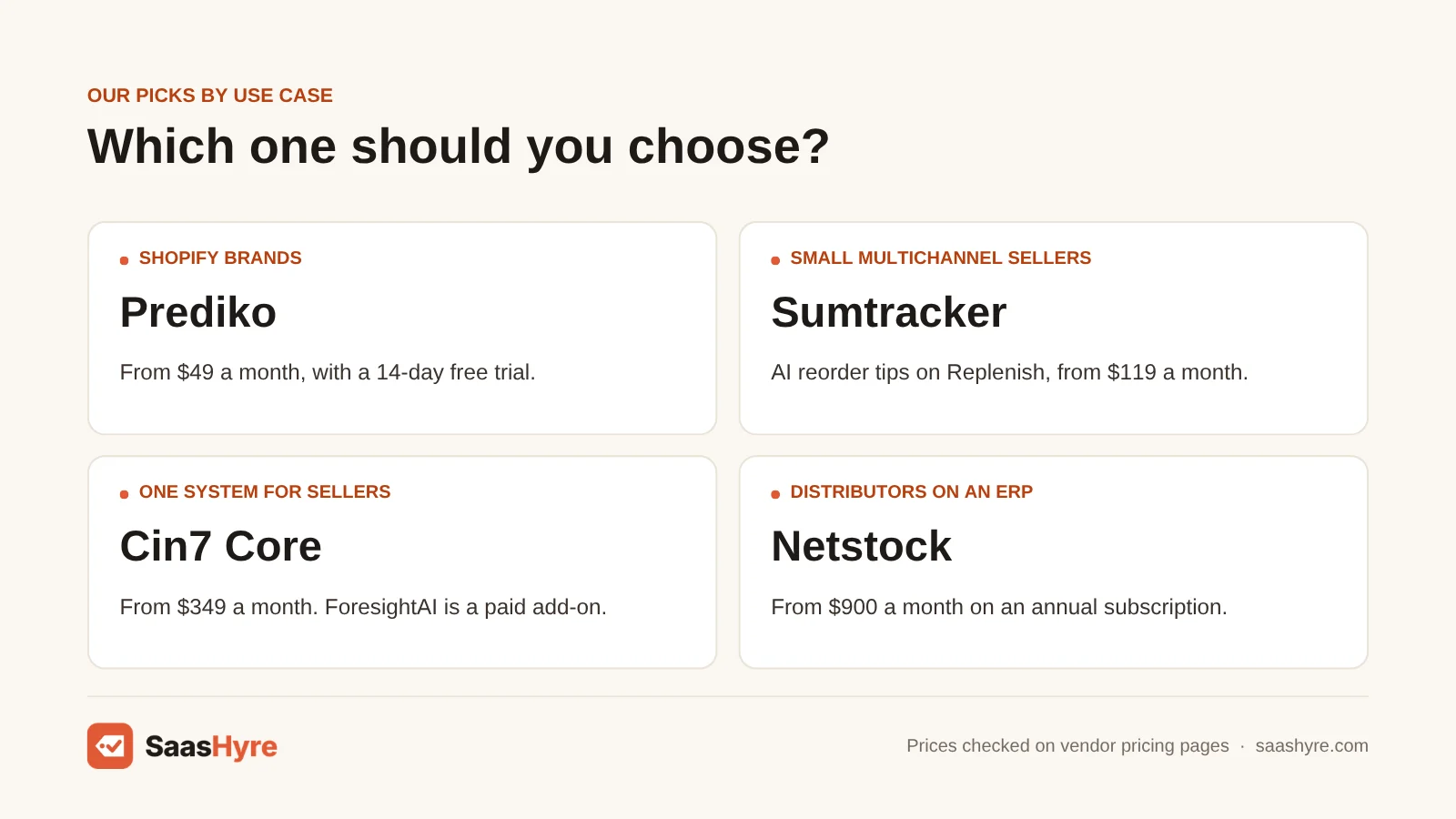
The best AI inventory management software for most Shopify brands is Prediko, from $49 a month. Sumtracker is the low-cost pick for small multichannel sellers, with AI reorder suggestions from $119 a month. Cin7 Core suits product sellers who want one system, from $349 a month. Netstock suits distributors on an ERP, from $900 a month.
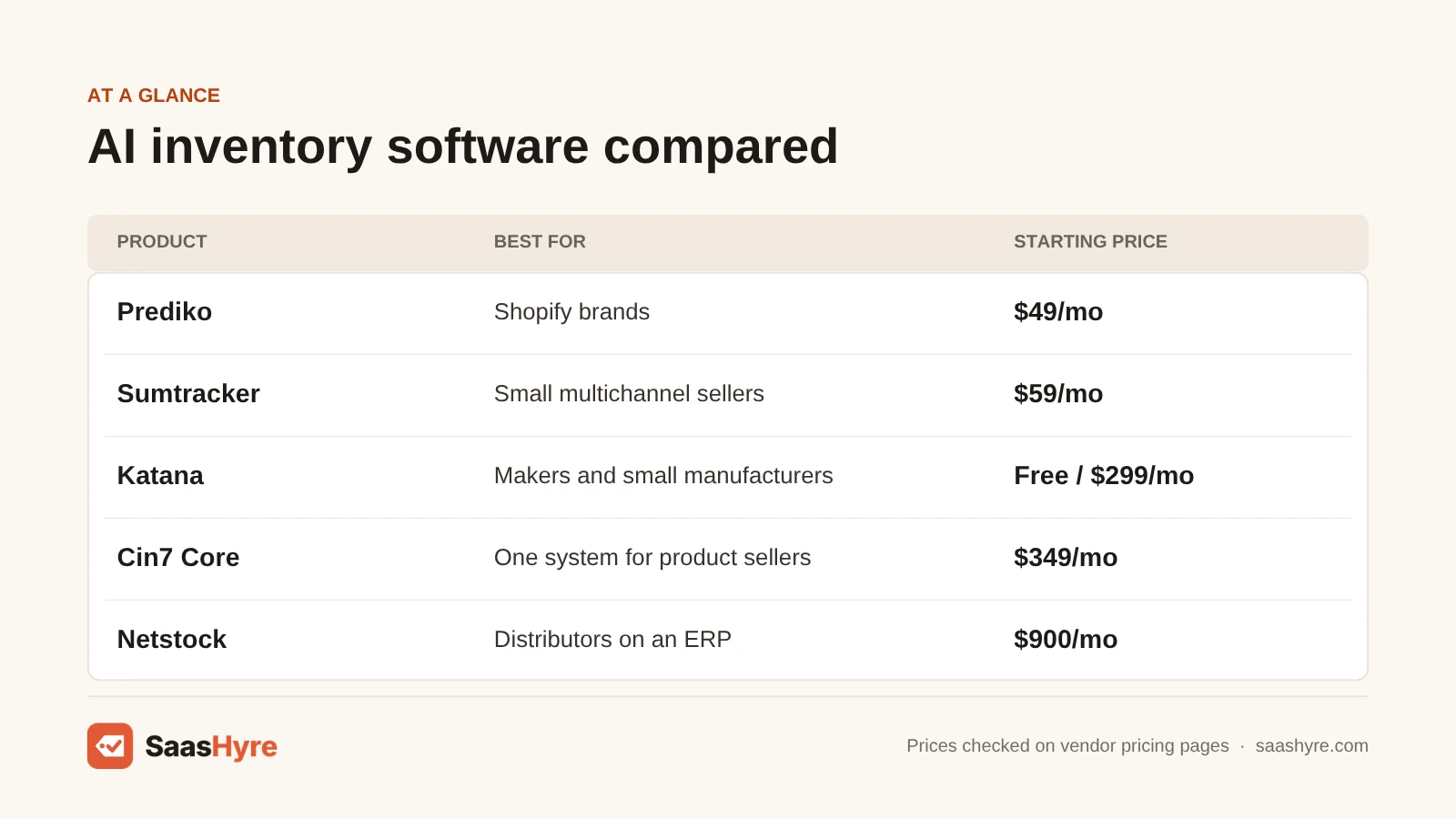
Here are all nine picks. “Quote only” means the vendor does not publish a price.
| Tool | Best for | Starting price | Free plan or trial |
|---|---|---|---|
| Prediko | Shopify brands | $49/mo | 14-day free trial |
| Inventory Planner by Sage | Multichannel forecasting | Quote only | Demo, no trial listed |
| Cin7 Core | One system for product sellers | $349/mo, AI add-on extra | 14-day free trial, no card |
| Netstock | Distributors on an ERP | From $900/mo, annual only | No trial listed |
| Sumtracker | Small multichannel sellers | $59/mo, AI plan $119/mo | 14-day free trial, no card |
| Katana | Makers and small manufacturers | Free plan, Core from $299/mo | Free plan with 30 SKUs |
| StockTrim | Forecasts for your current system | $39/mo on its Shopify listing | 14-day free trial, no card |
| Fulfil | High-volume Shopify Plus brands | Quote only | Demo only |
| Brightpearl by Sage | Multichannel retail operations | Quote only | Demo only |
What Is AI Inventory Management Software?
AI inventory management software uses machine learning to predict how much of each product you will sell. Then it tells you what to reorder and when. Most tools forecast demand, flag items that are about to run out, spot dead stock and draft purchase orders for you to approve.
IBM describes it as using AI to optimize and automate the inventory process. The software reads your sales history and does the math you used to do in a spreadsheet. It works at the SKU level. A SKU is one product variant that you track.
These tools come in two kinds. Planning tools, like Prediko, Inventory Planner, StockTrim and Netstock, add forecasts on top of a system you already have. Full systems, like Cin7 Core, Katana, Fulfil and Brightpearl, also run your orders, purchasing and warehouses.
Does the AI help? McKinsey found that forecasting errors often fall by 30 to 50 percent with machine learning, though that study dates from 2017. IHL’s 2025 research says retailers using AI saw sales grow 2.3 times faster than rivals.
Don’t mix this up with AI sales forecasting software, which predicts deals in a sales pipeline. If too much stock is eating your cash, pair it with cash flow forecasting tools.
The 9 Best AI Inventory Management Software, Reviewed
1 Prediko: Best for Shopify brands
If you sell on Shopify and still plan stock in a spreadsheet, start here.
What it does well. Prediko is a Shopify inventory app built around AI planning. It forecasts demand, builds a 12-month purchase order calendar and shows a buying table with restock tips. Its AI helper, called PIA, answers stock questions like a coworker would. On the Shopify App Store, Prediko holds a 4.9 out of 5 rating from 254 reviews.
Key features:
- AI demand and supply planning
- 12-month purchase order calendar
- PIA, an AI inventory helper
- Unlimited users, SKUs and purchase orders
Pricing. Prediko prices by your store’s sales over the last 12 months. Starter is $49 a month for stores up to $100k, Scale-up is $119 for up to $500k, and Growth is $199 for up to $2M. Stores above $2M get a custom quote. See Prediko pricing.
Annual plans come with two months free, and every plan has a 14-day free trial. The Raw Materials Forecasting and BOMs add-on is $20 a month.
Best for: You, if you run a Shopify store and want AI forecasts and purchase orders in one app.
Limitations. Your price climbs as your sales grow. Prediko is built for Shopify stores. I could not read prices above the $2M tier on Prediko’s own page.
2 Inventory Planner: Best for multichannel forecasting
If you sell on several channels and already have a system for orders, look here.
What it does well. Inventory Planner by Sage forecasts demand and suggests what to buy across your stores and warehouses. It adds Sage Copilot, an AI assistant for retail questions. It connects to more than 50 tools, including Shopify, Amazon, NetSuite, QuickBooks and Cin7. Sage says over 2,600 brands use it.
Key features:
- Demand forecasts by product and location
- Automated buying recommendations
- Sage Copilot AI assistant
Pricing. Inventory Planner does not publish prices. Its pricing page says the cost depends on the volume of inventory you manage, and every plan has unlimited users. You have to request a quote or book a demo. See Inventory Planner pricing.
Sage says most customers go live in four to six weeks.
Best for: You, if you sell on many channels and want a planning tool that plugs into the system you have.
Limitations. With no public price, you can’t budget before a sales call. The pricing page lists no self-serve free trial. Its Shopify rating was 4.3 out of 5 from 155 reviews when we checked, lower than Prediko’s.
3 Cin7 Core: Best for one system across channels
If you want inventory, orders and light production in one place, look at Cin7 Core.
What it does well. Cin7 Core runs products, purchases, stock, production and sales channels in one system. Its AI piece is ForesightAI, which forecasts demand up to 24 months ahead and drafts purchase orders. ForesightAI grew out of Inventoro, an AI forecasting firm that Cin7 bought in May 2024.
Key features:
- ForesightAI forecasts up to 24 months
- Automatic purchase orders and safety stock
- Unlimited inventory locations
Pricing. Standard is $349 a month with 5 users and 6,000 sales orders a year. Pro is $599 a month with 10 users and 24,000 orders. Advanced is $1,199 a month with 15 users and 120,000 orders. See Cin7 pricing.
ForesightAI is a paid add-on priced by your sales volume, and Cin7 does not publish that price. You can try Cin7 Core free for 14 days with no card.
Best for: You, if you sell through several channels and want stock, orders and purchasing in one system.
Limitations. The AI costs extra and has no public price. Standard caps you at 6,000 sales orders a year, so busy stores need Pro. Extra users and integrations have no listed price.
4 Netstock: Best for distributors on an ERP
If you run an ERP and plan stock for hundreds of items, look at Netstock.
What it does well. Netstock plugs into your ERP and turns its data into forecasts and order plans. Its AI Opportunity Engine has delivered more than one million stock recommendations. Its AI Pack explains dashboards, items and reports in plain words.
Key features:
- AI Opportunity Engine recommendations
- AI Pack with four analysis helpers
- Demand forecasts and order plans
- Links to NetSuite, Sage, Acumatica and SAP Business One
Pricing. Netstock pricing starts at $900 a month. It only sells annual subscriptions, so plan for at least $10,800 a year. Your price depends on the product and bundle you pick. See Netstock pricing.
Netstock says setup usually takes 6 to 10 weeks. Its page does not list setup fees or say if the AI Pack costs extra.
Best for: You, if you’re a distributor or manufacturer on an ERP and want better order plans without replacing it.
Limitations. You need an ERP first, so this isn’t for a new online store. Billing is annual only, and bundle prices come by form.
5 Sumtracker: Best for small multichannel sellers
If you sell on Shopify plus Amazon, Etsy or eBay on a tight budget, look at Sumtracker.
What it does well. Sumtracker keeps one stock count in sync across Shopify, Amazon, Etsy, eBay and Walmart. Its Replenish plan adds purchase orders, 12-month forecasting and AI reorder suggestions. Sumtracker says over 2,000 brands use it.
Key features:
- Stock sync across sales channels
- 12-month forecasting on Replenish
- AI reorder suggestions on Replenish
- QuickBooks integration on Replenish
Pricing. Manage is $59 a month, or $50 a month billed yearly, for up to 2,500 orders a year. Replenish, the plan with AI, is $119 a month or $100 billed yearly at the same order level. At 10,000 orders a year, Replenish is $179 a month or $150 billed yearly. See Sumtracker pricing.
Prices keep rising with your order count. You get a 14-day free trial with no card.
Best for: You, if you sell on a few channels and want low-cost stock sync with AI reorder tips.
Limitations. The AI is only on Replenish, which costs about twice what Manage does. Your price steps up as your orders grow. The pricing page does not state a refund policy.
6 Katana: Best for makers and small manufacturers
If you make what you sell, look at Katana.
What it does well. Katana tracks raw materials, production and finished goods together. Its AI Replenishment builds a 12-month forecast and gives you three order options, from minimum to maximum. It can then draft a purchase order or a manufacturing order for you. It needs at least six months of sales history.
Key features:
- Free plan with 30 SKUs
- Unlimited users on every plan
- AI Replenishment forecasts
- Draft purchase and manufacturing orders
Pricing. Katana has a free plan with up to 30 SKUs and unlimited users. Core starts at $299 a month with unlimited SKUs and one inventory location. Advantage is custom priced on an annual contract. See Katana pricing.
Add-ons cost extra. Manufacturing Management is $199 a month, Traceability is $249 and Warehouse Management is $149. I could not confirm if AI Replenishment costs extra on Core, so ask Katana in writing.
Best for: You, if you make your own products and want stock, production and purchasing in one tool.
Limitations. Core “starts at” $299, and the price grows with your usage. Extra inventory locations are billed separately, and onboarding is an optional $2,000.
7 StockTrim: Best for adding forecasts to your current system
If you like your current inventory system but its forecasts are weak, look at StockTrim.
What it does well. StockTrim is a planning tool, not a full system. It uses machine learning to forecast demand and tell you how much to order. It connects to Shopify, Xero, QuickBooks, Unleashed, Katana and Cin7, among others.
Key features:
- Machine learning demand forecasts
- Order plans for each supplier
- Unlimited users and SKUs
Pricing. StockTrim prices by your yearly revenue. When we checked, its page showed $298 a month, billed annually, for the $3M to $5M bracket. Annual billing saves 25%. See StockTrim pricing.
I could not confirm the price for every revenue bracket. Its Shopify App Store listing shows an Ecommerce Starter plan at $39 a month for up to 500 SKUs and $1M in sales. Onboarding is $299, and the raw materials add-on is $90 a month.
Best for: You, if you want better forecasts without changing your inventory system.
Limitations. StockTrim plans stock, but it does not run orders or warehouses. Annual plans lock you in for 12 months. Prices differ between its site and its Shopify listing, so confirm your bracket first.
8 Fulfil: Best for high-volume Shopify Plus brands
If you have outgrown apps and need a full ERP, look at Fulfil.
What it does well. Fulfil calls itself an agentic ERP for Shopify Plus and DTC brands. DTC means you sell direct to shoppers. It runs inventory, fulfillment and finance in one system. You can set up products and rules in plain English, and you can connect it to Claude or ChatGPT to ask about orders, stock and margins.
Key features:
- Inventory, fulfillment and finance in one ERP
- Setup in plain English
- Connects to Claude and ChatGPT
- 400+ 3PL integrations
Pricing. Fulfil does not publish prices. Its page says pricing depends on your order volume, channels and how complex your operation is. You book a demo first, and then you get a quote. See Fulfil pricing.
Best for: You, if you run a Shopify Plus brand with several warehouses or 3PLs. Fulfil says it targets brands doing $15M to $1B in sales.
Limitations. There is no public price and no free trial listed. It is far too much system for a small store.
9 Brightpearl: Best for multichannel retail operations
If you’re a retailer or wholesaler who wants orders, stock and accounting together, look at Brightpearl.
What it does well. Brightpearl by Sage is a retail operating system for multichannel merchants and wholesalers. It covers inventory, orders, shipping, warehouse, accounting and CRM. Its Automation Engine handles routine order steps for you. Demand planning comes from Inventory Planner, which gives buying recommendations based on sales forecasts.
Key features:
- Inventory and order management
- Automation Engine for order steps
- Demand planning from Inventory Planner
Pricing. Brightpearl does not publish prices. Its pricing page says every customer gets a tailored quote, with unlimited users at no extra cost. Setup costs arrive in a scoped proposal, and a typical go-live takes 90 to 120 days. See Brightpearl pricing.
Best for: You, if you run a multichannel retail or wholesale business and want one system for the back office.
Limitations. It is quote only, and setup takes months. If you only need forecasting, Inventory Planner alone is the smaller buy.
How Much Does AI Inventory Software Cost?
AI inventory software costs from $49 a month for a small Shopify store to $900 a month or more for a distributor on an ERP. Prediko starts at $49, Sumtracker’s AI plan at $119, Katana Core at $299 and Cin7 Core at $349. Inventory Planner, Fulfil and Brightpearl give prices by quote only.
The table below shows the plans with a public price. None are promo prices. They are regular list prices on the day we checked.
| Plan | Monthly billing | Yearly billing (per month) | Yearly total | What you get, and who it is for |
|---|---|---|---|---|
| Prediko Starter | $49 | $40.83* | $490* | AI forecasts and purchase orders. Stores up to $100k in sales. |
| Prediko Growth | $199 | $165.83* | $1,990* | Stores up to $2M. |
| Sumtracker Manage, 2,500 orders | $59 | $50 | $600 | Stock sync, no AI. |
| Sumtracker Replenish, 2,500 orders | $119 | $100 | $1,200 | Adds forecasting and AI reorder tips. |
| Sumtracker Replenish, 10,000 orders | $179 | $150 | $1,800 | Same, for more orders. |
| Katana Core | From $299 | Not published | $3,588 at the monthly rate | Unlimited SKUs and users, one location. |
| Cin7 Core Standard | $349 | Not published | $4,188 at the monthly rate | 5 users, 6,000 orders a year. ForesightAI costs extra. |
| Cin7 Core Pro | $599 | Not published | $7,188 at the monthly rate | 10 users, 24,000 orders a year. |
| StockTrim, $3M to $5M revenue | Not confirmed | $298 | $3,576 | Forecasts for your current system. |
| Netstock | Not offered | From $900 | From $10,800 | AI planning for your ERP. |
| Inventory Planner, Fulfil, Brightpearl | Quote only | Quote only | Quote only | Price set after a demo. |
*Prediko offers two months free on annual plans but shows no yearly figure I could read. I calculated these as ten times the monthly price.
What is not in the sticker price
- AI sold as an add-on. Cin7’s ForesightAI has no public price.
- Tier jumps. Prediko charges more as your sales grow. Sumtracker moves you to the next tier when you pass your order limit.
- Setup fees. Katana’s onboarding is an optional $2,000. StockTrim’s onboarding is $299. Netstock and Brightpearl do not list setup costs.
- Module add-ons. Katana’s modules run $149 to $249 a month each.
- Annual lock-in. Netstock is annual only. StockTrim’s annual plan commits you for 12 months.
What does that mean for your first year? Here are three cases, with the math shown.
| Scenario | Tool and plan | Math | First-year cost |
|---|---|---|---|
| New Shopify store, under $100k in sales, about 2,500 orders a year | Prediko Starter, monthly | $49 x 12 | $588 |
| Prediko Starter, annual | $49 x 10 | $490 | |
| Sumtracker Replenish, billed yearly | $100 x 12 | $1,200 | |
| Growing brand, $1.5M in sales, about 10,000 orders a year | Prediko Growth, monthly | $199 x 12 | $2,388 |
| Sumtracker Replenish, billed yearly | $150 x 12 | $1,800 | |
| Cin7 Core Pro | $599 x 12 | $7,188, before ForesightAI | |
| Small manufacturer or distributor that needs a full system | Katana Core with onboarding | $299 x 12 + $2,000 | $5,588, before add-ons |
| Cin7 Core Pro | $599 x 12 | $7,188, before ForesightAI | |
| Netstock, added to your ERP | $900 x 12 | $10,800 at least |
Why Cin7 Core Pro? Standard covers 6,000 sales orders a year, and the second brand ships 10,000. Pro is also the first plan with material requirements planning, which manufacturers need.
How Do You Choose the Right AI Inventory Tool?
To choose the right AI inventory tool, match it to where you sell, then price the AI part on its own line. Check which sales or order tier you fall into. Ask what setup costs. Then test the forecast on your own sales history during a free trial before you sign anything.
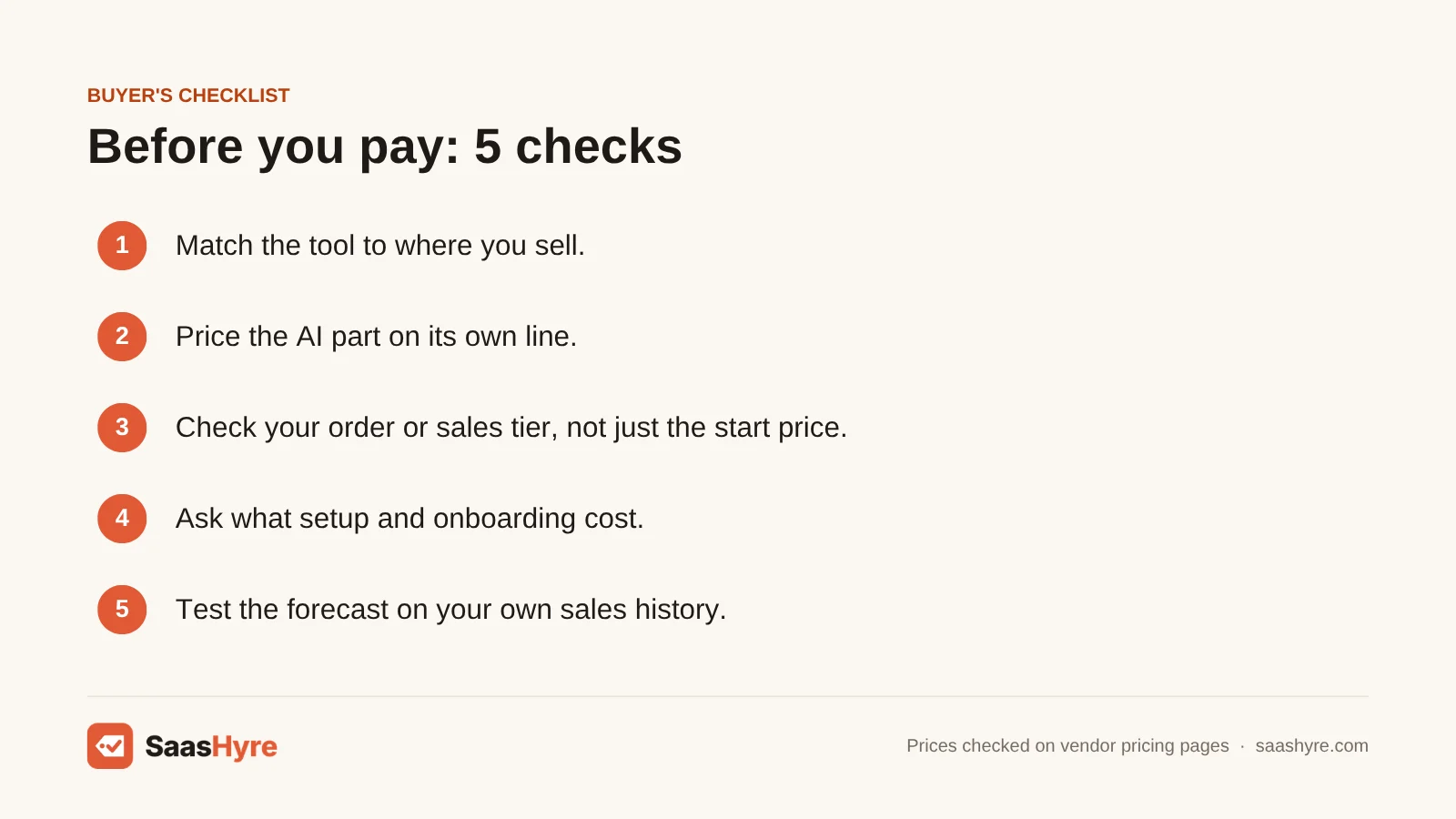
- Match the tool to where you sell. Shopify only? A planning app like Prediko is enough. Several channels or an ERP? Pick a tool that connects to all of them.
- Price the AI part on its own line. Sumtracker keeps AI on its pricier plan. Cin7 sells it as an add-on. Ask for that number in writing.
- Check your tier, not just the start price. Count last year’s orders and sales. Then find the plan that covers them with room to grow.
- Ask what setup and onboarding cost. Ask how long it takes too.
- Test the forecast on your own data. Compare its reorder tips with what you would have ordered yourself.
Your stock numbers should flow into your books, so see how each pick works with your AI accounting software. If buying needs approvals, look at AI procurement software as well.
A good forecast will also show you dead stock. You can clear it faster with dynamic pricing tools.
Tools We Left Out, and Why
Three names you may expect are missing.
- Cogsy. Its site now says Cogsy has been discontinued and is no longer available.
- Verve AI. It has a simple flat price of $19.99 a month. But its Shopify listing launched in October 2025 and had no reviews when we checked. That is too new to recommend yet.
- Zoho Inventory. It has a free plan and paid plans from $29 a month billed annually. But I could not confirm AI forecasting features on its pricing page.
How We Researched This Guide
We took every price from the vendor’s own pricing page, help center or app store listing on the date below. Where a price was missing, we said so.
Here is what we could not confirm. We don’t know the price of Cin7’s ForesightAI add-on. We could not tell if Katana’s AI Replenishment costs extra on Core. We could not read every StockTrim revenue bracket or Prediko’s tiers above $2M. Inventory Planner, Fulfil and Brightpearl do not publish prices.
We did not test these tools ourselves. Ratings and customer counts come from the vendors and their app store listings. No vendor pays to be listed or ranked. You can read more in our editorial policy.
Prices last checked: October 2, 2026.
The Bottom Line
You don’t need a big budget to get AI help with your stock. A Shopify store can start with Prediko at $49 a month. A small multichannel seller can get AI reorder tips from Sumtracker at $119 a month.
Bigger operations pay more, and the AI is often extra. Cin7 Core starts at $349 a month before its ForesightAI add-on. Three picks will only give you a price after a demo.
Here is your next step. Pick the one tool that fits where you sell. Start its 14-day free trial this week and load your real sales history. If its reorder tips beat your spreadsheet, you’ve found your tool. Better stock decisions are closer than you think.
Frequently Asked Questions
What is the cheapest AI inventory management software?
Prediko is the cheapest paid pick with AI in this guide, at $49 a month for Shopify stores with up to $100k in sales. Katana has a free plan, but it stops at 30 SKUs.
Is there free AI inventory management software?
Katana is the only pick here with a free plan. Katana’s free plan covers up to 30 SKUs with unlimited users. Prediko, Sumtracker, Cin7 Core and StockTrim each offer a 14-day free trial instead.
Can AI really forecast inventory demand?
Yes, within limits. McKinsey reported that forecasting errors often fall by 30 to 50 percent with machine learning. But the AI needs history to learn from. Katana, for example, asks for at least six months of sales data.
Do you need an ERP to use AI inventory software?
No. Prediko and Sumtracker connect straight to a Shopify store, and StockTrim connects to tools like Xero and QuickBooks. Netstock is the exception here. It plugs into an ERP such as NetSuite, Sage or SAP Business One.
How long does AI inventory software take to set up?
Inventory Planner says most customers go live in four to six weeks. Netstock says setup usually takes 6 to 10 weeks, and Brightpearl says a typical go-live takes 90 to 120 days.