
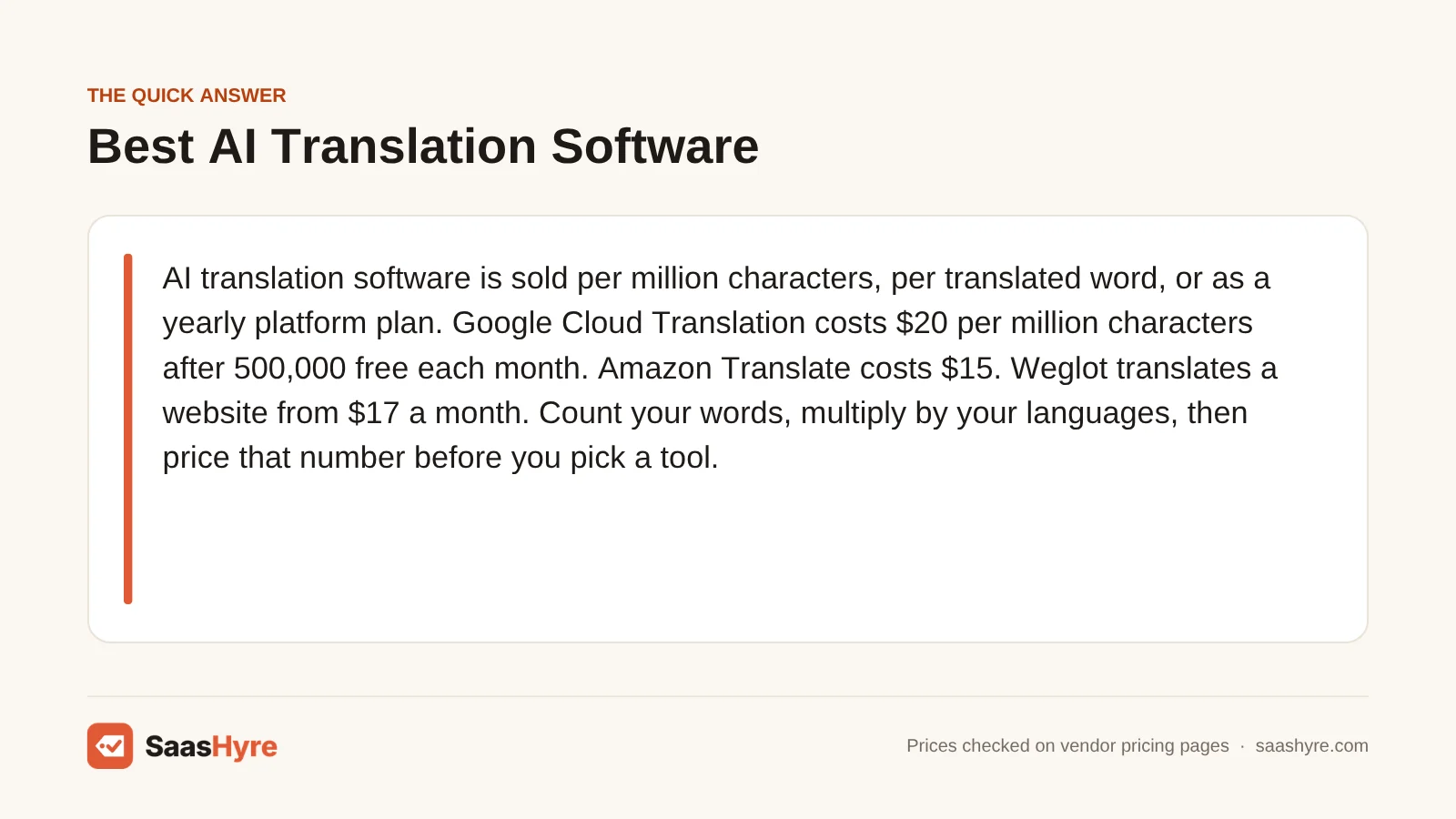
TL;DR: AI translation software is sold per million characters, per translated word, or as a yearly platform plan. Google Cloud Translation costs $20 per million characters after 500,000 free each month. Amazon Translate costs $15. Weglot translates a website from $17 a month. Count your words, multiply by your languages, then price that number before you pick a tool.
Picking AI translation software is hard because every vendor counts something different. One bills by the character. One bills by the word. One sells “Smartwords” by the year.
The price gap is huge. Translating 1,000 words costs about $0.12 through Google’s translation API. The same 1,000 words start at $60 through Smartling’s AI Translation service, which adds workflow and quality checks.
CSA Research surveyed 8,709 shoppers in 29 countries. It found that 76% prefer to buy products with information in their own language. And 40% said they will never buy from websites in other languages.
Still, many companies move slowly. A March 2026 report from DeepL found that 35% of global businesses still translate fully by hand.
I pulled every price below from each vendor’s own pages on October 2, 2026. Where a vendor hides a price, I say so. Then I put the prices on one footing, so you can compare cost per million characters or per word.
For picks across every other job, see our main guide to the best AI tools.
What Is the Best AI Translation Software in 2026?
The best AI translation software depends on what you translate. For a website, pick Weglot from $17 a month. For an app or bulk text, pick Google Cloud Translation at $20 per million characters or Amazon Translate at $15. For documents and daily writing, pick DeepL. For managed localization with reviewers, pick Smartcat, Smartling, Phrase or Lokalise.
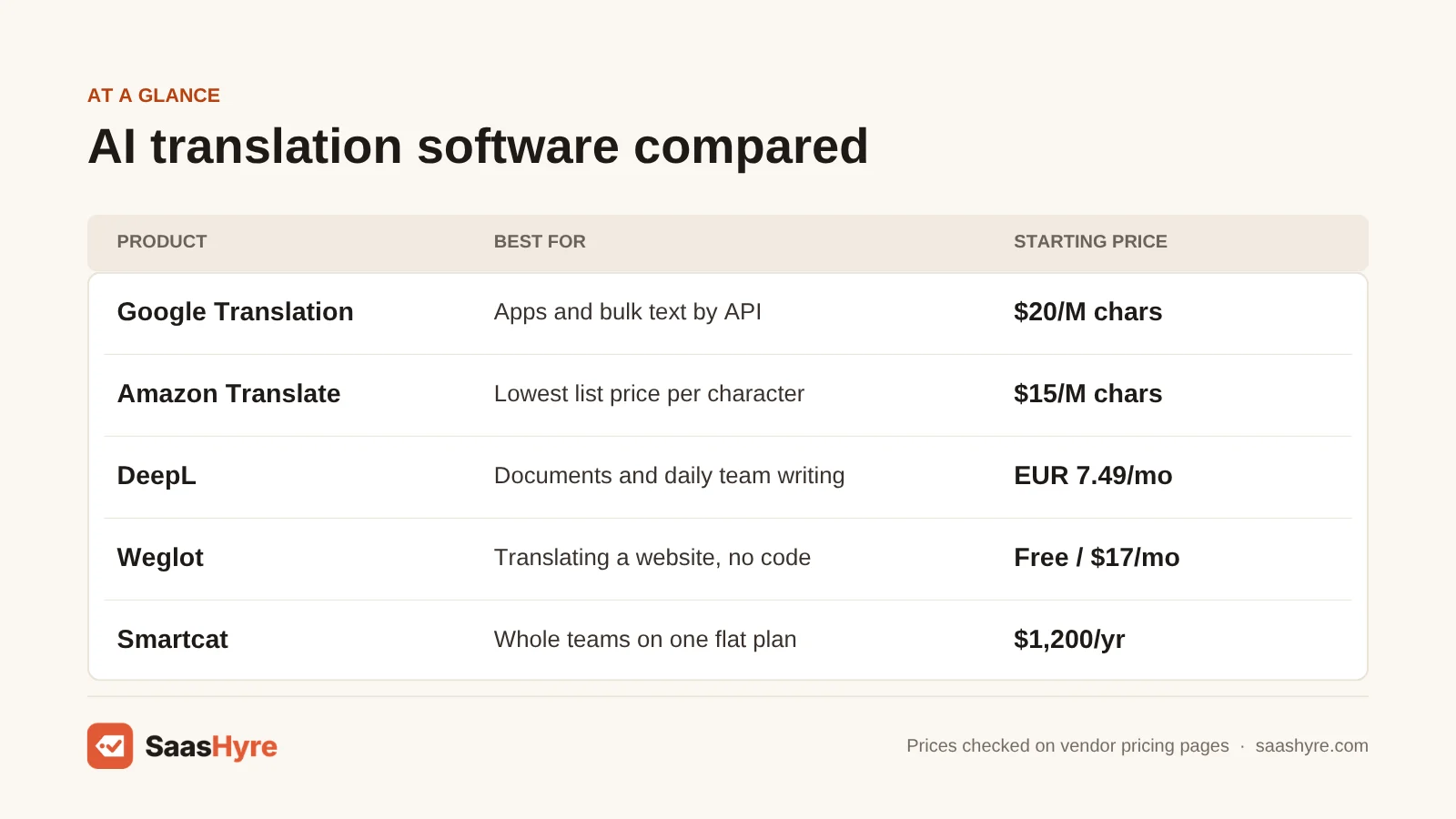
| Tool | Best for | Starting price | Free plan or trial |
|---|---|---|---|
| Google Cloud Translation | Apps and bulk text by API | $20 per million characters | 500,000 characters free each month |
| Amazon Translate | Lowest list price per character | $15 per million characters | 2 million characters a month for 12 months |
| DeepL | Documents and daily team writing | €7.49/mo billed yearly (US price not confirmed) | Free version, 50,000 characters a month |
| Weglot | Translating a website with no code | $17/mo, or $170 a year | Free plan, 2,000 words, plus 14-day trial |
| Smartcat | Whole teams on one flat plan | From $1,200 a year | 15-day trial |
| Smartling | AI translation with human checks | $0.0075 per word, plans from $200/mo billed yearly | None listed |
| Phrase | Large localization programs | $525/mo billed yearly | 14-day trial |
| Lokalise | Software and app strings | $149/mo as listed | 14-day trial, no card |
These eight tools fall into three groups. Google, Amazon and DeepL are translation engines. You reach them through an API, which lets your software send text and get a translation back.
Weglot is a website translator that plugs into your site. Smartcat, Smartling, Phrase and Lokalise are localization platforms. They add review steps and team workflows on top of an engine.
This guide covers written text. If you need to translate the voice in a video, see our guide to AI dubbing software. If your content starts as audio, you will need AI transcription software first.
I started with nine tools and dropped two. Crowdin’s paid prices load in a calculator I could not read. POEditor is a string manager that sells machine translation as an add-on. I added Amazon Translate for its low published price.
How Much Does AI Translation Software Cost?
AI translation software costs $15 to $20 per million characters through an API, which is about $0.09 to $0.12 per 1,000 words. Website translators run $17 to $769 a month. Managed AI translation costs $0.0075 to $0.12 per word. Localization platforms start at $1,200 to $6,300 a year.
The table shows regular list prices, not promos. “Not offered” means the vendor only sells yearly billing.
| Plan | Monthly billing | Yearly billing (per month) | Yearly total | What you get and who it is for |
|---|---|---|---|---|
| Google Cloud Translation (NMT) | $20 per million characters, pay as you go | No yearly plan | Depends on volume | First 500,000 characters free each month. For apps and bulk text. |
| Google Translation LLM | $10 per million input characters plus $10 per million output | No yearly plan | Depends on volume | Google’s newer large language model (LLM). For text where tone matters. |
| Amazon Translate | $15 per million characters, pay as you go | No yearly plan | Depends on volume | 2 million free characters a month for 12 months (intro offer). For AWS users. |
| DeepL Individual | Not confirmed | €7.49 | €89.88 | 300,000 characters and 3 files a month. For one person. |
| DeepL Team | Not confirmed | €24.99 per user | €299.88 per user | 1,000,000 characters per user a month and 20 files. For small teams. |
| Weglot Starter | $17 | $14.17 | $170 | 10,000 translated words, 1 language. For a small site. |
| Weglot Pro | $87 | $72.50 | $870 | 200,000 words, 5 languages. For stores and blogs. |
| Weglot Advanced | $329 | $274.17 | $3,290 | 1,000,000 words, 10 languages. For large sites. |
| Smartcat Adapt | Not offered | $100 | From $1,200 | 100,000 Smartwords a year, unlimited users. For small teams. |
| Smartling Basic | Not offered | $200 | $2,400 | 50,000 hosted words. Translation is billed per word on top. |
| Phrase Software UI/UX | Not shown | $525 | $6,300 | 15 Strings seats, 1 million machine translation units a year. For product teams. |
| Phrase Team | Not shown | $1,245 | $14,940 | Unlimited translation management (TMS) seats, 12 million machine translation units a year. |
| Lokalise Explorer | $149 as listed | Not confirmed | $1,788 at the listed rate | 5 advanced seats, up to 10 languages. For small app teams. |
Want to compare these on one footing? Count six characters per word, space included. Then Google’s $20 works out to about $0.00012 per word. Smartcat Adapt works out to $0.012 per Smartword. Smartling’s AI Translation starts at $0.06 per word.
What is not in the sticker price
- Languages multiply your bill. Weglot counts source words times the number of languages. An 8,000-word site in 3 languages uses 24,000 translated words.
- Spaces count as characters. Google and Amazon both bill for every character you send, whitespace included.
- Better models cost more. Google’s custom models cost $80 per million characters. Training one costs $45 an hour, capped at $300 a job. Amazon’s Active Custom Translation costs $60 per million.
- Overage adds up. Smartling charges $40 per extra 10,000 hosted words on Basic and $30 on Pro. Smartcat lets you top up Smartwords, but it does not publish the top-up price.
- Auto-upgrades. With auto-upgrade on, Weglot moves you to the next plan when you pass your word limit. With it off, your translations pause.
- Human review. Smartling’s AI Human Translation starts at $0.12 per word. Weglot’s pro translators start at €0.13 per word.
What three real jobs cost
Here are three jobs priced four ways, at six characters per word.
| Scenario | Google Cloud Translation (NMT) | Amazon Translate | Weglot (yearly billing) | Smartling AI Translation |
|---|---|---|---|---|
| Solo site owner. 10,000 words into 1 language. That is 10,000 translated words, or about 60,000 characters. | $0 (inside the free 500,000 characters) | $0.90 | Starter, $170 a year | $600 ($75 with plain machine translation) |
| Small team. 50,000 words into 4 languages. That is 200,000 translated words, or about 1.2 million characters. | $14 | $18 | Pro, $870 a year | $12,000 ($1,500 with plain machine translation) |
| Growing company. 100,000 words into 10 languages. That is 1,000,000 translated words, or about 6 million characters. | $110 | $90 | Advanced, $3,290 a year | $60,000 ($7,500 with plain machine translation) |
Google’s number assumes you run the whole job in one month and use the free 500,000 characters once. Amazon’s number is the regular rate, without the 12-month free tier. Smartling’s number is the translation fee only. Its platform plan starts at $2,400 a year on top.
API costs are one-time. You pay again only when you add or change text. Weglot is a subscription, so you pay every year.
So why would anyone pay $60,000 when an API costs $110? The API gives you raw text and nothing else. You still need a developer, a place to store translations and someone to check them.
The 8 Best AI Translation Software, Reviewed
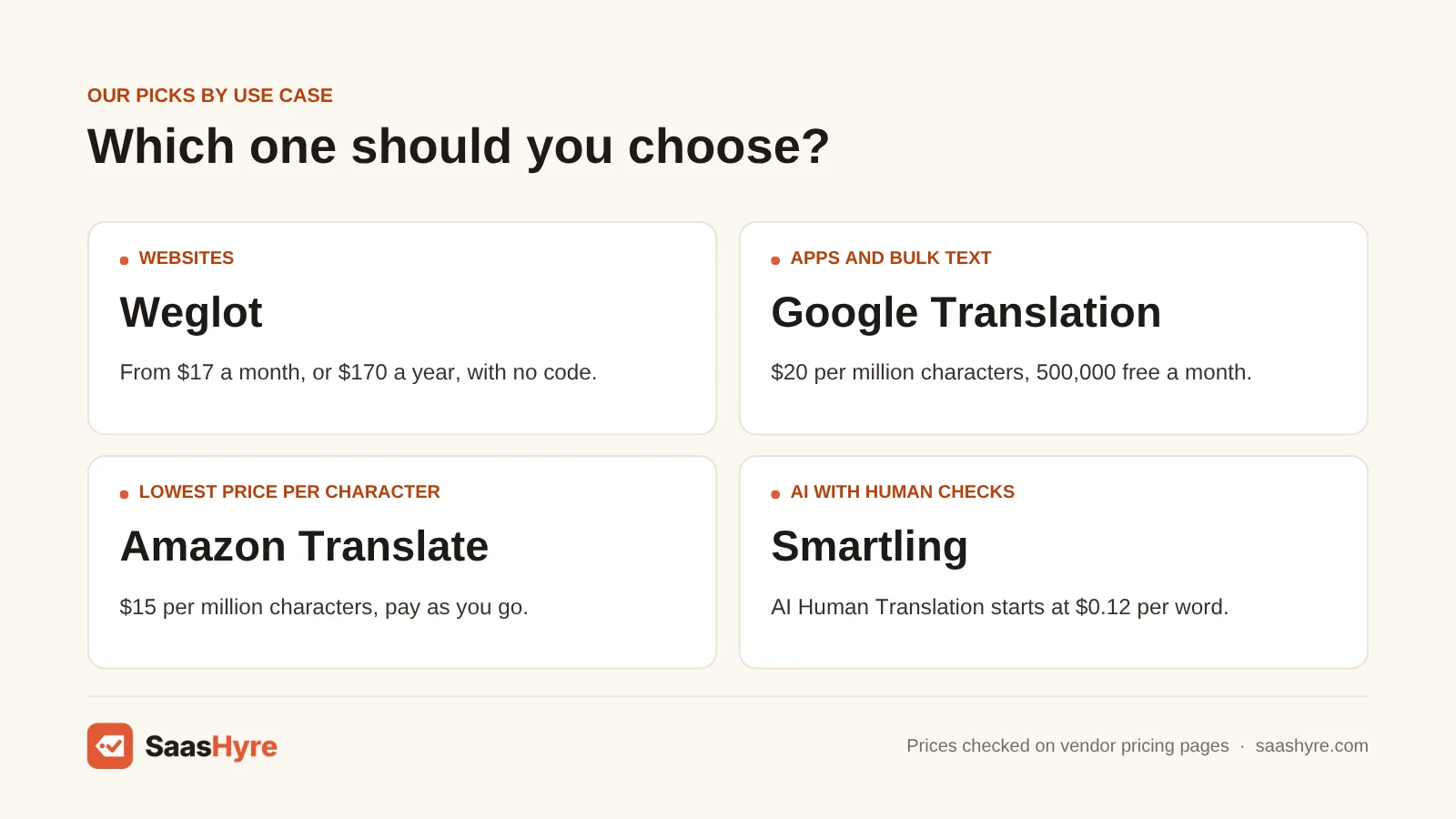
1 Google Cloud Translation: Best for apps and bulk text
If you have a developer and a lot of text, start here.
What it does well. Google gives you a published price and a free tier that resets every month. The Advanced edition adds a Translation LLM, glossaries, batch jobs and document translation. Our list of AI coding tools can speed up the setup.
Key features:
- Standard model (NMT) and Translation LLM
- Glossaries at no charge
- Batch and document translation
- Custom models trained on your text
Pricing. The standard model costs $20 per million characters, and the first 500,000 each month are free. The Translation LLM costs $10 per million input characters plus $10 per million output characters. Document translation costs $0.08 a page, and there is no monthly fee. See Google Cloud Translation pricing.
Best for: You, if you want the lowest cost for big volumes and can call an API.
Limitations. It is an API, not an app. You get no review workflow and no place to store translations. Google counts every character, spaces included.
2 Amazon Translate: Best for the lowest list price
If you already run on AWS, this is the cheapest published rate I found.
What it does well. Amazon Translate handles batch and real-time translation through one API. You can add custom terms so brand and product names stay the same.
Key features:
- Real-time and batch translation
- Custom terminology for brand names
- Active Custom Translation with your own data
- Document translation, including DOCX
Pricing. Standard translation costs $15 per million characters. New AWS users get 2 million characters a month free for 12 months, which is an intro offer. Active Custom Translation costs $60 per million characters, and real-time DOCX translation costs $30. See Amazon Translate pricing.
Best for: You, if your app is on AWS and you want to pay 25% less per character than Google’s standard rate.
Limitations. The free tier ends after 12 months. Like Google, it is a developer tool with no editor or review steps. Spaces count as characters here too.
3 DeepL: Best for documents and daily team writing
If your team translates emails, contracts and slide decks by hand, look at DeepL.
What it does well. DeepL works in a browser, so nobody needs a developer. You paste text or upload a file. Glossaries keep your terms consistent. Team plans add admin controls and usage reports.
Key features:
- Text and file translation
- Glossaries for your own terms
- Team admin and analytics
- API for developers
Pricing. The free version covers 50,000 characters a month. DeepL’s page showed me euro prices, all billed yearly. Yearly billing saves 16%, and Individual and Team come with a 30-day free trial. See DeepL pricing.
Individual is €7.49 a month for 300,000 characters. Team is €24.99 per user for 1,000,000 characters each. Business is €49.99 per user with unlimited characters.
The API is sold apart from those plans. DeepL’s help center says the Developer plan stops at 1,000,000 characters in total, with no reset. The Growth plan includes 1 million characters a month and bills extra use per character. I could not confirm the Growth rates.
Best for: You, if people on your team translate documents by hand every day.
Limitations. I could not confirm US dollar prices or the monthly billing rate. On Team, €24.99 for 1,000,000 characters is more per character than Google or Amazon. Individual allows only 3 files a month.
4 Weglot: Best for translating a website
If you want your site in another language this week, pick Weglot.
What it does well. Weglot connects to your site with no code and translates every page. It supports more than 110 languages and uses DeepL, Microsoft and Google engines. It adds hreflang tags, which tell search engines what language a page is in.
It works with WordPress, Shopify, Wix, Webflow and Squarespace. Still choosing a platform? See our guide to AI website builders.
Key features:
- No-code setup on major site builders
- Visual editor for fixing translations
- Glossary and custom AI language model
- Hreflang tags and translated metadata
Pricing. The free plan covers 2,000 words in 1 language. Starter is $17 a month or $170 a year for 10,000 words. Yearly billing gives you 2 months free on every plan. See Weglot pricing.
Business is $32 or $320 for 50,000 words. Pro is $87 or $870 for 200,000 words. Advanced is $329 or $3,290 for 1,000,000 words.
Best for: You, if you run a marketing site or store and have no developer.
Limitations. Words are multiplied by languages, so limits fill up fast. Starter covers only 1 language. You keep paying to keep your translated pages live.
5 Smartcat: Best for whole teams on one plan
If seat fees have burned you before, try Smartcat’s 15-day free trial.
What it does well. Every Smartcat plan includes unlimited users. You pay for Smartwords, a yearly word allowance for its AI. Once a sentence is approved, reusing it costs no Smartwords. It supports 280+ languages.
Key features:
- Unlimited users on every plan
- AI translation and content agents
- Approved sentences reused for free
- Marketplace of human reviewers
Pricing. Adapt starts at $1,200 a year with 100,000 Smartwords, which is $0.012 per Smartword. Accelerate starts at $24,000 a year with 1 million Smartwords and adds a reviewer agent. Anticipate starts at $60,000 with 2 million and adds single sign-on. See Smartcat pricing.
Best for: You, if many people touch translations and you don’t want to pay per seat.
Limitations. The jump from $1,200 to $24,000 is steep. There is no free plan and no monthly billing. You can top up Smartwords, but the top-up price is not published.
6 Smartling: Best for AI translation with human checks
If a wrong word could cost you a customer, look at Smartling.
What it does well. Smartling sells translation as a service with a per-word price. You choose how much human review you want. Its AI Hub connects 15+ translation engines and LLMs. It applies your glossary, style guide and past translations.
Key features:
- Four service levels priced per word
- AI Hub with 15+ engines and LLMs
- Translation memory and glossaries
- API access on every plan
Pricing. Machine translation starts at $0.0075 per word, AI Translation at $0.06 and AI Human Translation at $0.12. Creative Translation starts at $0.20. The platform is extra, at $200 a month billed yearly for Basic and $800 for Pro. See Smartling pricing.
Best for: You, if you need publish-ready translations and have the budget for review.
Limitations. You pay twice, once for the platform and once per word. Basic covers only 50,000 hosted words, which are the words stored in your translation memory. Contracts are yearly only, and the pricing page lists no free trial.
7 Phrase: Best for large localization programs
If you translate software, documents and video in one program, Phrase covers all three.
What it does well. Phrase bundles a translation management system (TMS), a strings tool for software text and workflow automation. Its platform routes content across 30+ engines and LLMs based on content type and language pair. It also lists 200+ integrations, including GitHub and Figma.
Key features:
- Phrase TMS and Phrase Strings
- Routing across 30+ engines and LLMs
- Automated quality scoring
- 200+ integrations
Pricing. Software UI/UX is $525 a month billed yearly, or $6,300 a year, with 15 Strings seats. Team is $1,245 a month billed yearly, or $14,940 a year, with unlimited TMS seats. Business and Enterprise are priced by quote, and every plan has a 14-day free trial. See Phrase pricing.
Best for: You, if you run a localization team that ships in many languages every week.
Limitations. The cheapest plan costs $6,300 a year. The page shows no monthly billing price. You have to track managed words, machine translation units and AI units.
8 Lokalise: Best for software and app strings
If your product team ships app updates often, Lokalise fits that rhythm.
What it does well. Lokalise is built for the short bits of text inside apps, called strings. Translator and reviewer seats are unlimited on paid plans, and so are hosted words. Standard AI handles everyday content. Pro AI is for text where accuracy and tone matter.
Key features:
- Unlimited translator and reviewer seats
- Standard AI and Pro AI translation
- Automations and native integrations
- Free for open source non-profit projects
Pricing. Explorer is listed at $149 a month, Growth at $379 and Advanced at $1,049. The page has monthly and yearly toggles, but I could not confirm which one those prices belong to. You get a 14-day trial with no card. See Lokalise pricing.
Lokalise’s help docs say Explorer includes 5 advanced seats and 60,000 processed words a year. Enterprise is priced by quote.
Best for: You, if developers and designers need translations inside their own tools.
Limitations. Processed words are capped by plan, and Lokalise’s own pages list different caps. Confirm yours before you buy. Explorer stops at 10 languages and 5 projects.
Is AI Translation Accurate Enough to Skip Human Review?
AI translation is accurate enough to publish without review for low-risk content like help articles, product listings and internal docs. It is not safe to skip review for legal, medical, financial or brand copy. A 2026 Crowdin survey found that 20.4% of teams saw more quality problems after they added AI translation.
Crowdin surveyed 152 B2B professionals in early 2026. It found that about 95% already use AI or machine translation in some way. But one in five reported more quality incidents.
The 2026 Nimdzi 100 report sizes language services at $72.6 billion in 2025. It says full automation of the linguist has not happened. Buyers who publish raw AI output to save money often run into quality failures.
Here is my advice. Sort your content by risk. Let AI handle the bulk. Pay for review only where a mistake would hurt, like checkout pages, contracts and ads. Marketing copy also needs a human eye, even if you draft it with AI blog writers.
How Do You Choose the Right Translation Tool?
Choose a translation tool by counting your words and languages first, because that number sets your price everywhere. Then check the billing unit, whether you have a developer, how much human review you need and what happens when you pass your limit. Those five checks rule out most tools fast.
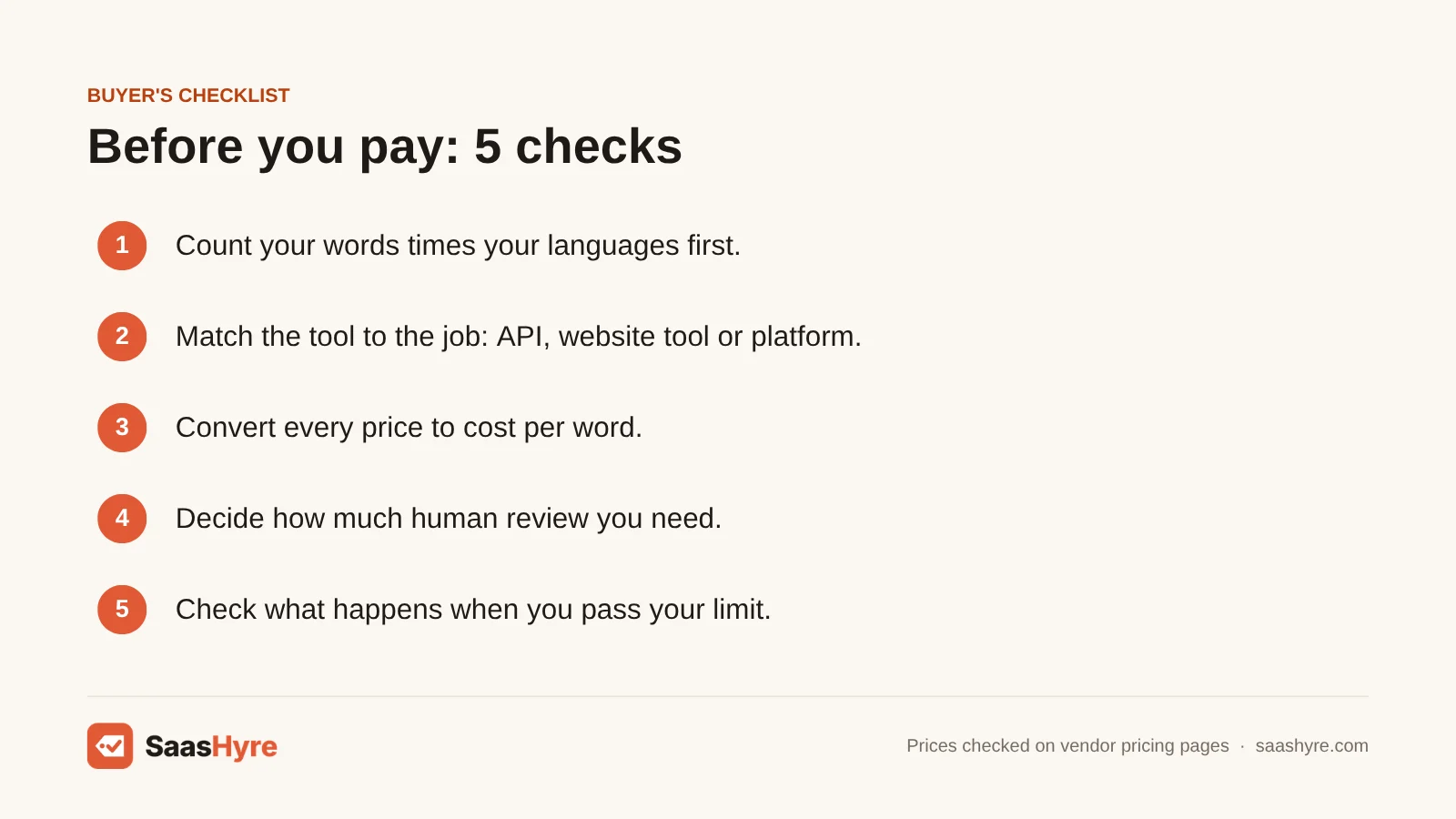
- Count words times languages. This one number sets your price on every tool here. A 50,000-word site in 4 languages is 200,000 translated words.
- Match the tool to the job. Use an API for apps and bulk text. Use Weglot for a website. Use a platform when a team reviews every release. Translating a help center? Check what your AI knowledge base software supports first.
- Convert every price to one unit. Turn characters, Smartwords and hosted words into cost per word. Only then can you compare.
- Decide how much review you need. Raw AI is cheap. Review costs about $0.12 a word at Smartling. Budget for it only where it matters.
- Check the overage rules. Ask what happens when you pass your limit. Some tools pause, some upgrade you and some bill per unit.
Crowdin’s survey found that 47.4% of teams use more than one translation provider. So you can mix a cheap API with a platform.
How We Researched This Guide
We took every price from the vendor’s own pricing page, help center or official docs on October 2, 2026. We did the cost math ourselves.
We could not confirm a few things. DeepL showed us euro prices, so its US dollar and monthly rates are missing. DeepL’s API Growth rates did not load. Lokalise’s yearly billing rate and Smartcat’s top-up price were not shown. Crowdin’s paid prices did not load, and POEditor’s pages showed two different sets of prices.
We did not test these tools ourselves. Read our editorial policy for how we pick and review products.
Prices last checked: October 2, 2026.
The Bottom Line
You can stop comparing sticker prices now. What matters is your volume and how much help you need around the translation.
Three things to remember. First, raw AI translation is nearly free. Google charges $20 per million characters and Amazon charges $15. Second, the real money goes to workflow and review, which run from $0.06 to $0.12 per word at Smartling. Third, languages multiply everything, so count them early.
Here is your next step. Count the words you need to translate and multiply by your languages. Then run a sample through Google’s free 500,000 characters or Weglot’s 14-day trial. You will soon know which kind of tool you need.
The good news? Reaching customers in their own language has never cost less. Start small, check the output and grow from there.
Frequently Asked Questions
What is the cheapest AI translation software?
Amazon Translate has the lowest published rate at $15 per million characters. Google Cloud Translation costs $20 per million, but its first 500,000 characters are free every month. For small jobs, Google can cost you nothing. Both need a developer.
Is DeepL better than Google Translate for business?
It depends on how you work. DeepL is easier for people who translate documents by hand, since it runs in a browser and handles files. Google Cloud Translation is cheaper per character and built for developers. We did not test output quality, so run your own sample text through both before you decide.
How much does AI translation cost per word?
Raw AI translation through an API costs about $0.0001 per word. That is based on $15 to $20 per million characters and six characters per word. Managed AI translation costs more. Smartling lists machine translation from $0.0075 per word, AI Translation from $0.06 and a human-checked level from $0.12.
Is there free AI translation software?
Yes. Google Cloud Translation gives you 500,000 free characters every month, and DeepL’s free version covers 50,000. Weglot has a free plan for sites with up to 2,000 words in one language. Amazon Translate is free for 2 million characters a month, but only for your first 12 months.
What is the difference between LLM translation and neural machine translation?
Neural machine translation (NMT) is a model trained only to translate. A large language model (LLM) is a general model that can also follow instructions about tone and context. Google sells both. Its NMT model costs $20 per million characters, and its Translation LLM costs $10 per million input characters plus $10 per million output.