
TL;DR: Stripe charges 2.9% + 30¢ per US card payment, plus extra for international cards and currency conversion. The best Stripe alternatives cost about the same or less. Helcim and Adyen pass through card network costs. Square wins for in-person sales. Paddle costs more but handles global sales tax for you. PayPal and Braintree add buyer trust. Pick by how and where you sell.
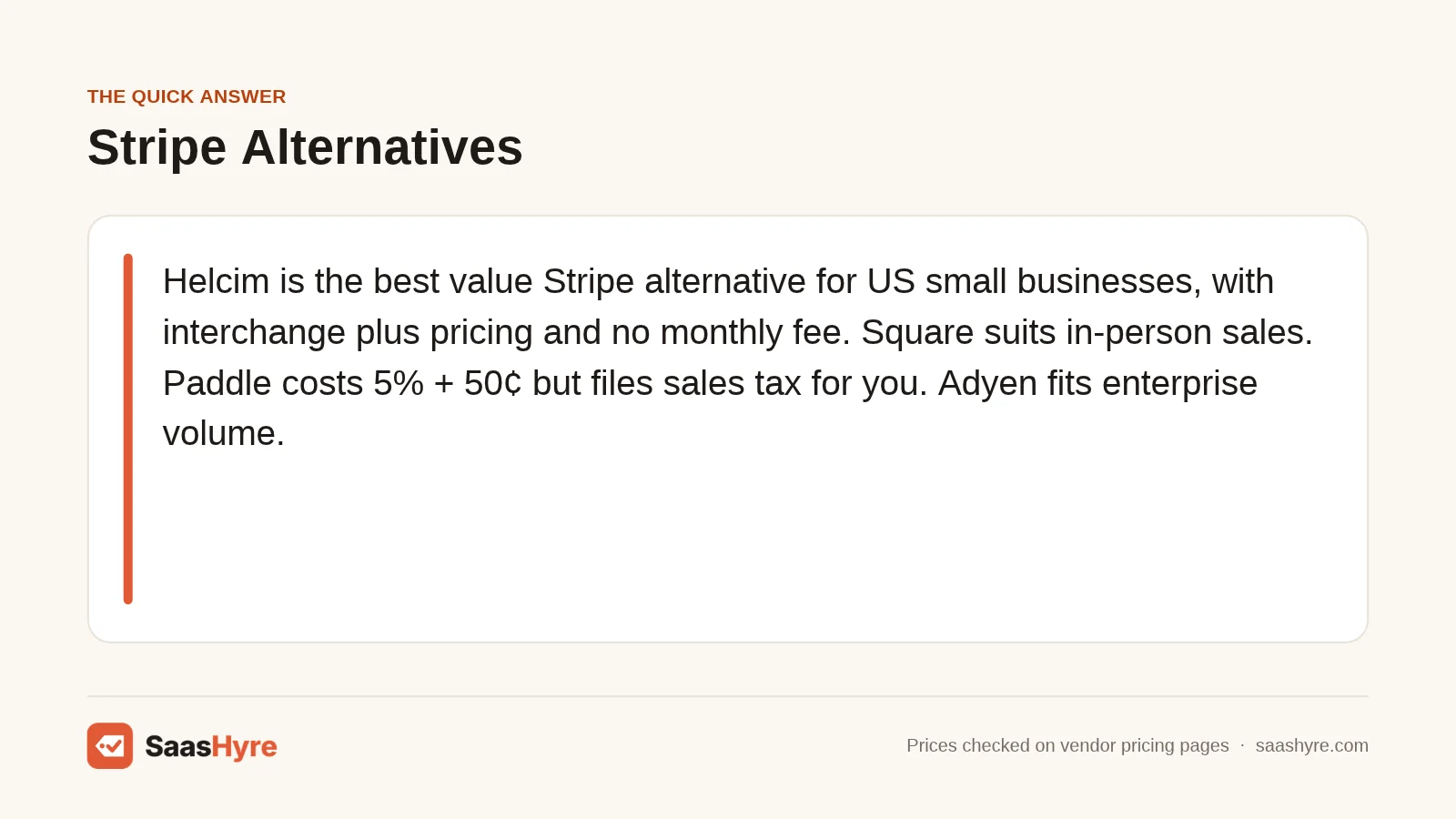
Top pick: Helcim is the best value Stripe alternative for most US small businesses. It has no monthly fee, uses interchange plus pricing, and gets cheaper as your volume grows. If you sell software worldwide and hate tax filing, Paddle is the better pick, even though its 5% + 50¢ fee is higher.
Stripe is a great product. But it is not always the cheapest one. Its standard US rate is 2.9% + 30¢ per successful card charge. International cards add 1.5%. Currency conversion adds another 1%. Disputes cost $15 each, and a second $15 if you counter one. On a busy month, those extras add up fast.
Reviewers notice this too. On Capterra’s Stripe reviews, users praise the integrations but complain about fund holds, costly chargebacks, and limited country access.
This guide is about money. For each Stripe alternative, you will see the real fee from the vendor’s own pricing page, the billing model, and what a year of payments costs. You will also see when Stripe is still the right call. If you are also trimming your accounting stack, our QuickBooks alternatives guide covers the books side of the same problem.
All prices below are US rates as listed in November 2026. Payment fees change often, so click through and check before you sign anything.
Quick Comparison: Stripe Alternatives at a Glance
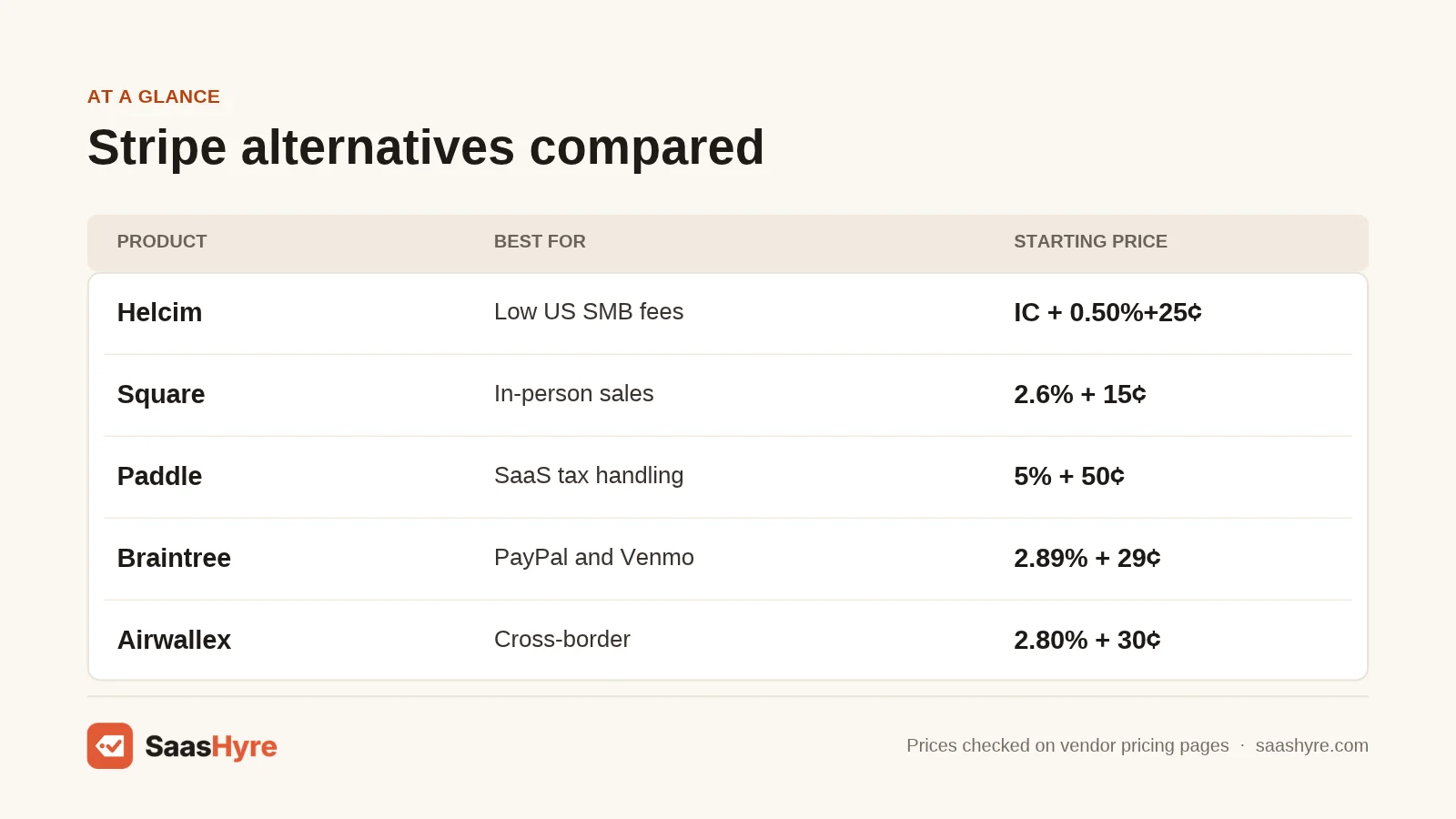
| Tool | Best for | Starting price | Billing | Free plan or trial |
|---|---|---|---|---|
| Helcim | Low fees for US SMBs | Interchange + 0.50% + 25¢ online | Per transaction | No monthly fee |
| Square | In-person and online | 2.6% + 15¢ in person | Per transaction + optional plan | Free plan |
| PayPal | Buyer trust | 2.89% + 29¢ (advanced cards) | Per transaction | No monthly fee |
| Braintree | Developers who want PayPal and Venmo | 2.89% + 29¢ | Per transaction | No monthly fee |
| Paddle | SaaS merchant of record | 5% + 50¢ | Per transaction | No monthly fee |
| Adyen | Global enterprise | Interchange++ + 0.60% + 13¢ | Per transaction, minimum invoice | No |
| Airwallex | Cross-border sellers | 2.80% + 30¢ | Per transaction + optional plan | Free plan |
| Shopify Payments | Shopify stores | 2.9% + 30¢ on Basic | Plan + per transaction | Trial |
| Authorize.net | Keeping your own merchant account | $25/mo + 2.9% + 30¢ | Monthly + per transaction | No |
What Are the Best Stripe Alternatives for Small Businesses?
The best Stripe alternatives for small businesses are Helcim, Square, and PayPal. Helcim has the lowest typical card cost because it uses interchange plus pricing with no monthly fee. Square is best if you also sell in person. PayPal is best when buyers already trust its checkout button.
1 Helcim: Best for lowest fees at small business volume
Helcim is a card processor that charges the network cost plus a small fixed margin.
What it does well. Helcim shows its margins in public. That is rare in card processing. You pay the wholesale interchange cost plus a set markup, and the markup drops as your monthly volume rises.
Key features:
- Interchange plus pricing with automatic volume discounts
- Online payments, invoicing, and in-person card readers
- ACH bank payments capped at $6 each
- No setup, PCI, statement, or cancellation fees
Pricing. Under $50K a month, the margin is 0.40% + 8¢ in person and 0.50% + 25¢ for keyed and online sales, on top of interchange. ACH costs 0.5% + 25¢, capped at $6. Recurring payments add 0.4%. Lost chargebacks cost $15, and won ones cost nothing. See Helcim pricing.
Best for: US and Canadian small businesses that want lower card costs without a contract.
Limitations. Helcim only serves the US and Canada. Interchange plus also means your exact cost changes per card, so monthly statements are harder to predict.
2 Square: Best for selling in person and online
Square bundles payments, a point of sale app, and simple online checkout.
What it does well. Square makes counter sales easy. You can take a tap payment the day you sign up. Its free plan covers most small shops.
Key features:
- Free point of sale app and low-cost card readers
- Online store, invoices, and payment links
- Inventory and staff tools on paid plans
- Flat rates that do not change by card type
Pricing. On the Free plan, in-person sales cost 2.6% + 15¢, online sales cost 3.3% + 30¢, and keyed-in sales cost 3.5% + 15¢. Plus costs $49 a month per location and drops online fees to 2.9% + 30¢. Premium costs $149 a month and cuts in-person fees to 2.4% + 15¢. See Square pricing.
Best for: Retail shops, cafes, and service businesses that sell face to face.
Limitations. Online fees on the Free plan are higher than Stripe’s. Square also offers fewer developer tools for complex subscription billing.
3 PayPal: Best for buyer trust at checkout
PayPal lets buyers pay with their PayPal balance, Venmo, Pay Later, or a card.
What it does well. Many shoppers already have a PayPal login. That can help small or new stores look safe. You also get cards, wallets, and buy now pay later in one account.
Key features:
- PayPal, Venmo, and Pay Later buttons
- Card payments through advanced checkout
- Invoices and payment links
- Seller protection on eligible sales
Pricing. PayPal Checkout costs 3.49% + 49¢. Standard card payments cost 2.99% + 49¢. Advanced card payments cost 2.89% + 29¢. Card chargebacks cost $20. See PayPal pricing.
Best for: Small online stores that want a familiar button next to card checkout.
Limitations. PayPal wallet payments cost more than Stripe cards. The $20 chargeback fee is also higher than Stripe’s $15.
Which Stripe Alternatives Work Best for SaaS and Developers?
For SaaS and developer teams, the strongest Stripe alternatives are Braintree and Paddle. Braintree gives you a flexible API with PayPal and Venmo built in. Paddle acts as your merchant of record, so it collects and files sales tax and VAT for you. Paddle costs more per sale, but it removes a lot of tax work.
4 Braintree: Best for developers who want PayPal and Venmo
Braintree is PayPal’s developer platform for cards, wallets, and bank payments.
What it does well. Braintree gives you one API for cards, PayPal, Venmo, and digital wallets. Its card rate is a bit under Stripe’s headline rate.
Key features:
- Cards, PayPal, Venmo, Apple Pay, and Google Pay
- Recurring billing and card vault
- ACH direct debit capped at $5
- Lower rate for 501(c)(3) charities
Pricing. Cards and wallets cost 2.89% + 29¢. Charities pay 2.19% + 29¢. ACH costs 0.75%, capped at $5. Venmo costs 3.49% + 49¢. Cards issued outside the US add 1%, and chargebacks cost $15. See Braintree pricing.
Best for: Developer teams that want PayPal and Venmo without two separate setups.
Limitations. Braintree’s docs and dashboard feel older than Stripe’s. It also has fewer add-on products for tax, billing, or issuing.
5 Paddle: Best for a SaaS merchant of record
Paddle sells your software on your behalf and handles tax, fraud, and billing.
What it does well. As a merchant of record, Paddle is the legal seller. It collects the right tax rate and files sales tax returns. It also handles chargebacks and buyer support emails.
Key features:
- Global sales tax and VAT collection and filing
- Subscription billing and checkout
- Fraud and chargeback handling
- Free migration help
Pricing. Pay as you go costs 5% + 50¢ per checkout transaction, with no monthly fee. Custom pricing is available for high volume or low price items. See Paddle pricing.
Best for: SaaS and digital product sellers with buyers in many countries.
Limitations. The fee is far higher than raw card processing. It only makes sense if you would otherwise pay for tax tools or an accountant. FastSpring is a similar merchant of record, but it does not publish its rates.
A quick note on Lemon Squeezy. It is another merchant of record at 5% + 50¢ per sale. But its site now says it sells through Link, LLC, and it links to Stripe Managed Payments. So it is not a true escape from Stripe.
Which Stripe Alternatives Are Best for Global and Enterprise Sales?
Adyen and Airwallex are the best Stripe alternatives for global sales. Adyen suits large companies that want interchange++ pricing and one platform across many countries. Airwallex suits smaller cross-border sellers that want low currency conversion costs and multi-currency accounts. Both cut costs on international payments.
6 Adyen: Best for global enterprise volume
Adyen is a single payments platform used by large global brands.
What it does well. Adyen passes interchange and scheme fees through at cost. You then pay a small fixed fee and a payment method fee. At high volume, that can be much cheaper than a blended rate.
Key features:
- Online, in-app, and in-store payments on one platform
- Many local payment methods worldwide
- Risk and fraud tools
- No setup, monthly, or closure fees
Pricing. Visa and Mastercard cost $0.13 + interchange++ + 0.60%. Adyen sets a minimum invoice that depends on your industry, so you need to talk to sales. See Adyen pricing.
Best for: Large merchants with high volume across several countries.
Limitations. Adyen is built for big companies. The minimum invoice and setup work make it a poor fit for small stores.
7 Airwallex: Best for cross-border businesses
Airwallex combines card acceptance with multi-currency accounts and global transfers.
What it does well. Airwallex keeps foreign exchange cheap. You can collect money in one currency and pay suppliers in another without heavy markups.
Key features:
- Online card acceptance and payment links
- Multi-currency business accounts
- Global transfers and spend cards
- API for platforms
Pricing. Domestic cards cost 2.80% + 30¢. International cards cost 4.30% + 30¢. FX costs 0.5% above interbank for major currencies and 1% for others. The Explore plan is free. Grow costs $12 per user a month plus a platform fee. See Airwallex pricing.
Best for: Online businesses that buy and sell in several currencies.
Limitations. The international card rate of 4.30% is only a little below Stripe’s 4.4% (2.9% plus 1.5%), so most savings come from FX. It also has no in-person card readers in the US.
What Are the Best Stripe Alternatives for Ecommerce Stores?
For ecommerce, Shopify Payments and Authorize.net are the main Stripe alternatives. Shopify Payments is the cheapest choice on Shopify, because using another processor adds an extra fee. Authorize.net suits stores that already have a merchant account and want a gateway that works with many carts.
8 Shopify Payments: Best for Shopify stores
Shopify Payments is the built-in processor for Shopify stores.
What it does well. It is set up in minutes and avoids Shopify’s extra fee on outside processors. Rates drop on higher plans.
Key features:
- Built into Shopify checkout and Shop Pay
- One dashboard for orders and payouts
- Lower rates on Grow, Advanced, and Plus
- Works with Shopify POS
Pricing. Basic costs $39 a month, or $29 a month billed yearly, with online cards at 2.9% + 30¢. Grow costs $105, or $89 yearly, at 2.7% + 30¢. Advanced costs $399, or $359 yearly, at 2.5% + 30¢. Using another processor adds 2% on Basic. See Shopify pricing.
Best for: Anyone already selling on Shopify. Our best Shopify apps guide covers the rest of the stack.
Limitations. It only works inside Shopify. You also pay the plan fee on top of card fees.
9 Authorize.net: Best for keeping your own merchant account
Authorize.net is a long-running payment gateway owned by Visa.
What it does well. It works with almost every cart and with many merchant account banks. If you already got a good rate from your bank, you can keep it.
Key features:
- Gateway only or all-in-one plans
- eCheck payments
- Fraud detection suite
- Recurring billing and customer profiles
Pricing. All plans cost $25 a month with no setup fee. The all-in-one plan adds 2.9% + 30¢ per sale. Gateway only costs 10¢ per transaction plus a 10¢ daily batch fee. eCheck costs 0.75%. See Authorize.net pricing.
Best for: Stores with an existing merchant account, or teams on an older cart.
Limitations. The $25 monthly fee hurts at low volume. The tools also feel dated next to Stripe.
How Much Do Stripe Alternatives Cost per Year?
For a store doing $120,000 a year in 2,400 online card sales, Stripe costs about $4,200 in fees. Airwallex, PayPal advanced cards, and Braintree land within $120 of that. Paddle costs about $7,200 but includes tax filing. Helcim and Adyen add interchange on top of a smaller margin.
The table assumes US domestic online cards, a $50 average sale, and no disputes. These are list rates, not quotes.
| Provider | Rate used | Fees per year | Plan fees per year | Estimated total |
|---|---|---|---|---|
| Stripe | 2.9% + 30¢ | $4,200 | $0 | $4,200 |
| Airwallex | 2.80% + 30¢ | $4,080 | $0 on Explore | $4,080 |
| PayPal (advanced cards) | 2.89% + 29¢ | $4,164 | $0 | $4,164 |
| Braintree | 2.89% + 29¢ | $4,164 | $0 | $4,164 |
| Square (Free plan) | 3.3% + 30¢ | $4,680 | $0 | $4,680 |
| Shopify Payments (Basic, yearly) | 2.9% + 30¢ | $4,200 | $348 | $4,548 |
| Authorize.net (all-in-one) | 2.9% + 30¢ | $4,200 | $300 | $4,500 |
| Paddle | 5% + 50¢ | $7,200 | $0 | $7,200 |
| Helcim | Interchange + 0.50% + 25¢ | Interchange + $1,200 | $0 | Varies by card mix |
| Adyen | Interchange++ + 0.60% + 13¢ | Interchange + $1,032 | Minimum invoice | Quote needed |
Two things move these numbers most. First, international buyers. Stripe adds 1.5% for foreign cards and 1% for conversion. Second, disputes. A few chargebacks a month can wipe out a small rate gap.
Which Stripe Alternative Should You Pick?
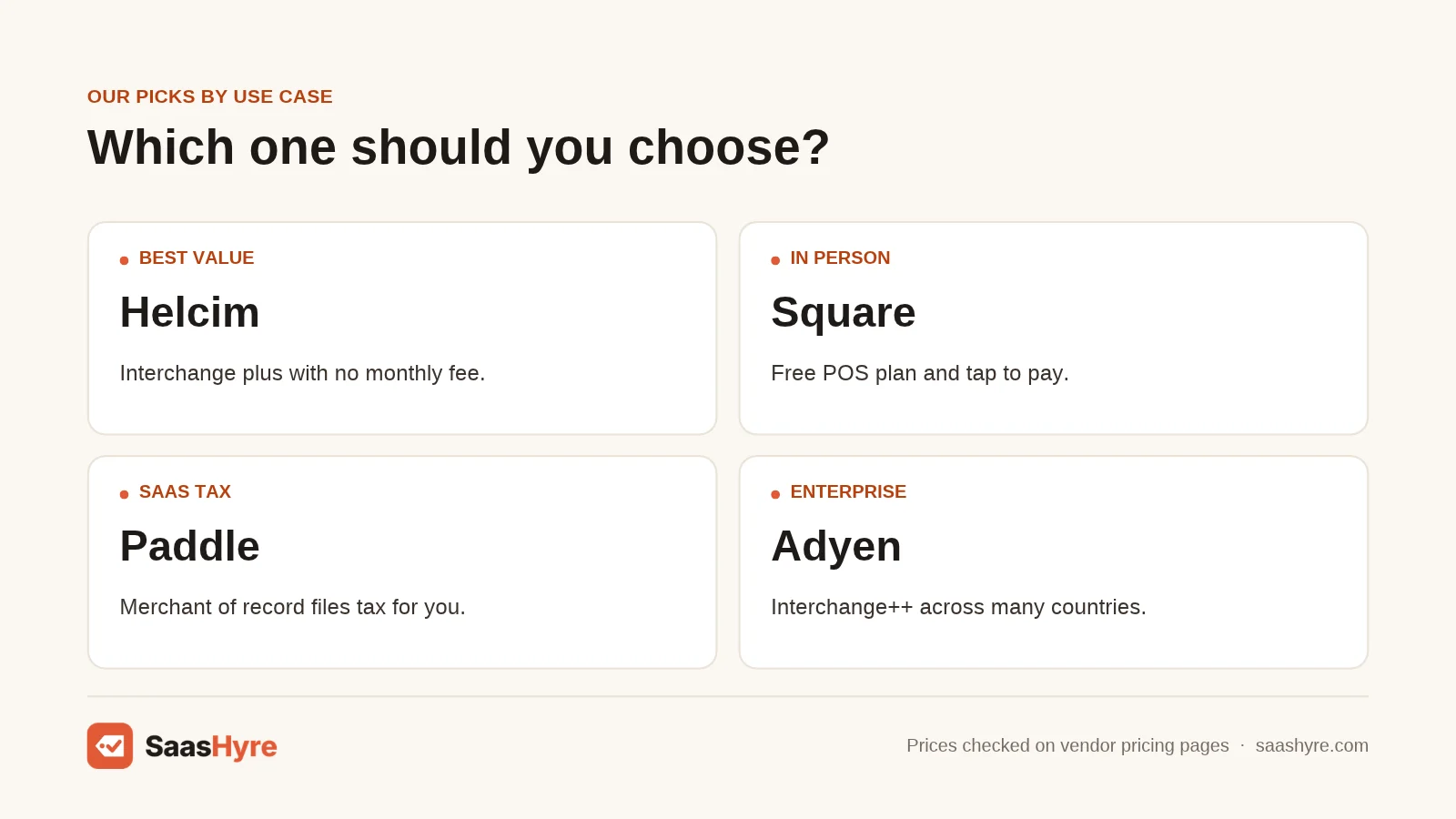
Pick Helcim for low US fees, Square for in-person sales, and Paddle if you sell software worldwide and want tax handled. Pick Shopify Payments if you run Shopify. Pick Adyen only at enterprise volume. If none of these fit better, staying on Stripe is a fine choice.
- Lowest cost for a US small business: Helcim
- Shop with a counter and a website: Square
- Selling SaaS to many countries: Paddle
- Need PayPal and Venmo in your app: Braintree
- Many currencies and suppliers abroad: Airwallex
- Running on Shopify: Shopify Payments
- Global brand with high volume: Adyen
Run a marketplace or platform that pays out to sellers? That is a different problem. See our guide to Stripe Connect alternatives for split payments and payouts.
How to Choose a Stripe Alternative
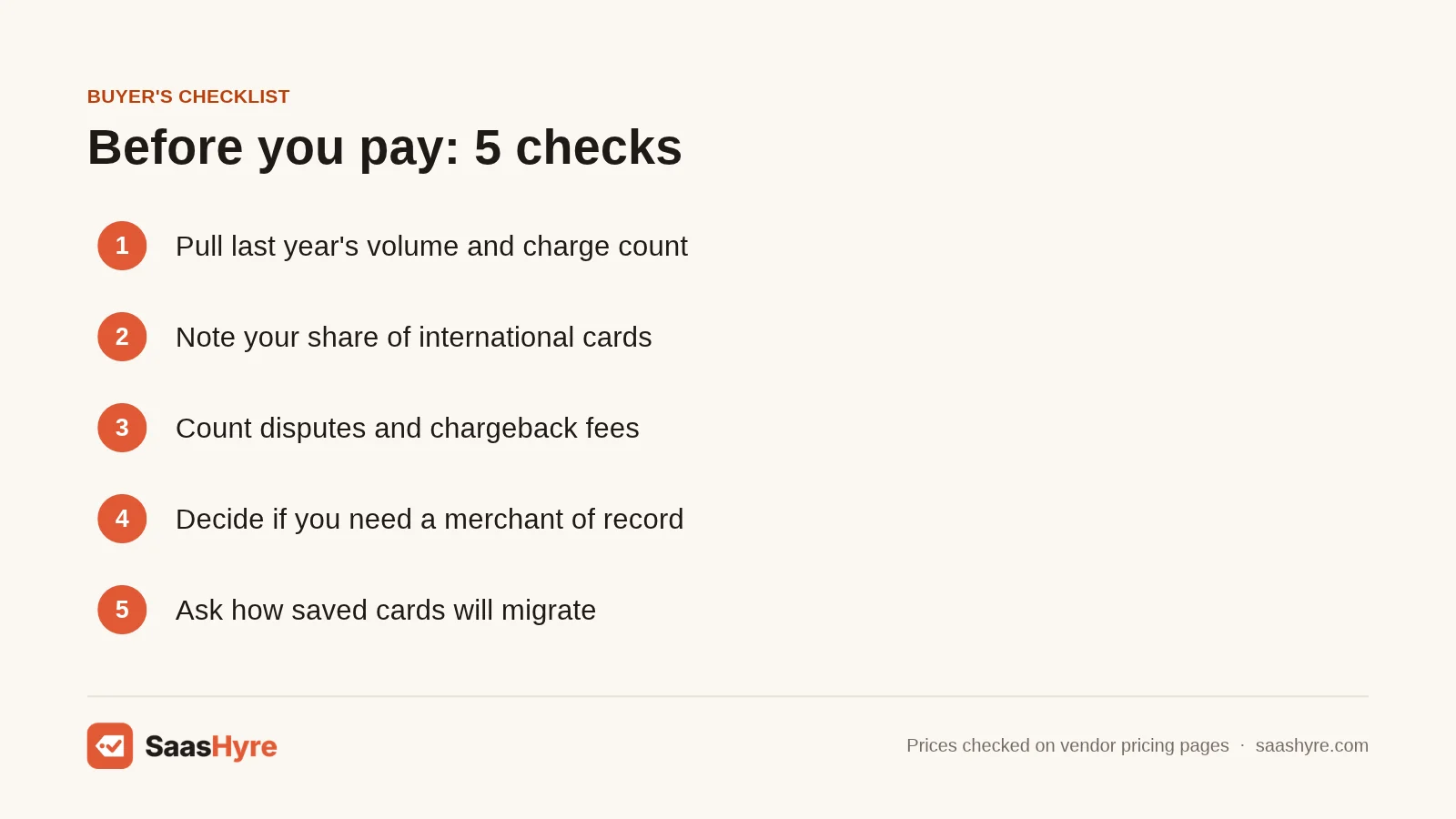
Start with your real numbers, not headline rates. Pull last year’s Stripe report and note four things: total volume, number of charges, share of foreign cards, and number of disputes. Then price each option against those numbers.
- Pricing model. Flat rates are easy to predict. Interchange plus is often cheaper but changes per card.
- Where you sell. In person, online, or both. Not every option has card readers.
- Tax burden. If sales tax and VAT filing eat your time, a merchant of record may pay for itself.
- Countries. Check that the provider supports your business country and your buyers’ payment methods. Wise’s comparison of Stripe alternatives shows how much card fees vary by region.
- Switching cost. Ask whether saved cards and subscriptions can move over. Stripe card data can be exported, but the new provider must accept it.
- Billing tools. If you pair payments with invoicing, see our best AI invoicing software roundup.
How We Picked These Stripe Alternatives
I read the top ranking Stripe alternatives guides, including Zapier’s Stripe alternatives list, and noted which providers came up again and again. I kept the ones that suit US businesses and dropped tools that are now owned by Stripe or closed.
For every price in this article, I read the vendor’s own US pricing page in November 2026. I used list rates, not negotiated deals. The yearly cost table uses one simple scenario so you can compare like for like. I also read Capterra user reviews of Stripe to see why people leave. I did not run live transactions through these providers. Your real rate will depend on your industry, card mix, and risk profile.
Conclusion
Stripe is still a strong default, but its fees are not the lowest for every business. If you are a US small business, Helcim’s interchange plus pricing will likely save you money. If you sell in person, Square is simpler. If you sell software around the world, Paddle costs more per sale but takes tax off your plate.
The smart move is to price your own last 12 months against two or three of these options. Most have no monthly fee, so testing one on a single product or region costs very little. Ask each one about saved card migration before you switch.
Ready to compare? Start with Helcim’s fee calculator, then check Paddle’s pricing if you sell SaaS.
Frequently Asked Questions
What is the cheapest alternative to Stripe?
For most US small businesses, Helcim is the cheapest because it charges interchange plus a small margin with no monthly fee. At very high volume, Adyen’s interchange++ pricing can be cheaper still. For flat rates, Airwallex’s 2.80% + 30¢ domestic card rate sits slightly under Stripe’s 2.9% + 30¢.
Is PayPal cheaper than Stripe?
It depends on the payment type. PayPal’s advanced card rate of 2.89% + 29¢ is slightly cheaper than Stripe’s 2.9% + 30¢. But PayPal Checkout wallet payments cost 3.49% + 49¢, which is more. PayPal’s $20 chargeback fee is also higher than Stripe’s $15.
Is there a Stripe alternative with no monthly fee?
Yes. Helcim, PayPal, Braintree, Paddle, and Square’s Free plan all have no monthly fee. You pay only per transaction. Airwallex’s Explore plan is also free. Authorize.net and Shopify charge a monthly fee on top of card costs.
Which Stripe alternative handles sales tax for me?
Paddle does, because it acts as the merchant of record. It collects the correct tax rate and files sales tax and VAT returns. FastSpring works the same way. Regular processors like Stripe, Square, and Helcim leave tax filing to you.
Can I move my customers’ saved cards from Stripe?
Often, yes. Stripe supports exporting card data to another PCI compliant provider on request. The new provider must agree to import it. Ask about this before you sign, especially if you run subscriptions, because re-collecting cards loses customers.