

TL;DR: The best Chargebee alternatives in 2026 are Stripe Billing (0.7% of billing volume, no monthly fee), Recurly ($249 a month with a 90-day trial), Paddle (5% + 50¢ with sales tax handled), and Maxio ($599 a month for B2B SaaS). Pick Stripe Billing for the lowest cost, Paddle or Lemon Squeezy if you want someone else to handle global tax, and Lago if you want open source.
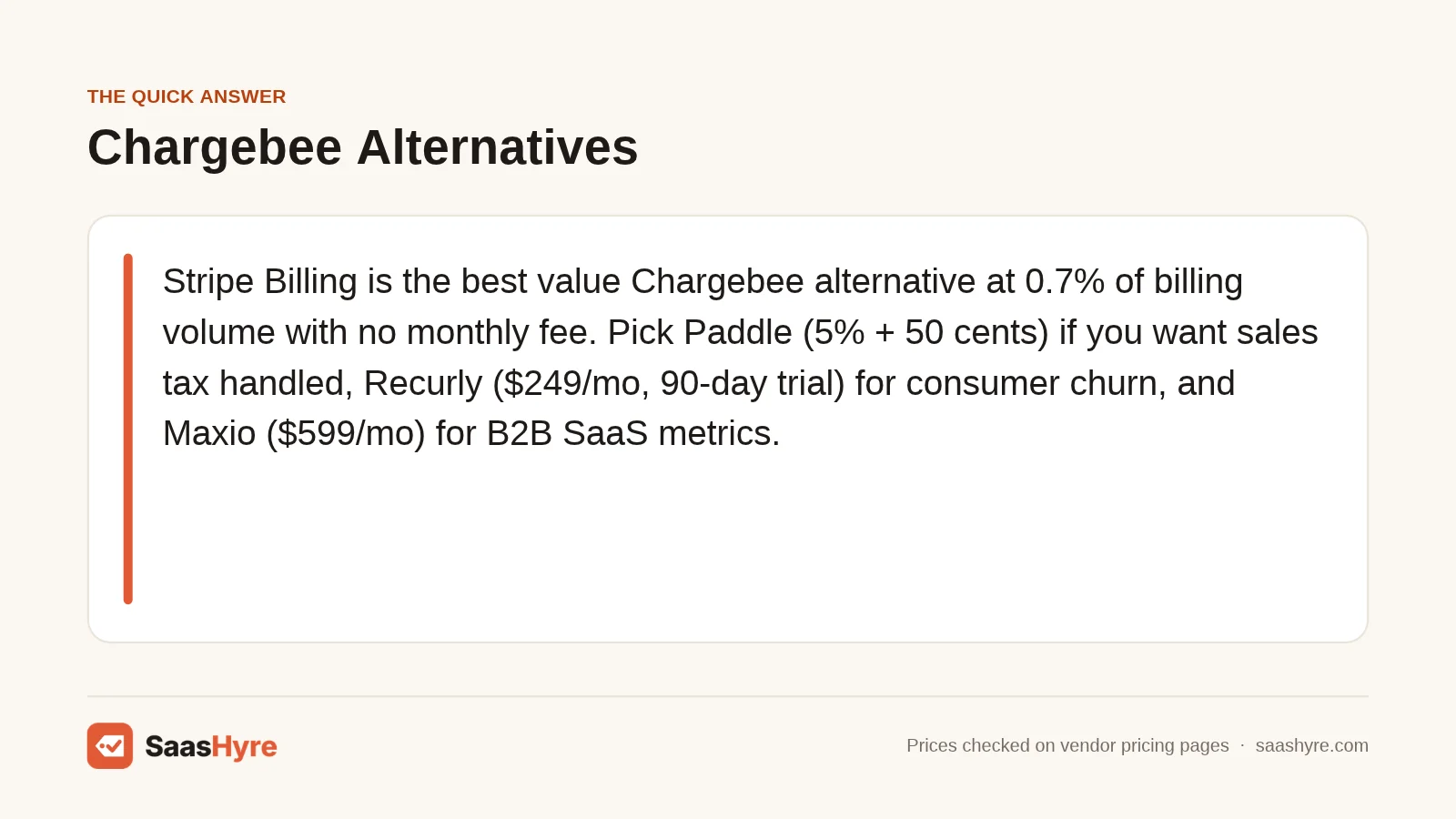
Top pick: Stripe Billing is the best value Chargebee alternative for most SaaS startups. Pay as you go costs 0.7% of billing volume with no recurring fee, which is a little under Chargebee Flow’s 0.80% rate. If you already take payments on Stripe, setup is the fastest of any tool here.
Chargebee is one of the best known subscription billing platforms. It handles plans, trials, invoices, dunning and revenue reports. It even has a $0 Starter tier for small businesses. So why look for Chargebee alternatives?
Cost at scale is the usual reason. On the Chargebee pricing page in November 2026, the calculator showed two rates for the Flow plan: 0.80% of volume, or $99 plus 0.65%. Enterprise is custom. As your revenue grows, that percentage becomes a real line item.
Other teams want something different. Some want a merchant of record that files sales tax and VAT for them. Others want open source billing they can host, or a B2B tool with deeper revenue reports.
This guide compares nine Chargebee alternatives by yearly cost, fee model, trial and best use case. Every price comes from the vendor’s own pricing page. If you sell on Shopify, our guide to the best Shopify subscription apps covers store-native options.
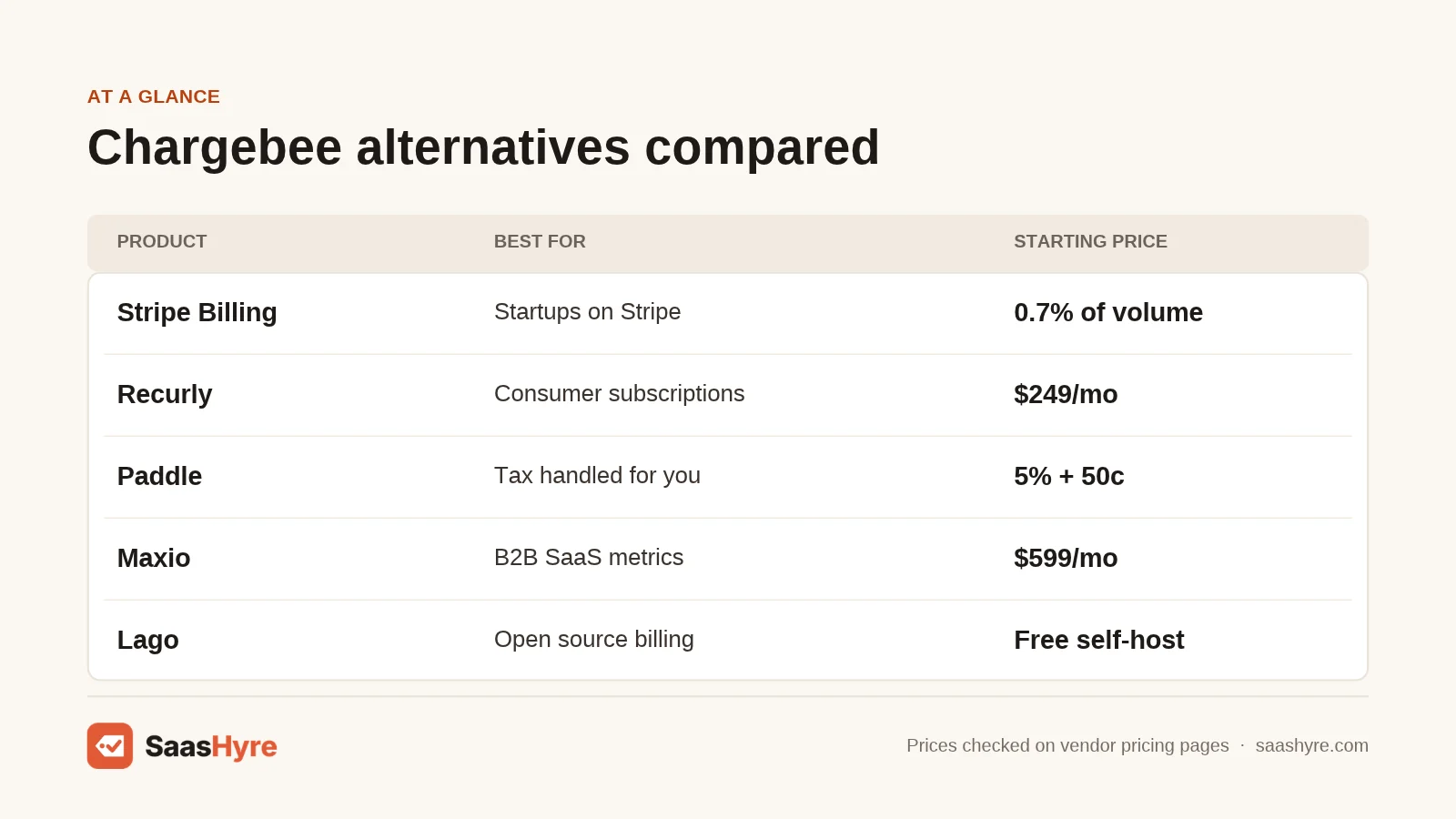
Quick Comparison: Chargebee Alternatives at a Glance
| Tool | Best for | Starting price | Billing | Free plan or trial |
|---|---|---|---|---|
| Stripe Billing | Startups already on Stripe | 0.7% of billing volume | Pay as you go | No monthly fee |
| Recurly | Consumer subscriptions | $249/mo + 0.9% after $40K | Monthly | 90-day trial |
| Maxio | B2B SaaS metrics | $599/mo | Billed annually | Demo |
| Zuora | Enterprise billing | Custom quote | Annual contract | Demo |
| Paddle | Merchant of record for SaaS | 5% + 50¢/transaction | Per sale | No monthly fee |
| Lemon Squeezy | Indie makers and digital products | 5% + 50¢/transaction | Per sale | No monthly fee |
| FastSpring | Established software sellers | Custom revenue share | Per sale | Free trial (terms not listed) |
| Zoho Billing | Small firms on Zoho | Check current price | Monthly or yearly | Free trial |
| Lago | Open source usage billing | Free to self-host; Premium on request | Custom | Open source |
Why Do SaaS Companies Look for a Chargebee Alternative?
Most companies switch over cost, tax or fit. Chargebee Flow charges a share of your billing volume, which grows with revenue. It does not act as your merchant of record. And some teams want open source, deeper B2B reporting, or a tool built into their payment processor.
Chargebee is still strong. Its Starter tier is $0 for single-brand businesses with hundreds of subscribers, per its pricing page. It supports 40+ payment gateways on Flow. Before you move, list the exact problem you want to fix.
Users rate it well. Chargebee holds 4.3 out of 5 from 122 reviews on Capterra. Most switches are about cost and fit, not a broken product.
Common reasons include:
- Billing fees that rise with every new dollar of revenue.
- The need to collect and file sales tax and VAT worldwide.
- Pricing that needs a sales call to understand.
- A wish for open source code and full data control.
Other roundups list similar names. Orb’s Chargebee alternatives guide covers Stripe, Recurly, Zoho Billing and Maxio. Dodo Payments’ list adds Paddle, Lemon Squeezy, FastSpring and Zuora. Both are written by billing vendors, so read their own rankings with care.
Which Billing Platforms Are the Closest Chargebee Replacements?
Stripe Billing, Recurly, Maxio and Zuora are the closest like-for-like swaps. They manage subscriptions while you stay the seller. Stripe Billing is cheapest at 0.7% of volume. Recurly suits consumer brands. Maxio and Zuora suit B2B and enterprise finance teams.
1 Stripe Billing: Best for startups already on Stripe
Stripe’s subscription and invoicing layer, built into the payment platform many SaaS startups already use.
What it does well. There is almost no setup if you already take payments on Stripe. Plans, trials, coupons, usage billing and smart retries live in the same dashboard as your payments.
Key features:
- Recurring, usage-based and tiered pricing
- Customer portal for plan changes and cancellations
- Smart retries and dunning emails
- Revenue and churn reports
- Works with Stripe Tax and Stripe Invoicing
Pricing. Pay as you go is 0.7% of Billing volume with no recurring fees. Annual contracts billed monthly start at $620 a month for up to $100,000 in volume. Card processing is separate at 2.9% + 30¢ per charge. See Stripe Billing pricing.
Best for: Early and mid-stage SaaS teams that want low fees and developer-friendly tools.
Limitations. It ties you to Stripe as your main processor. Complex B2B contracts and multi-entity setups take custom work. Processing fees sit on top of the billing fee.
2 Recurly: Best for consumer subscriptions
A subscription management platform known for churn tools and support for consumer and media brands.
What it does well. Recurly is built to keep subscribers. Its retry logic and churn tools target failed payments, and the Starter plan includes a generous trial.
Key features:
- Revenue recovery and dunning tools
- Multiple payment gateways
- Subscriber analytics
- Shopify edition for store brands
- Free sandbox for testing
Pricing. Starter is $249 a month plus 0.9% of billing volume, with the first $40K of billings each month at no charge. It has a 90-day free trial. All-Access is billed annually and requires a $1M billing volume minimum. See Recurly pricing.
Best for: Consumer subscription, streaming and box brands that care most about churn.
Limitations. The $249 base fee is high for tiny startups. Higher tiers need a sales call. RevRec and Engage are separate products with their own fees.
3 Maxio: Best for B2B SaaS metrics
The platform formed from Chargify and SaaSOptics, focused on B2B billing and SaaS financial reports.
What it does well. Maxio is strong on the finance side. It ties billing to SaaS metrics like MRR, churn and cohorts, and it includes unlimited users at no extra charge.
Key features:
- Subscription and usage billing
- SaaS metrics and cohort reports
- Revenue recognition add-on
- A/R management and multi-entity add-ons
- Unlimited users
Pricing. Grow is $599 a month for businesses with up to $100K in monthly billings. Scale is custom. Default agreements are billed annually, with monthly or quarterly payment as premium options. See Maxio pricing.
Best for: B2B SaaS companies with a finance team that lives in metrics.
Limitations. There is no self-serve trial listed. Annual billing is the default. Key modules are priced separately.
4 Zuora: Best for enterprise billing
An enterprise monetization suite for complex pricing, contracts and global billing.
What it does well. It handles the hardest cases. Large companies use it for multi-product bundles, complex contracts and revenue rules across many entities.
Key features:
- Quote to cash workflows
- Usage and hybrid pricing models
- Revenue recognition
- Multi-entity and multi-currency billing
Pricing. Zuora does not publish list prices. Pricing is by custom quote on an annual contract, so check the current price with its sales team. See Zuora pricing.
Best for: Large enterprises with complex contracts and a dedicated billing team.
Limitations. It is overkill for most startups. Rollouts can take months. You cannot see a price without talking to sales.
Which Chargebee Alternatives Handle Sales Tax for You?
Paddle and Lemon Squeezy act as your merchant of record. That means they sell to the customer, then collect and file sales tax and VAT for you. Both charge 5% + 50¢ per transaction with no monthly fee, per their pricing pages.
5 Paddle: Best for merchant of record for SaaS
A merchant of record that bundles checkout, subscriptions, payments and global tax for software companies.
What it does well. You stop worrying about tax. Paddle collects the right rate and files returns. It also handles chargebacks, fraud screening and buyer billing support.
Key features:
- Branded checkout
- Subscription management
- Sales tax and VAT collection and filing
- Fraud and chargeback handling
- Subscriber migration service
Pricing. Pay as you go is 5% + 50¢ per checkout transaction. Paddle says there are no monthly fees or migration fees. Sellers of products under $10 should ask for custom pricing. See Paddle pricing.
Best for: SaaS teams selling worldwide that want tax and compliance off their plate.
Limitations. 5% is far higher than a 0.7% billing fee, though it includes payments and tax. Paddle becomes the seller on invoices. Some B2B buyers prefer to buy direct.
6 Lemon Squeezy: Best for indie makers and digital products
A simple merchant of record for software, courses and digital downloads.
What it does well. It is the easiest way to start selling. You get a hosted store, subscriptions, license keys and global tax handling with no monthly bill.
Key features:
- Hosted checkout and storefront
- Subscriptions and license keys
- Global tax handling as merchant of record
- Affiliate program tools
Pricing. Lemon Squeezy charges 5% + 50¢ per sale with no monthly fees. Its site notes that some payments, including non-US sales, may carry small extra fees. See Lemon Squeezy pricing.
Best for: Solo founders and small teams selling apps, plugins or digital products.
Limitations. Extra fees for edge cases are not listed as fixed amounts. Advanced B2B billing is limited. Fees add up fast at higher revenue.
7 FastSpring: Best for established software sellers
A long-running merchant of record for software, games and SaaS, with checkout, subscriptions and global tax.
What it does well. It is a mature Paddle rival. FastSpring handles payments, tax and compliance worldwide, and it offers lower rates for ACH and wire payments.
Key features:
- Global checkout in many currencies
- Subscription management
- Sales tax and VAT handling as merchant of record
- Custom quotes with all features included
Pricing. FastSpring takes a revenue share on each transaction, and the rate depends on your volume. It publishes no fixed rate or tiers. There is no minimum volume, and custom rates come from sales, so check the current price. See FastSpring pricing.
Best for: Software and game companies with steady volume that want a negotiated merchant of record rate.
Limitations. You cannot see a rate without a quote. Trial terms are not listed. Like Paddle, it becomes the seller of record on your invoices.
Which Chargebee Alternatives Suit Small Businesses and Developers?
Zoho Billing is a good fit if you already use Zoho Books or Zoho CRM. Lago is the pick for developers who want open source usage billing they can host. Both give you more control over cost than a percent-of-revenue model.
8 Zoho Billing: Best for small firms on Zoho
Zoho’s recurring billing and subscription app, formerly Zoho Subscriptions.
What it does well. It plugs into the rest of Zoho. Invoices flow to Zoho Books and customer data syncs with Zoho CRM, which saves manual work.
Key features:
- Recurring invoices and subscriptions
- Customer self-service portal
- Dunning and payment reminders
- Native Zoho Books and CRM sync
Pricing. Zoho Billing uses flat monthly or yearly plans rather than a share of revenue. The pricing page did not load when I checked in November 2026, so check the current price. See Zoho Billing pricing.
Best for: Small service and SaaS firms already on Zoho apps.
Limitations. It is less suited to complex usage pricing. Limits vary by plan. Prices vary by region.
9 Lago: Best for open source usage billing
An open source metering and billing engine for usage-based and hybrid pricing.
What it does well. You own the code and the data. Developers can self-host the open source project from GitHub and meter events for API, AI or infrastructure pricing.
Key features:
- Event-based usage metering
- Hybrid subscription and usage plans
- Self-hosted or cloud deployment
- API-first design
Pricing. The open source project is on GitHub for self-hosting. Lago Premium, for cloud or self-hosted use, has no public price and needs a demo, so check the current price. See Lago pricing.
Best for: Developer-led teams with usage-based pricing and the skills to host software.
Limitations. Self-hosting means you run servers and updates. Premium features need a sales call. Finance teams may want more ready-made reports.
Which Chargebee Alternative Should You Pick for Your Use Case?
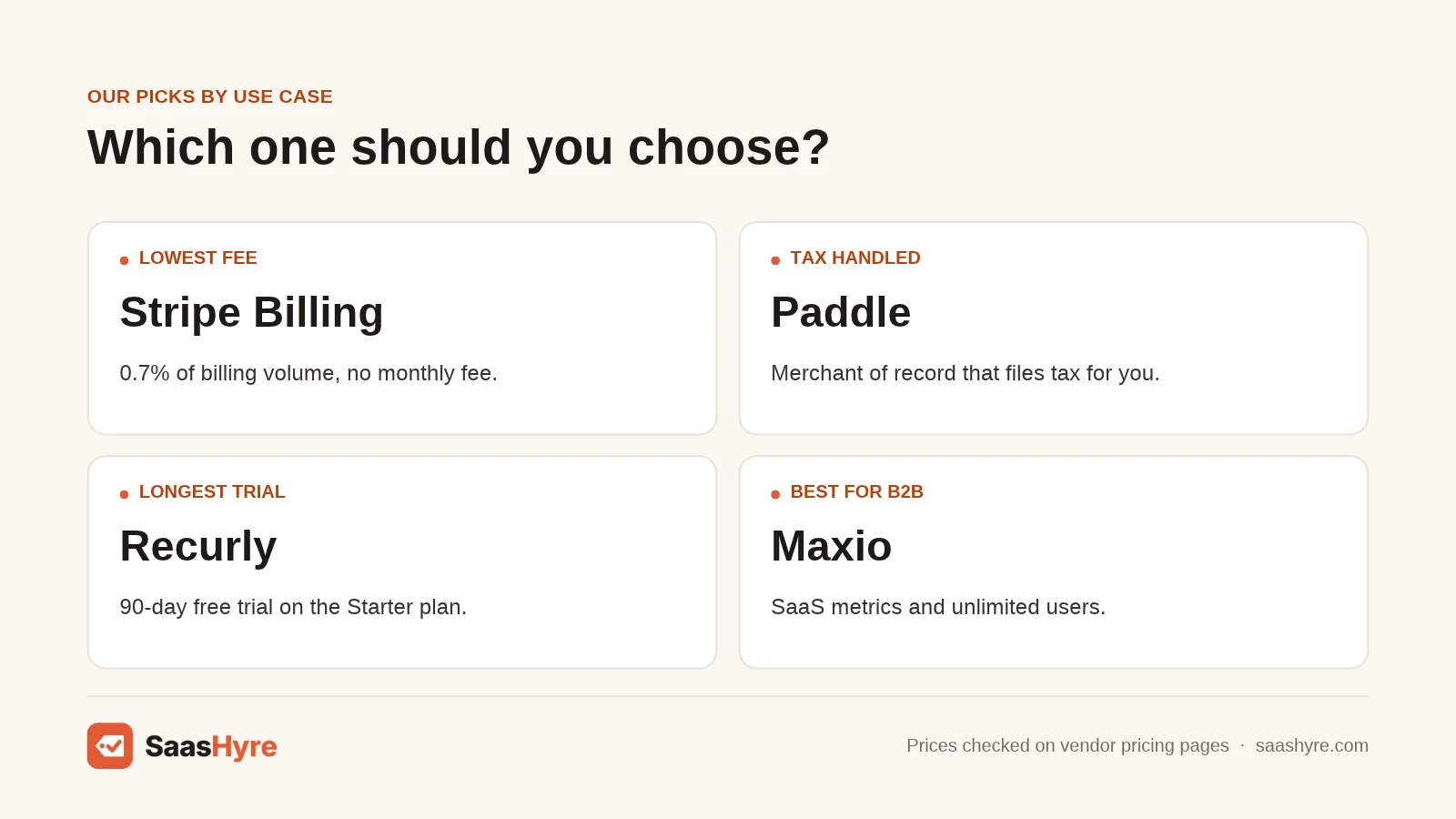
Match the tool to your business model. Stripe Billing is best for low cost. Paddle or Lemon Squeezy is best if you want tax handled. Recurly fits consumer churn, Maxio fits B2B finance, Zuora fits enterprise, and Lago fits open source usage billing.
| If you need | Pick | Why |
|---|---|---|
| Lowest billing fee | Stripe Billing | 0.7% of volume, no monthly fee |
| Global tax handled | Paddle | Merchant of record at 5% + 50¢ |
| A negotiated MoR rate | FastSpring | Custom revenue share, no minimum |
| A long free trial | Recurly | 90-day trial on Starter |
| B2B SaaS metrics | Maxio | MRR and cohort reports, $599/mo |
| Complex enterprise deals | Zuora | Quote to cash and revenue rules |
| Open source control | Lago | Self-host from GitHub |
| Digital products, solo | Lemon Squeezy | Store and tax in one, no monthly fee |
How Much Do Chargebee Alternatives Cost per Year?
At $10,000 a month in billings ($120,000 a year), yearly costs range from about $840 for Stripe Billing to $7,188 for Maxio Grow. Merchant of record tools cost more, about $6,000 plus per-sale fees, but they include payments and tax.
| Tool | Fee model | Yearly cost at $120K billings |
|---|---|---|
| Chargebee Flow | 0.80% of volume | About $960 |
| Stripe Billing | 0.7% of volume | About $840, plus card fees |
| Recurly Starter | $249/mo + 0.9% after $40K/mo | About $2,988 (volume under the free $40K) |
| Maxio Grow | $599/mo, billed annually | $7,188 |
| Paddle | 5% + 50¢ per sale | About $6,000 plus 50¢ per sale |
| Lemon Squeezy | 5% + 50¢ per sale | About $6,000 plus 50¢ per sale |
| FastSpring | Revenue share by volume | Check the current price |
| Zuora | Custom | Check the current price |
| Zoho Billing | Flat plan | Check the current price |
| Lago | Open source or Premium | $0 license to self-host, plus hosting |
These are my own estimates from list prices. Chargebee, Stripe, Recurly and Maxio do not include card processing, which often runs near 2.9% + 30¢ on cards. Paddle and Lemon Squeezy include payment processing and tax, so compare total cost, not just the billing fee.
How Do You Migrate Off Chargebee Without Losing Subscribers?
Plan the move in four steps. Export your customers and plans, move saved card tokens processor to processor, run both systems side by side for one billing cycle, and only then switch off Chargebee. Never ask customers to re-enter cards unless you must.
- Export customers, plans, coupons and invoice history from Chargebee first.
- Ask your current payment gateway to transfer card tokens to the new vendor. This avoids re-collecting cards.
- Map every Chargebee plan and add-on to a plan in the new tool before import.
- Test renewals, upgrades and failed payments in a sandbox.
- Run one billing cycle in parallel and compare totals line by line.
- Tell customers ahead of time if invoices or receipts will look different.
Merchant of record moves take more care, since the new vendor becomes the seller. Paddle lists a migration service on its pricing page, so ask each vendor what help is included.
How to Choose the Right Chargebee Alternative
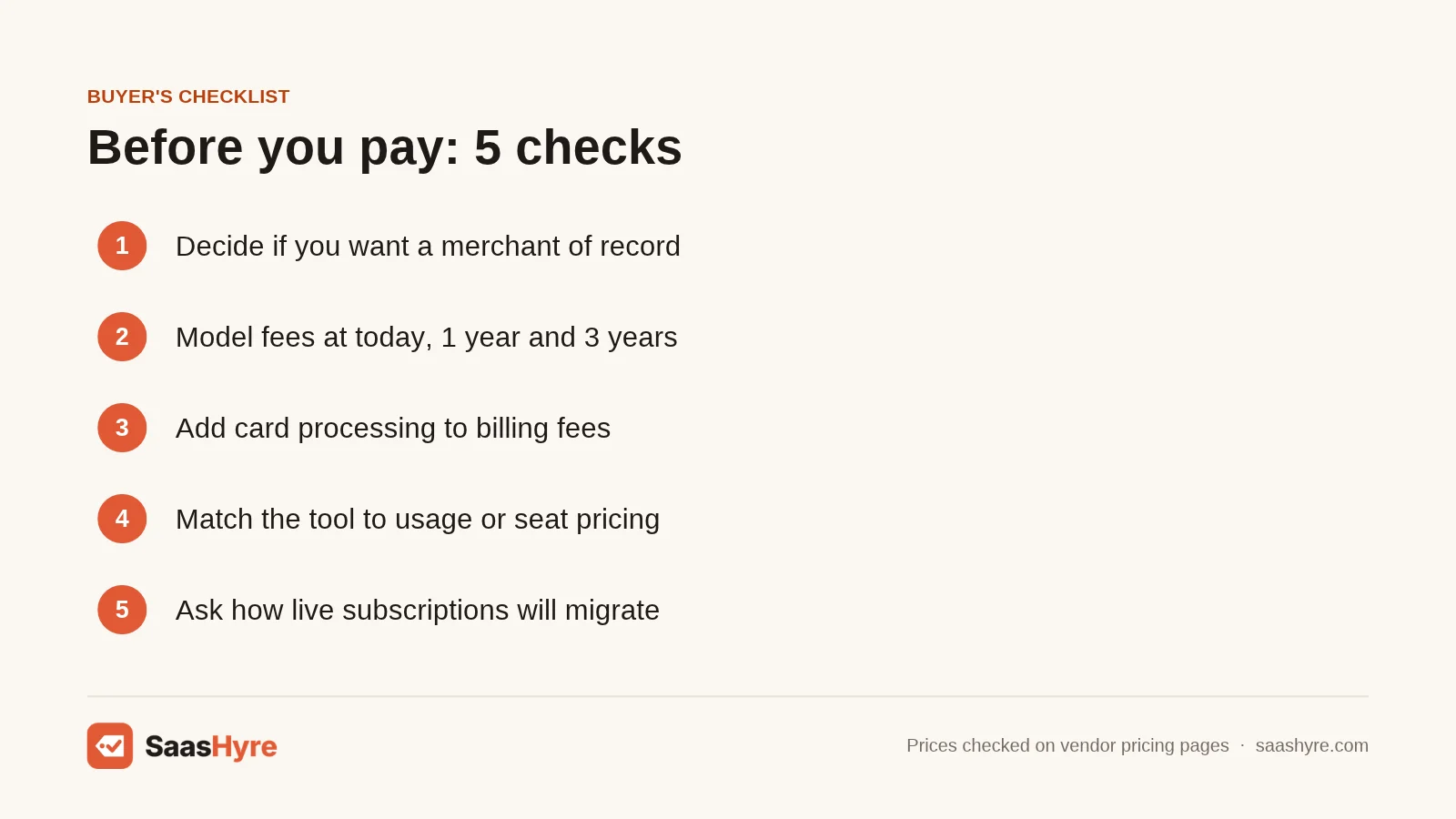
First, decide who should be the seller. If you want to keep your own merchant account, pick a billing tool like Stripe Billing, Recurly or Maxio. If you want tax handled, pick a merchant of record like Paddle.
Second, model your cost at three revenue levels: today, in one year and in three years. Percentage fees feel cheap early and grow later. Flat fees feel high early and shrink as a share of revenue.
Third, check your pricing model. Usage pricing needs strong metering, which Lago and Stripe handle well. Seat-based B2B deals with contracts fit Maxio or Zuora.
Fourth, plan the migration. Ask each vendor how they move card tokens and active subscriptions. Paddle lists a migration service. A failed migration can cost more than a year of fees. For invoicing on the side, see our best AI invoicing software guide, and our AI accounts receivable software list for collections.
How Did I Compare These Chargebee Alternatives?
I read each vendor’s own pricing page in November 2026 and noted the fee model, base fee, trial and billing terms. I did not run hands-on tests. Yearly costs are my estimates at $10,000 in monthly billings using list prices only.
I ranked tools on four factors: yearly cost at a common revenue level, how clear the pricing is, whether tax is handled, and fit for a specific business model. Where a vendor hides prices, I say so and link to the page. If you also sell with quotes, our best CPQ software guide pairs well with this list.
Conclusion: The Best Chargebee Alternative for Your Stage
Chargebee is a solid platform, and its $0 Starter tier is generous. But its Flow plan takes a share of every dollar you bill, and it does not handle tax filing as a merchant of record.
For the lowest fee, pick Stripe Billing at 0.7% of volume. For tax-free peace of mind, pick Paddle or Lemon Squeezy. For a long test run, Recurly’s 90-day trial is the best here. B2B finance teams should look at Maxio.
Take your last three months of billing data and plug it into the cost table above. Then start a trial or book a demo with your top two picks this week. Ask each one exactly how they will migrate your live subscribers.
Frequently Asked Questions
What is the cheapest Chargebee alternative?
Stripe Billing is the cheapest paid option on list price. Pay as you go costs 0.7% of billing volume with no recurring fee. Lago’s open source project is free to self-host, but you pay for hosting and upkeep.
Is Chargebee free?
Partly. Chargebee lists a $0 Starter tier for single-brand businesses with hundreds of subscribers. The Flow plan charges a share of billing volume, and Enterprise is custom. Check the Chargebee pricing page for limits.
Is Paddle better than Chargebee?
It depends on your needs. Paddle is a merchant of record, so it handles sales tax, VAT and payments for 5% + 50 cents per sale. Chargebee is cheaper per dollar but leaves tax and payment processing to you.
Does Stripe Billing replace Chargebee?
For most startups, yes. Stripe Billing covers plans, trials, usage billing, dunning and a customer portal. Large B2B companies with complex contracts may still prefer Maxio, Zuora or Chargebee Enterprise.
Which Chargebee alternative has the longest free trial?
Recurly has the longest trial in this list. Its Starter plan includes a 90-day free trial, per its pricing page. Stripe Billing, Paddle and Lemon Squeezy have no monthly fee, so you only pay when you bill.