

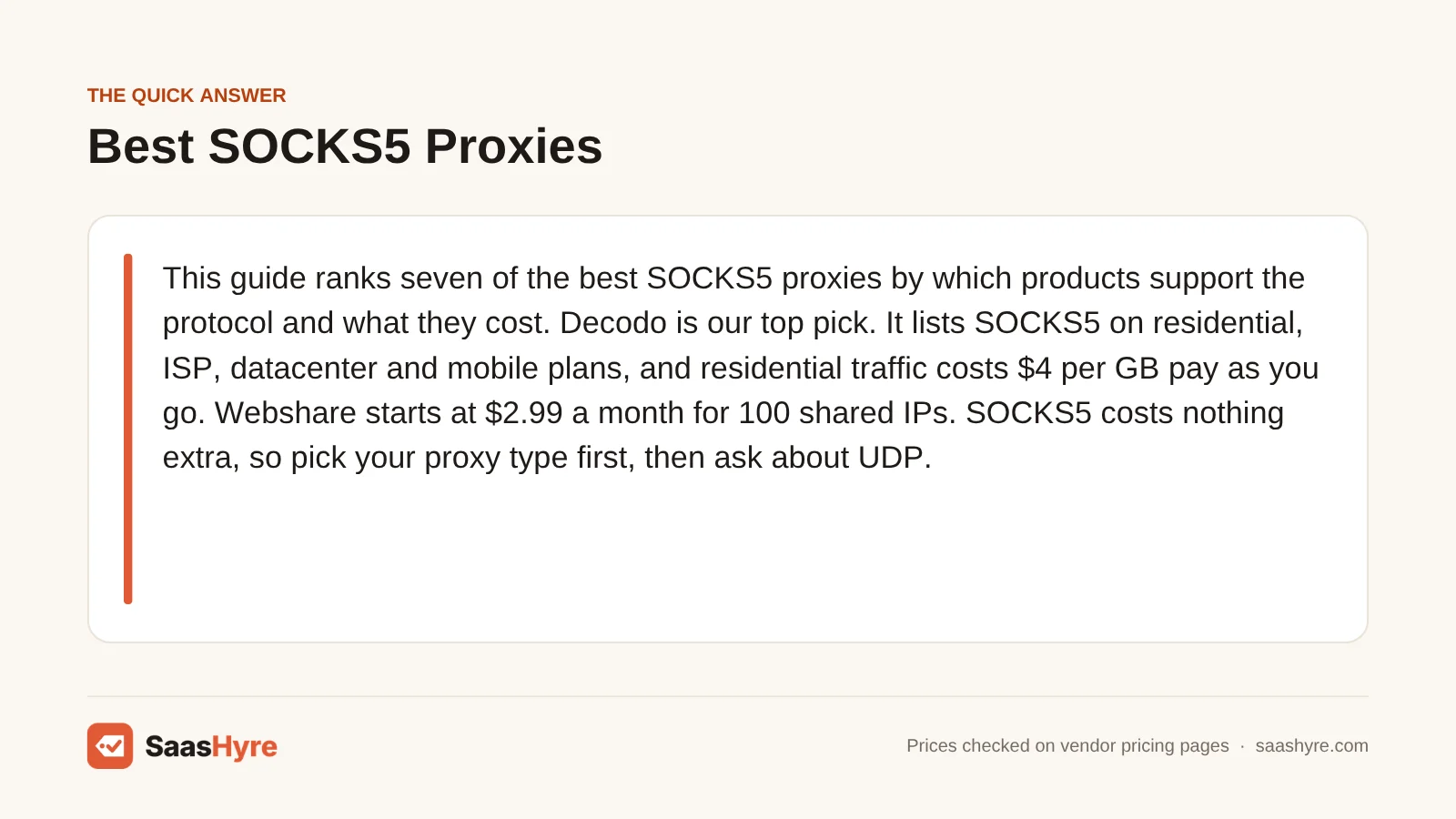
TL;DR: This guide ranks seven of the best SOCKS5 proxies by which products support the protocol and what they cost. Decodo is our top pick. It lists SOCKS5 on residential, ISP, datacenter and mobile plans, and residential traffic costs $4 per GB pay as you go. Webshare starts at $2.99 a month for 100 shared IPs. SOCKS5 costs nothing extra, so pick your proxy type first, then ask about UDP.
Looking for the best SOCKS5 proxies? You almost never buy “a SOCKS5 proxy”. You buy a residential, ISP, datacenter or mobile plan, and SOCKS5 is a free setting on it.
A proxy is a middle server that sends your traffic from its own IP address. An IP address is the number that identifies a device online. SOCKS5 is one of the protocols, or languages, your app can use to talk to that server.
Support is wide but uneven. Proxyway’s 2026 research found SOCKS5 on 12 of the 13 residential services it tested. Only 3 offered UDP by default. UDP is a fast way to send data that some apps need.
So I read each vendor’s own pages on October 7, 2026. I noted which products list SOCKS5 and what each costs.
We did not test these proxies, and no vendor pays to be ranked here. Performance notes come from named third parties.
New to proxies? Our best proxy providers guide compares every proxy type and price first.
What Is a SOCKS5 Proxy, and How Is It Different From an HTTP Proxy?
A SOCKS5 proxy is a middle server that passes any kind of internet traffic without reading it. The standard behind it, RFC 1928, added UDP, logins, domain names and IPv6 addresses to the older SOCKS4. An HTTP proxy only understands web requests. SOCKS5 adds no encryption of its own.
SOCKS5 is defined in RFC 1928, published in March 1996. An RFC is a public document that sets out how an internet protocol works. It defines four things.
- Three commands. CONNECT opens a TCP connection, the ordered way most web traffic travels. BIND accepts an incoming connection. UDP ASSOCIATE relays UDP packets.
- Three address types. You can send an IPv4 address, a domain name or an IPv6 address. With a domain name, the proxy looks up the site for you.
- Three login methods. They are no login, GSSAPI and username with password.
- One usual port. The RFC puts the service on TCP port 1080 by convention. Vendors pick their own. DataImpulse uses 824, and Evomi uses 1002.
Now the SOCKS5 vs HTTP proxy question. An HTTP proxy speaks the language of the web. MDN explains that it uses the CONNECT method to open a tunnel for HTTPS traffic. It can also add headers such as X-Forwarded-For, which names the IP a request came from.
SOCKS5 works one level lower. The RFC calls it a “shim-layer” between the application and the transport layer.
So when do you need it? Pick SOCKS5 when your tool only accepts SOCKS5, or when your traffic isn’t web traffic. Nothing in the RFC promises more speed.
A SOCKS5 Proxy Is Not a VPN
Here for privacy or torrents? Read this part first.
Cloudflare defines a VPN as a service that “encrypts Internet communications”. SOCKS5 does not. RFC 1928 has no encryption built in. It only leaves room for a login method to add protection.
The common login adds none. The standard for username and password logins, RFC 1929, says the request “carries the password in cleartext”. Evomi, for one, accepts only username and password logins.
A SOCKS5 proxy swaps the IP address a site sees. It does not hide your traffic from your internet provider or from the proxy owner. Only the app itself can do that, for example by using HTTPS.
The providers below sell to businesses. Their plans fit work like collecting public web data, SEO and price monitoring, ad checks and app testing. Proxy-Seller’s terms ban torrents and piracy. Decodo blocks streaming and mailing sites by default.
Want private browsing at home? Use a VPN. For business data work, check each site’s terms and your local law before you start.
What Are the Best SOCKS5 Proxies in 2026?
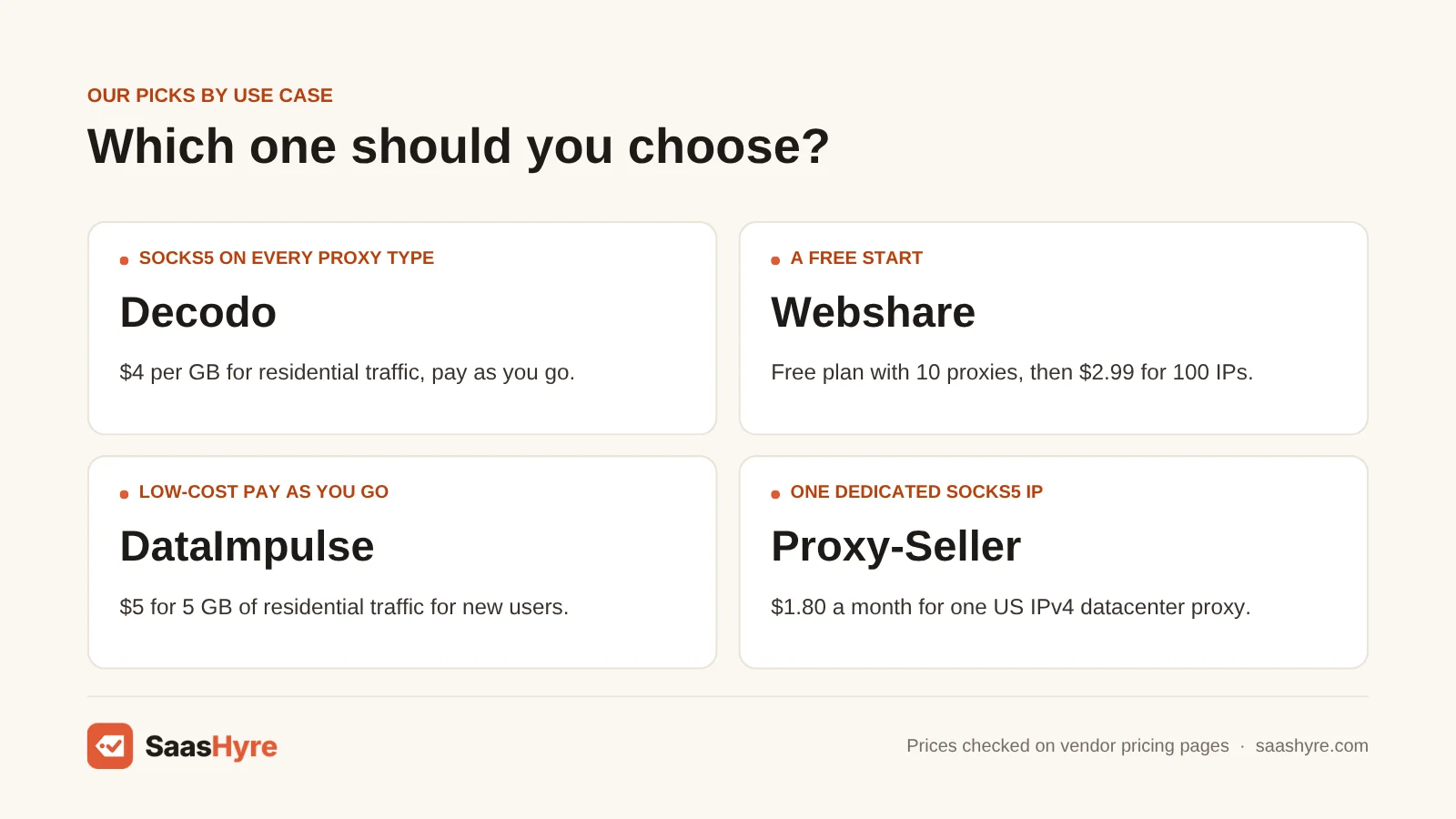
The best SOCKS5 proxies for most buyers come from Decodo, which lists SOCKS5 on residential, ISP, datacenter and mobile plans. Its residential traffic costs $4 per GB pay as you go. Webshare is the cheapest start at $2.99 a month for 100 shared datacenter IPs. Oxylabs covers every proxy type on one $30 monthly plan.
| Provider | Best for | Starting price | Trial or refund |
|---|---|---|---|
| Decodo | SOCKS5 on every proxy type | $4 per GB residential, pay as you go | 3-day trial with a card. 14-day refund, with limits. |
| Oxylabs | Every proxy type on one plan | $30/mo plan, $6 per GB residential | $5 welcome credit. Treat as non-refundable. |
| IPRoyal | Traffic that never expires | $7.35 for 1 GB residential | No free trial published. Refunds end at 100 MB. |
| Evomi | The lowest monthly rate | $49/mo for 100 GB residential | 1-day trial with a card. Capped 30-day refund. |
| Webshare | A free start and cheap IPs | $2.99/mo for 100 shared datacenter IPs | Free plan with 10 proxies. 2-day refund. |
| DataImpulse | Low-cost pay as you go | $5 for 5 GB residential, new users | No free trial. 7-day refund on the Intro plan. |
| Proxy-Seller | One dedicated SOCKS5 IP | $1.80 per datacenter IP a month | No free trial. 72-hour refund for faults. |
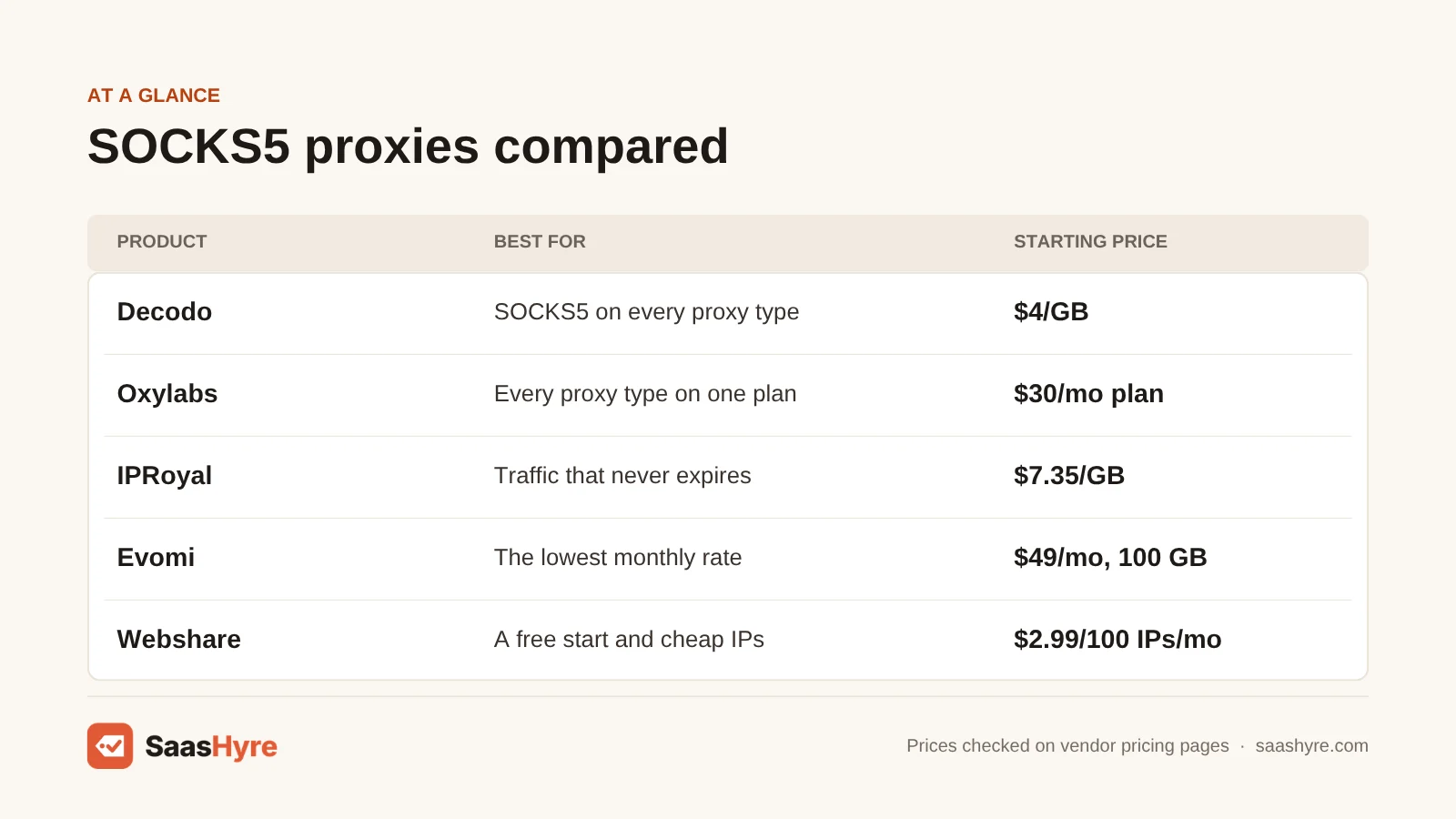
I ranked these SOCKS5 proxy providers on how many products list SOCKS5, the published price and the terms. For the overall ranking, see our guide to the best proxy providers.
This table shows which products list SOCKS5 on each vendor’s pages.
| Provider | Residential | ISP or static residential | Datacenter | Mobile | UDP on residential |
|---|---|---|---|---|---|
| Decodo | Yes | Yes | Yes | Yes | Not on by default |
| Oxylabs | Yes | Yes | Yes | Yes | Not on by default |
| IPRoyal | Yes | Yes | Yes | Yes | None listed |
| Evomi | Yes, port 1002 | Yes, with UDP | Yes, over TCP | Yes, port 3002 | Not on by default |
| Webshare | Yes | Yes | Yes | Not sold | None listed |
| DataImpulse | Yes, port 824 | Not sold | Yes | Yes | Not on by default |
| Proxy-Seller | Yes | Yes | Yes, IPv4 | Not stated | Not tested |
The last column comes from Proxyway. It wrote that UDP support “remains limited” and “often requires jumping through hoops”. Proxyway earns affiliate commissions.
What changed in 2026: Krebs on Security reported that the FBI seized NetNut’s domains on July 2, so NetNut is off this list. Oxylabs moved every product to one credit subscription. Rayobyte relaunched its site and prices on October 1. SOAX no longer lists ISP or datacenter proxies.
The 7 Best SOCKS5 Proxies, Reviewed
Success and speed figures come from Proxyway’s 2026 test of each residential pool. We can’t say which protocol it used, so read them as pool quality. UDP and port notes come from AIMultiple’s SOCKS5 checks. AIMultiple says some vendors here pay for its benchmark service.
1 Decodo: Best for SOCKS5 on every proxy type
If you want one account where every proxy type speaks SOCKS5, start with Decodo.
What it does well. Decodo, once called Smartproxy, lists SOCKS5 on its residential, ISP, datacenter and mobile pricing pages. Proxyway measured a 99.92% success rate and a 0.53 second response time on its residential pool.
Key features:
- HTTP(S) and SOCKS5 on all four proxy types
- Pay as you go residential, bought 1 GB at a time
- Sticky sessions that hold one residential IP for up to 24 hours
Pricing. Residential costs $4 per GB pay as you go, or $11.25 a month for 3 GB. Shared datacenter IPs start at $3.50 a month for 100. Mobile starts at $7.50 for 2 GB, a 50% promo on a regular $15, and all prices are plus VAT. See Decodo pricing.
Best for: You, if you run more than one proxy type and want SOCKS5 on all of them.
Limitations. The 3-day trial needs a card and turns into a paid plan. AIMultiple reports that Decodo’s residential and mobile proxies allow ports 80 and 443 by default, so ask about others. Decodo says its residential IPs are ethically sourced, which we can’t audit. Our Decodo pricing guide lists every plan.
2 Oxylabs: Best for every proxy type on one plan
If you mix proxy types every month, one Oxylabs plan covers them all.
What it does well. Oxylabs lists SOCKS5 on residential, mobile, ISP and datacenter proxies. It posted the top residential success rate in Proxyway’s test, at 99.93%, with a 0.60 second response time.
Key features:
- HTTP(S), HTTP3 and SOCKS5 on residential and mobile
- One credit balance for every product
- $5 welcome credit with no card
Pricing. The Starter plan costs $30 a month. At that tier, residential costs $6 per GB and mobile costs $7.50 per GB. A shared datacenter IP costs $1. See Oxylabs pricing.
Best for: You, if you spend $30 or more each month across several proxy types.
Limitations. Oxylabs says unused credit expires at the end of each cycle. Every customer also answers a KYC questionnaire, a short identity check. AIMultiple reports that its UDP check on Oxylabs failed. Our Oxylabs pricing guide covers the bigger tiers.
3 IPRoyal: Best for traffic that never expires
If your jobs come and go, you won’t lose unused data here.
What it does well. IPRoyal lists SOCKS5 on residential, ISP, datacenter and mobile proxies. Its residential page promises “never expiring traffic”.
Key features:
- HTTP(S) and SOCKS5 on all four proxy types
- Residential traffic that never expires
- ISP proxy plans as short as 24 hours
Pricing. One GB of residential traffic costs $7.35 pay as you go, or $7.00 on a monthly subscription. ISP proxies start from $1.80 per proxy for 24 hours. Datacenter proxies start from $1.57 per proxy for 30 days. See IPRoyal pricing.
Best for: You, if you buy small amounts and use them slowly.
Limitations. The first GB costs more here than at any other pick. Proxyway measured a 96.11% success rate and a 1.24 second response time, the lowest of the six picks it tested. AIMultiple reports that IPRoyal returned a UDP error. ID checks aren’t forced at signup, but some features need one.
4 Evomi: Best for the lowest monthly rate
If you use 15 GB or more a month, Evomi has the lowest listed residential rate here.
What it does well. Evomi gives SOCKS5 its own port on residential and mobile plans. Its static residential page lists “HTTP, SOCKS5 and UDP”. Proxyway tested its pricier Premium pool, which scored 99.58% success.
Key features:
- SOCKS5 on port 1002 for residential and 3002 for mobile
- Static residential IPs with SOCKS5 and UDP
- Free country, region and city targeting
Pricing. Core Residential costs $49 a month for 100 GB, or $0.49 per GB. Pay as you go costs $0.99 per GB from 15 GB, so the smallest order is $14.85 (our math). Shared static residential IPs start from $1.00 each a month. See Evomi pricing.
Best for: You, if you want residential SOCKS5 proxies at the lowest listed rate per GB.
Limitations. Plan GB don’t roll over, and pay-as-you-go purchases aren’t refundable. Evomi’s datacenter page says SOCKS5 runs “over TCP”, so don’t plan on UDP there. The trial needs a payment method and renews into a paid plan.
5 Webshare: Best for a free start and cheap IPs
If you want to test a SOCKS5 setup before you spend anything, start here.
What it does well. Webshare’s free plan gives you 10 shared datacenter proxies and 1 GB a month with no card. Its free plan page lists both HTTP and SOCKS5.
Key features:
- Free plan with 10 proxies, HTTP and SOCKS5
- 250 GB a month included on listed per-proxy plans
- About 30% off with yearly billing
Pricing. 100 shared datacenter proxies cost $2.99 a month, or $0.0299 each. Twenty shared static residential proxies cost $6.00 a month. Rotating residential starts at $3.50 a month for 1 GB. See Webshare pricing.
Best for: You, if you want cheap SOCKS5 proxies for easy public pages.
Limitations. Webshare warns that its free shared proxies may be blocked by some sites. AIMultiple reports that it restricts mail ports 25, 110, 465 and 587.
6 DataImpulse: Best for low-cost pay as you go
If you want residential traffic with no monthly bill, look at DataImpulse.
What it does well. DataImpulse sells every product per GB with no subscription, and its traffic never expires. Its docs put rotating SOCKS5 on port 824. Proxyway measured 99.74% success and a 0.97 second response time on its standard pool.
Key features:
- SOCKS5 on residential, datacenter and mobile
- Traffic that never expires
- Free country targeting
Pricing. The Intro plan for new users costs $5 for 5 GB of residential traffic, or $1 per GB. After that, the smallest standard top-up is $50. Datacenter traffic costs $5 for 10 GB. See DataImpulse pricing.
Best for: You, if you want a low per-GB rate and no plan to manage.
Limitations. State, city, ZIP and ASN targeting is billed at double the standard rate. An ASN is the network an IP belongs to. AIMultiple says UDP works only after you ask support to enable it. The 7-day refund covers only your first Intro purchase.
7 Proxy-Seller: Best for one dedicated SOCKS5 IP
If your tool needs one fixed IP that only you use, start here.
What it does well. Proxy-Seller has no minimum pack on IPv4 datacenter or ISP proxies. Its IPv4 page lists HTTP, HTTPS and SOCKS5, and says each IP is exclusive to your account.
Key features:
- Dedicated IPs sold one at a time
- Terms from 1 week to 12 months
- SOCKS5 on datacenter, ISP and residential proxies
Pricing. One US IPv4 datacenter proxy costs $1.80 a month, or $0.90 for a week. One US ISP proxy costs $3.00 a month. Residential traffic costs $3.50 for 1 GB that stays valid for 30 days. See Proxy-Seller pricing.
Best for: You, if you need one or two static SOCKS5 IPs and no monthly plan.
Limitations. We couldn’t match the “from $0.49” price on the page to any monthly price. Refunds cover confirmed faults only, within 72 hours. Its terms set a default fair-use line of 100 GB per IP.
Who we left out. Bright Data’s docs list SOCKS5 on port 22228. But its regular residential rate is $8 per GB, and residential access goes only to registered companies. SOAX lists SOCKS5 and UDP on residential proxies, with paid plans from $200 a month.
Rayobyte’s docs say SOCKS5 stays off until support turns it on after an identity check. NetNut is out for the reason above.
How Much Do SOCKS5 Proxies Cost?
SOCKS5 proxies cost the same as HTTP proxies on the same plan, because SOCKS5 is a free setting. In this guide, residential traffic costs $0.49 to $7.35 per GB to start. A shared datacenter IP costs about $0.03 a month, and one dedicated IP costs $1.80 a month. Webshare also has a free plan.
We found no SOCKS5 fee on any of the seven vendors’ pricing pages. AIMultiple reports the same for Oxylabs, Webshare and Decodo. So the price depends on the proxy type and the billing unit. GB is short for gigabyte, a measure of the data you move.
| Provider and plan | Price to start | Unit price | Billing basis | What you get |
|---|---|---|---|---|
| Decodo residential | $4 | $4 per GB | Pay as you go, or monthly from $11.25 | 1 GB of rotating traffic |
| Oxylabs Starter | $30 | $6 per GB, or $1 per shared datacenter IP | Monthly credits that expire | Up to 5 GB residential or 30 shared IPs |
| IPRoyal residential | $7.35 | $7.35 per GB | Pay as you go, or monthly at 5% off | 1 GB that never expires |
| Evomi Core residential | $14.85, or $49/mo | $0.99 per GB, or $0.49 on the plan | Pay as you go, or monthly | 15 GB with no expiry, or 100 GB a month |
| Webshare shared datacenter | $2.99, after a free plan | $0.0299 per IP | Monthly, or yearly for about 30% off | 100 shared IPs, 250 GB for the plan |
| DataImpulse residential | $5, new users | $1 per GB | Prepaid, pay as you go | 5 GB that never expires |
| Proxy-Seller datacenter | $1.80 | $1.80 per IP | Per term, 1 week to 12 months | 1 dedicated US IPv4 proxy |
What is not in the sticker price:
- Minimum spend. Oxylabs needs a $30 monthly plan. Evomi’s pay as you go starts at 15 GB. After the Intro plan, DataImpulse’s smallest top-up is $50.
- Data that expires. Oxylabs credit expires each cycle. Webshare and Evomi plan GB don’t roll over.
- Targeting surcharges. DataImpulse doubles the rate for state, city, ZIP and ASN targeting. Evomi’s ZIP, ISP and ASN filters multiply your billed data.
- Fair-use caps. IPRoyal caps ISP and datacenter proxies at 100 GB per proxy each monthly cycle.
- Promo end dates. Decodo’s 50% mobile promo shows no end date.
- ID checks and tax. Oxylabs checks every customer. Decodo prices are plus VAT.
- Refund limits. Decodo’s 14-day refund ends at 20% of your traffic or 1 GB.
Now three real jobs. The table below is our math from published rates. It shows the lowest listed price for one month.
| Provider | 10 GB residential | 100 GB residential | 10 dedicated datacenter IPs |
|---|---|---|---|
| Decodo | $35 | $275 | $17.50 |
| Oxylabs | $60 (Starter plus a $30 top-up) | $500 (Flexible plan) | $30 (Starter plan, $20 used) |
| IPRoyal | $52.50 (subscription) | Not published | From $15.70 |
| Evomi | $14.85 (15 GB minimum order) | $49 (100 GB plan) | Not sold per IP |
| Webshare | $27.50 | $225 | $26.60 (smallest listed pack is 20) |
| DataImpulse | $10 ($50 minimum top-up) | $100 | Not sold per IP |
| Proxy-Seller | $29 | $220 | $17.10 |
Take Oxylabs at 10 GB. The Starter plan gives you $30 of credit at $6 per GB, which covers 5 GB. The other 5 GB need a $30 top-up. At 100 GB, the $500 Flexible plan covers up to 125 GB.
IPRoyal’s figure for 10 IPs uses its “starting from” rate of $1.57, which we couldn’t confirm for one order. Decodo figures are plus VAT.
So 100 GB of cheap SOCKS5 proxies costs $49 to $500 a month. For more per-GB plans, see our guide to the best residential proxies.
How Do You Choose a SOCKS5 Proxy Provider?
To choose a SOCKS5 proxy provider, first confirm your tool really needs SOCKS5. Then pick the IP type, because that sets the price and the block rate. Ask about UDP in writing if you need it. Check the ID rules and where the IPs come from, then test on a small plan.
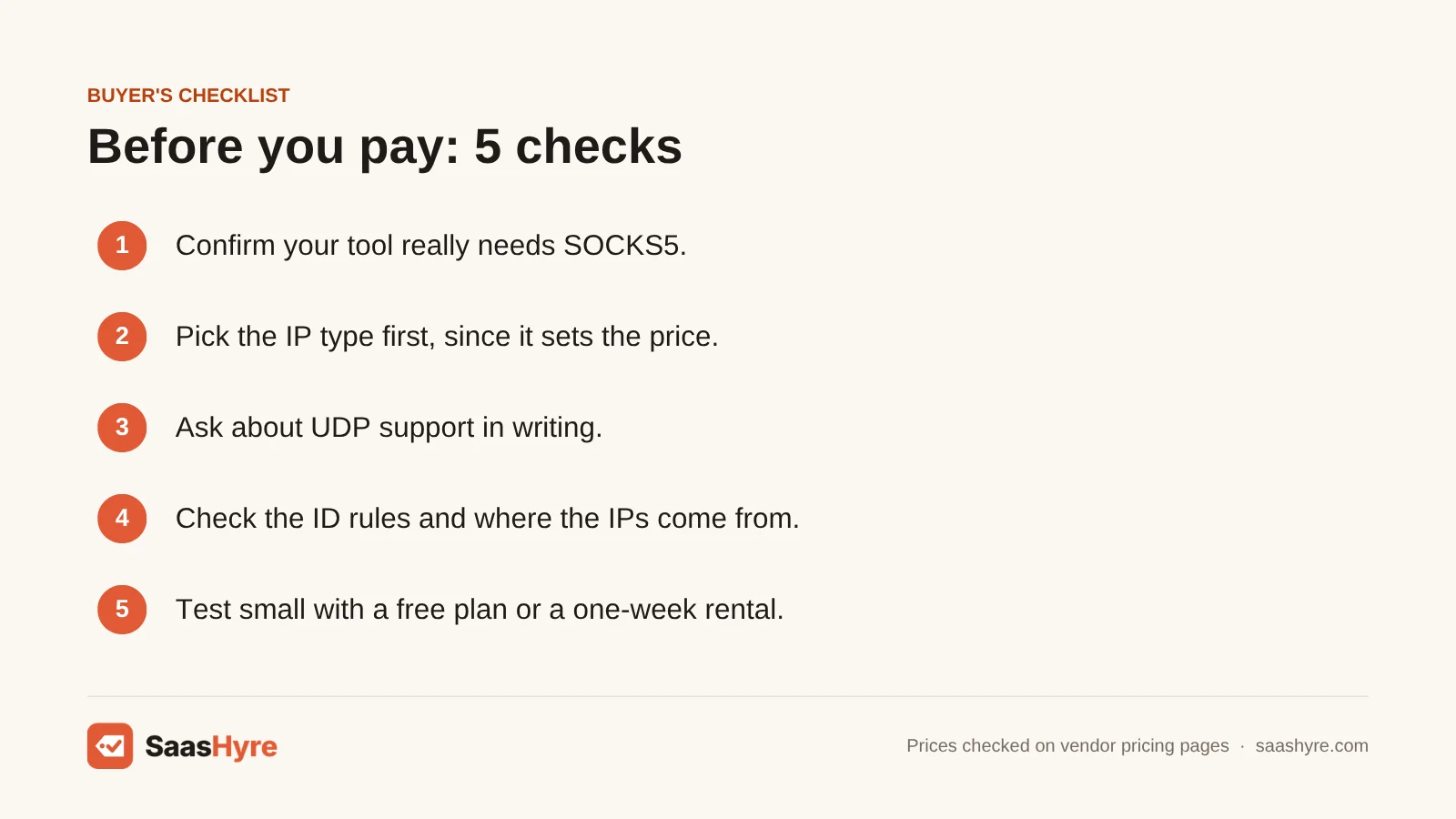
- Confirm you need SOCKS5. For plain web pages, an HTTP proxy on the same plan does the job. Choose SOCKS5 for tools that require it.
- Pick the IP type first. Datacenter IPs cost the least, but Proxyway says sites ban them more often than residential IPs. Compare them in our guides to the best datacenter proxies and the best ISP proxies.
- Ask about UDP in writing. “SOCKS5 supported” doesn’t mean UDP works. Proxyway lists it as off by default at four of the seven providers here.
- Check the ID rules. Oxylabs asks every customer for a KYC questionnaire. Evomi, DataImpulse and Proxy-Seller say ID checks aren’t required by default, though each can ask later.
- Check where the IPs come from. See the warning below.
- Test small. Try Webshare’s free plan, Oxylabs’ $5 credit or a $0.90 week at Proxy-Seller.
Be careful with unknown “S5” brands. In 2024, the US Justice Department said the 911 S5 botnet had spread to more than 19 million IP addresses. In 2025, TechCrunch reported that police shut down Anyproxy and 5socks, which sold hacked routers as proxies.
In January 2026, Google tied a group of proxy brands to the IPIDEA network, including PIA S5 Proxy and 922 Proxy. None of those brands is on our list.
How We Researched This Guide
We read every price on the vendor’s own pages on October 7, 2026. We used rendered pages and opened each tab, toggle and hidden FAQ. Protocol facts come from RFC 1928 and RFC 1929.
We could not confirm a few things. They are IPRoyal’s single-proxy prices, the traffic on Decodo’s pay-per-IP plans and Evomi’s rates under 15 GB. We also couldn’t confirm UDP support at Proxy-Seller, or which protocol Proxyway used in its tests.
We did not test these proxies ourselves. Success, speed and UDP notes come from Proxyway and AIMultiple, two named third parties. AIMultiple names Oxylabs, Decodo, Webshare and DataImpulse among its paying subscribers.
The cost tables are our math from published rates. No vendor pays to be listed or ranked. You can read more in our editorial policy.
Prices last checked: October 7, 2026.
The Bottom Line
First, SOCKS5 is a free setting, not a product. You pay for the proxy type behind it. Second, SOCKS5 does not encrypt anything, so it is not a VPN. Third, “SOCKS5 supported” rarely means UDP works out of the box.
For most buyers, I’d start with Decodo at $4 per GB, because every proxy type there lists SOCKS5. Want to pay nothing first? Try Webshare’s free plan. Need one fixed IP? Proxy-Seller sells one for $1.80 a month.
Your next step is simple. Write down the tool you use, the protocol it needs and your monthly GB. Then run a small test on your real target this week. You’ll know fast which provider fits.
Next, compare this with our best rotating proxies guide, then read our cheap residential proxies and residential vs datacenter proxies guides to see the full price range.
Frequently Asked Questions
What is a SOCKS5 proxy?
A SOCKS5 proxy is a middle server that passes your traffic from its own IP address without reading it. The standard, RFC 1928, supports TCP and UDP traffic, logins, domain names and IPv6 addresses.
Is SOCKS5 faster or safer than an HTTP proxy?
Not by design. RFC 1928 promises no speed gain and has no encryption built in. On one plan, the IP type matters more than the protocol.
Does a SOCKS5 proxy encrypt my traffic?
No. A SOCKS5 proxy changes the IP address a site sees, but it does not encrypt your data. RFC 1929 says a username and password login sends the password in cleartext. Your traffic is only encrypted if the app does it, as HTTPS does.
Is a SOCKS5 proxy better than a VPN?
A SOCKS5 proxy and a VPN do different jobs. Cloudflare says a VPN encrypts internet communications, and a SOCKS5 proxy does not. Use a proxy for business data work and a VPN for private browsing.
Do SOCKS5 proxies cost more than HTTP proxies?
No. We found no SOCKS5 fee at any of the seven providers in this guide. You pay for the proxy type, such as $4 per GB for residential traffic on Decodo’s pricing page.