
TL;DR: This guide shows what the best proxies for price monitoring need to do, how to size the job and what it costs. For most retail sites, pick rotating residential proxies with city or ZIP targeting. Decodo is our pick for most teams at $4 per GB, pay as you go. By our math, checking 1,000 products a day uses about 15 GB a month. Measure your page size first, then start on the smallest plan.
Looking for the best proxies for price monitoring? Start with the job, not the provider list. A proxy is a middle server that sends your request from a different IP address. An IP address tells a website where a visit comes from.
Price tracking is normal retail work. Back in 2017, the European Commission found that a majority of retailers track competitors’ online prices. Two thirds of them used software that adjusts their own prices based on rivals’ prices.
Stores push back, though. Imperva sells bot protection, and its 2025 report says bad bots made up 59% of retail traffic in 2024. So retail sites screen visitors hard.
I read every price on the vendor’s own page on October 7, 2026. Then I worked out the monthly cost for three catalog sizes.
One thing up front. We didn’t test these proxies. Every speed or success figure comes from a named third party.
New to proxies? Our best proxy providers guide compares every proxy type and price first.
What Do Proxies for Price Monitoring Need to Do?
Proxies for price monitoring need to do three things. They must show the price a local shopper sees, so you need country, city or ZIP targeting. They must get through retail bot checks. And they must do both at a cost per good price record that fits your budget.
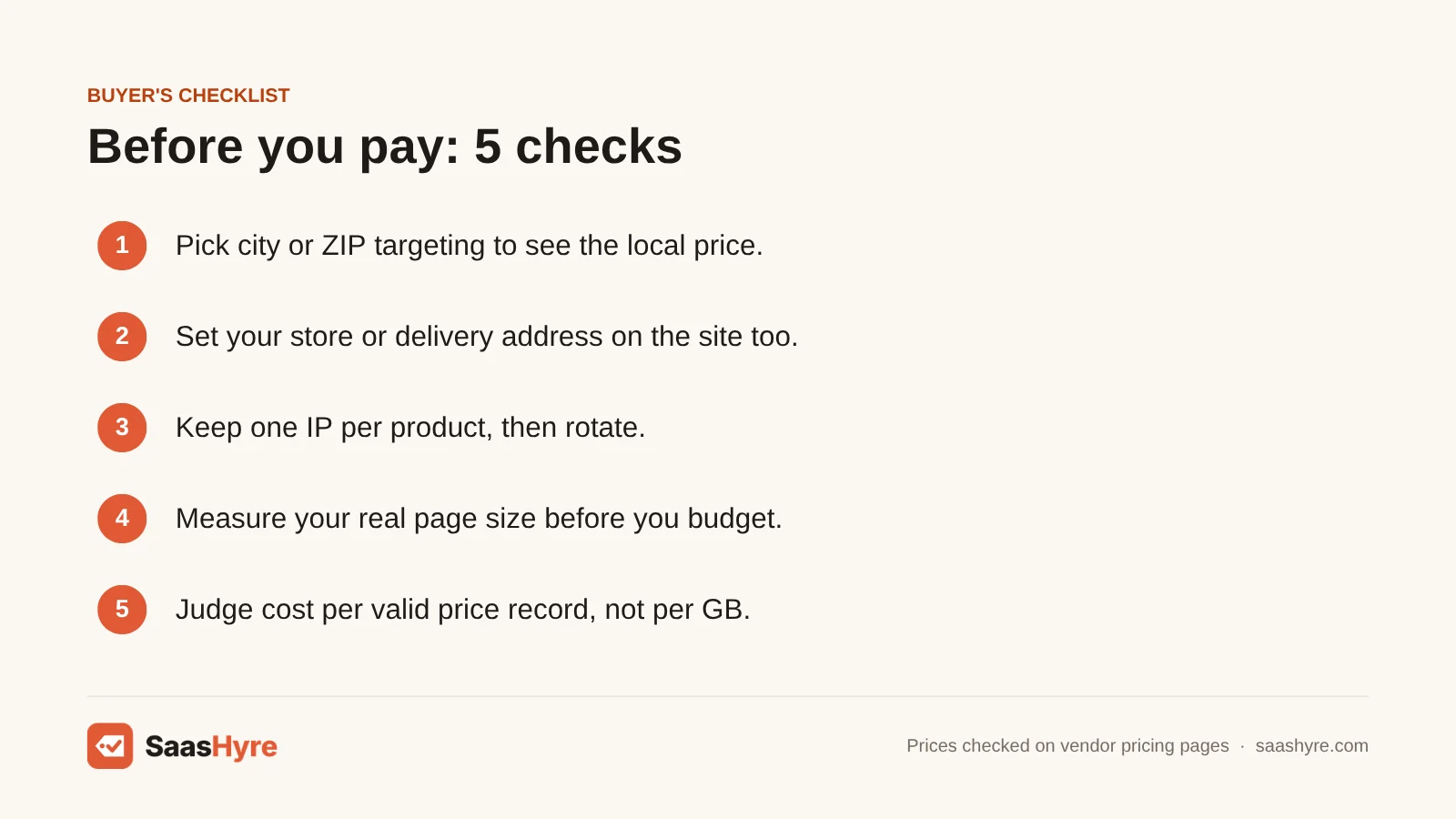
Location comes first. A store can show one price in Texas and another in Ohio. Bright Data includes country, state, city and ZIP targeting for free. Decodo targets down to ZIP code.
A local IP is not the whole answer. Proxidize, a proxy seller, warns that a location-targeted proxy does not guarantee the local price. The site may also use your chosen store, delivery address or currency. So set those too.
Sessions come second. Rotation means a new IP on each request. A sticky session keeps one IP for a set time. Proxidize’s advice is to keep one IP while you load a single product, then rotate.
Bot checks come third. In Proxyway’s 2026 tests, the median residential network connected 99.28% of the time on a test server. On Amazon, Google and Instagram, the median success rate fell to 74.43%. Proxyway earns affiliate commissions.
That gap is why price per GB can fool you. Proxidize suggests you judge cost per valid price record instead.
Collect public prices only, and check each site’s terms and your local law first. This guide is not legal advice.
How Much Proxy Traffic Does Price Monitoring Use?
Price monitoring uses about 15 GB of proxy traffic a month for 1,000 products checked once a day, by our math. That assumes 500 KB per check. The same math gives 150 GB for 10,000 products and 1,500 GB for 100,000 products. Your real page size can move those numbers a lot.
Most residential proxies are billed per GB, short for gigabyte. So your bill depends on how many pages you load and how heavy each one is.
- Checks per month. Multiply your products by checks per day, then by 30.
- GB per month. Multiply checks by KB per check, then divide by 1,000,000.
- Quick rule. At 500 KB per check, 1 GB covers 2,000 price checks.
The 500 KB figure is our assumption, not a measurement. Swap in your own average page size.
How you load the page matters most. The HTTP Archive found that the median desktop home page weighed 2,862 KB in July 2025. Only 22 KB of that was HTML. Those are home pages, not product pages. Still, a full browser load could use over five times our 500 KB.
Three habits keep the GB count down.
- Load less. If the price is in the HTML, skip images, fonts and scripts.
- Check less often. Slow-moving products can wait a week.
- Count retries. SOAX, for one, says it bills data in both directions, including retries. At a 74.43% success rate, you need about 1.34 tries per good record, by our math.
Which Proxy Type Is Best for Price Monitoring?
Rotating residential proxies are the best proxy type for price monitoring on big retail sites. Residential IPs come from home internet connections, so they look like real shoppers. Datacenter proxies cost far less and can work on small stores with light bot checks. Mobile proxies rarely pay off for this job.
Datacenter proxies. These IPs come from servers at hosting companies. Webshare sells 100 shared datacenter proxies for $2.99 a month. Try them first on small stores.
Residential proxies. These are the default for large retailers. Proxyway found an average price of $4.16 per GB at 5 GB and $3.00 per GB at 50 GB. Our guide to the best residential proxies compares the pools.
ISP proxies. These are fixed IPs hosted on servers but registered to home internet providers. You pay per IP, not per GB. Proxyway’s October 2026 test put a typical dedicated ISP proxy at $2 to $4 per IP. They fit when you watch a few sites and want the same IP all day.
Mobile proxies. These use phone network IPs. In Proxyway’s real-site tests, the mobile median was 75.26% success, against 74.43% for residential. Yet Oxylabs charges $7.50 per GB for mobile and $6 for residential on its $15 plan.
Our residential vs datacenter comparison covers the trade-offs.
How Much Do the Best Proxies for Price Monitoring Cost?
The best proxies for price monitoring cost $0.49 to $8 per GB for residential traffic at regular prices, read on October 7, 2026. For 1,000 products checked daily, that works out to about $15 to $120 a month, by our math. Datacenter proxies for easy sites start at $2.99 a month for 100 IPs.
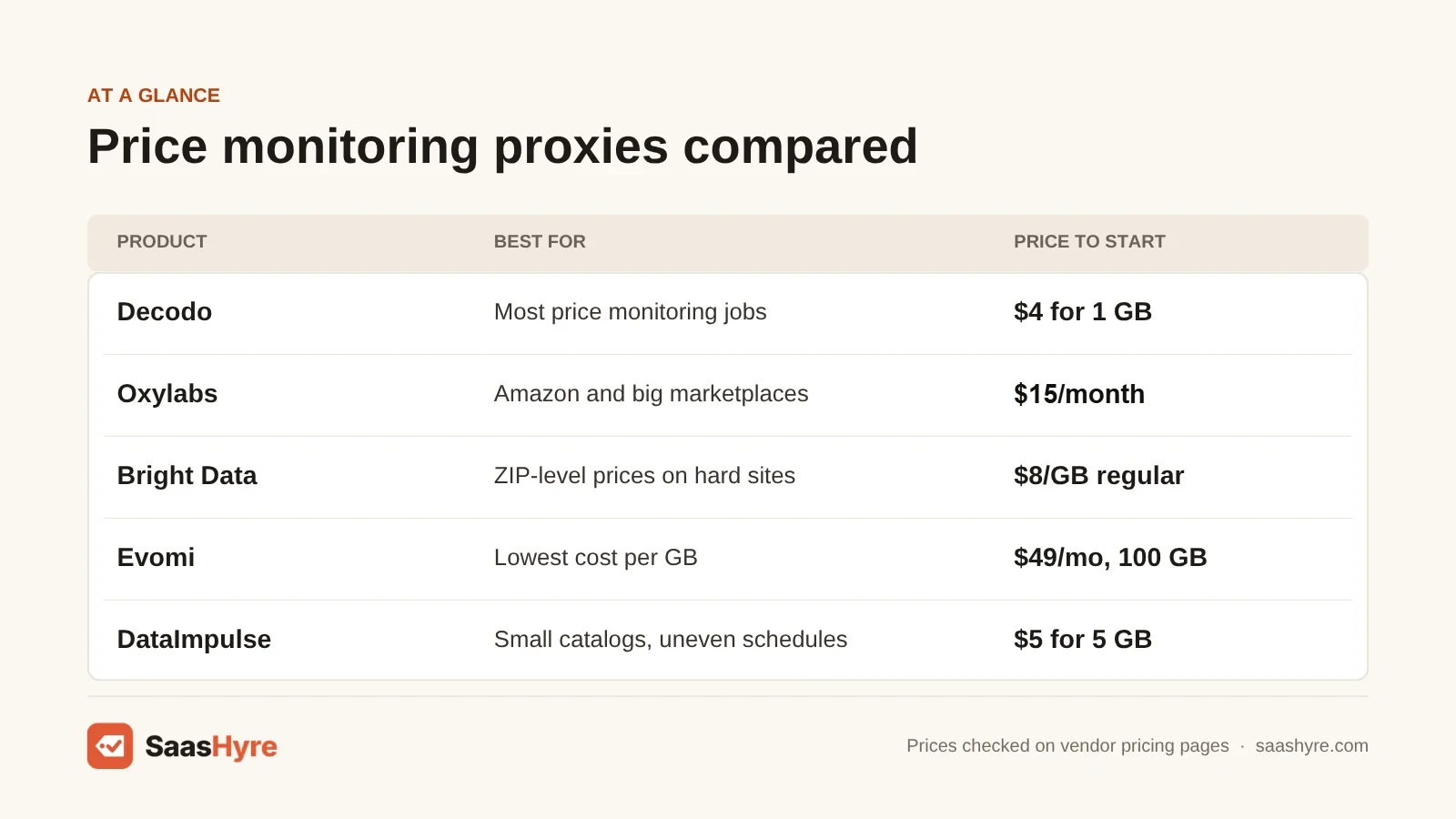
| Provider | Best for | Price to start | Unit price | Billing basis | What you get |
|---|---|---|---|---|---|
| Decodo | Most price monitoring jobs | $4 for 1 GB | $4/GB pay as you go. $3.75/GB at 3 GB. | Pay as you go, or monthly plus VAT | Residential IPs with ZIP targeting |
| Oxylabs | Amazon and big marketplaces | $15/month | $6/GB. $0.50 per 1,000 Amazon results. | Monthly credits that expire | Proxies and a scraper API |
| Bright Data | ZIP-level prices on hard sites | No minimum | $8/GB regular. $4/GB promo. | Pay as you go, or plans from $499/month | Residential IPs with free ZIP targeting |
| Evomi | Lowest cost per GB | $49/month for 100 GB | $0.49/GB monthly. $0.99/GB pay as you go. | Monthly, or pay as you go | Residential IPs with free city targeting |
| DataImpulse | Small catalogs, uneven schedules | $5 for 5 GB | $1/GB. $2/GB with city or ZIP targeting. | Prepaid, pay as you go | Residential traffic that never expires |
| Webshare | Small stores with light bot checks | $2.99/month for 100 proxies | $0.0299 per proxy. $3.50/GB residential. | Monthly, or yearly at about 30% off | Shared datacenter IPs with 250 GB |
Bright Data’s $4 rate is a promo. Code RESIGB50 takes 50% off for three months. DataImpulse’s $5 deal is for new users only.
What is not in the sticker price:
- Targeting fees. DataImpulse bills state, city, ZIP and ASN targeting at double the rate. An ASN is the network an IP belongs to.
- Minimum spend. DataImpulse sets a $50 minimum top-up after the $5 plan. Evomi’s pay as you go starts at 15 GB.
- Credit expiry. Oxylabs says unused credit expires at the end of each cycle. Webshare’s residential GB don’t roll over either.
- Trials that bill you. Decodo’s free trial needs a card and turns into a paid plan unless you cancel.
- Refund limits. Decodo’s 14-day refund ends at 20% of your data or 1 GB.
- ID checks. Bright Data requires a KYC check, short for “know your customer”, before you can use residential IPs.
Now the worked example. Each product is checked once a day for 30 days, at 500 KB per check. Every figure is our math from the published prices.
| Option | 1,000 products (15 GB) | 10,000 products (150 GB) | 100,000 products (1,500 GB) |
|---|---|---|---|
| Evomi Core residential | $14.85 | $73.50 | $735.00 |
| DataImpulse residential | $15 | $150 | $1,300 |
| Webshare residential | $41.25 | $337.50 | $2,250 |
| Decodo residential | $60 | $600 | Sales quote |
| Oxylabs residential | $100 | $600 | $3,750 |
| Bright Data residential | $120 | $1,200 | Sales quote |
| Oxylabs Web API, Amazon pages | $15 | $135 | $1,050 |
| Bright Data Web Unlocker | $45 | $450 | $3,901.10 |
| Webshare datacenter, 100 proxies | $2.99 | $2.99 | $10.49 |
- Evomi. 15 GB is pay as you go. Larger sizes are the $49 plan plus extra GB at $0.49.
- DataImpulse. Country targeting only. City or ZIP targeting doubles each figure.
- Webshare residential. Custom plan sizes at $2.75, $2.25 and $1.50 per GB.
- Decodo. Pay as you go, sold 1 GB at a time. The 250 GB plan is $625, and the largest listed plan is 1,000 GB for $2,000.
- Oxylabs. The $100 plan, then the $500 plan plus top-ups. The $3,750 uses the $2.50 Enterprise rate.
- Bright Data. Regular $8 per GB. The $3,901.10 uses the $499 Scale plan.
- Webshare datacenter. The $10.49 buys 3,000 GB a month. This prices bandwidth only. Shared IPs may not pass a big retailer’s bot checks.
For a ranked budget list, see our cheap residential proxies guide.
The 6 Best Proxies for Price Monitoring, Compared
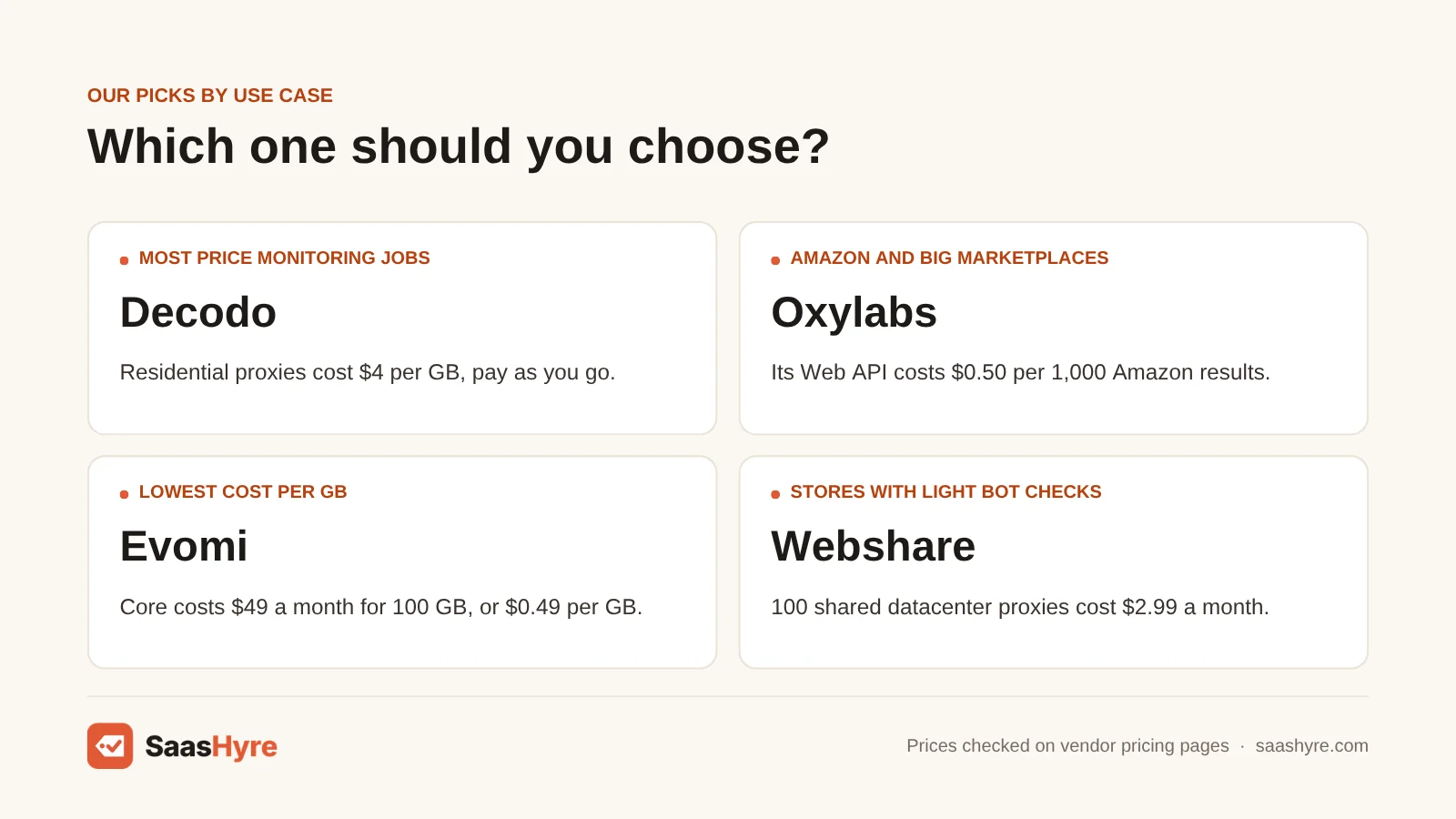
I picked these six on published price, location targeting and fit. Nobody paid for a spot. For the overall ranking, see our best proxy providers guide.
What changed in 2026: NetNut is off this list. Krebs on Security reported that the FBI seized NetNut’s domains on July 2, 2026. Oxylabs moved every product to one credit subscription. SOAX no longer lists ISP or datacenter proxies on its pricing page.
Google’s threat team says “ethical sourcing” claims need auditable proof of user consent. So treat each sourcing line below as the vendor’s claim.
1 Decodo: Best for most price monitoring jobs
If you want one provider for most retail sites, start with Decodo.
What it does well. Decodo, the old Smartproxy, targets by country, state, city and ZIP code. In Proxyway’s 2026 residential test, it connected 99.92% of the time. Proxyway also named it Best All-Rounder in its 2026 awards.
Key features:
- City and ZIP code targeting.
- Sticky sessions up to 24 hours.
- Pay as you go or monthly plans.
Pricing. Residential pay as you go costs $4 per GB. Monthly plans run from $11.25 for 3 GB to $275 for 100 GB, plus VAT. See Decodo pricing.
Best for: You, if you track prices on a mix of retail sites and want to start small.
Limitations. Using the free trial cancels the 14-day refund. We could not confirm whether unused monthly GB roll over. Decodo calls its pool “ethically-sourced”.
2 Oxylabs: Best for Amazon and big marketplaces
If most of the prices you track are on big marketplaces, look at Oxylabs.
What it does well. Oxylabs sells proxies and a scraper API on one plan. Its Web API returns Amazon results from $0.50 per 1,000, so you pay per result, not per GB. Oxylabs topped Proxyway’s 2026 residential test at 99.93%.
Key features:
- State, city and ZIP targeting with no extra fee.
- One credit balance for proxies and the Web API.
- A free $5 welcome credit, no card needed.
Pricing. Oxylabs sells one monthly credit subscription. Residential traffic costs $6 per GB on the $15 plan and $4 on the $500 plan. See Oxylabs pricing. Our Oxylabs pricing guide covers every tier.
Best for: You, if you track Amazon or other large marketplaces at volume.
Limitations. The help center says self-service purchases are non-refundable, while older pages describe a 3-day refund. Oxylabs co-founded an industry ethics group, which is not an outside audit.
3 Bright Data: Best for ZIP-level prices on hard sites
If you need one ZIP code’s price on a tough site, Bright Data fits.
What it does well. Bright Data includes ZIP targeting at no extra cost. Its Web Unlocker costs $1.50 per 1,000 requests, and you pay only for successes. Bright Data sat out Proxyway’s 2026 tests, so I have no independent figure for it.
Key features:
- Free ZIP code targeting on residential IPs.
- Web Unlocker with 5,000 free requests a month.
- Pay as you go with no commitment.
Pricing. Residential pay as you go costs $8 per GB at the regular price. Promo code RESIGB50 cuts that to $4 per GB for three months. Monthly plans start at $499. See Bright Data pricing.
Best for: You, if you need ZIP-level prices from hard sites and can pass an identity check.
Limitations. This is the highest regular price per GB here. The KYC check may include a short video call. The trial is a $2 credit for 7 days. Bright Data says its software turns on only after a user opts in.
4 Evomi: Best for the lowest cost per GB
If you track a big catalog on a tight budget, look at Evomi.
What it does well. Evomi’s Core plan works out to $0.49 per GB, the lowest residential rate in this guide. Proxyway named Evomi Best Value for 2026. But Proxyway tested Evomi’s pricier Premium pool, which connected 99.58% of the time, not Core.
Key features:
- Country, region and city targeting free on every plan.
- Sticky sessions up to 24 hours.
- Pay as you go traffic that never expires.
Pricing. Core costs $49 a month for 100 GB, and extra GB cost $0.49 each. Pay as you go costs $0.99 per GB from 15 GB. See Evomi pricing.
Best for: You, if you track a large catalog and cost per GB matters most.
Limitations. ZIP and ISP filters use extra bandwidth, up to 15 times. The 30-day refund is capped at 10% of your data or 1 GB. Evomi says its IPs come from volunteer devices that opt in.
5 DataImpulse: Best for small catalogs and uneven schedules
If you check prices weekly or in bursts, DataImpulse is a good match.
What it does well. DataImpulse charges $1 per GB with no subscription, and the traffic never expires. In Proxyway’s 2026 residential test, it connected 99.74% of the time.
Key features:
- Pay as you go with no monthly plan.
- Unused GB roll over and never expire.
- Country targeting included in the $1 rate.
Pricing. New users can buy 5 GB for $5. After that, traffic costs $1 per GB with a $50 minimum top-up. A 1 TB block costs $800. See DataImpulse pricing.
Best for: You, if your catalog is small or you check prices in bursts.
Limitations. State, city, ZIP and ASN targeting doubles the rate to $2 per GB. DataImpulse says its IPs come from people who gave full consent.
6 Webshare: Best for small stores with light bot checks
If the stores you watch don’t block server IPs, Webshare costs the least to start.
What it does well. Webshare sells 100 shared datacenter proxies for $2.99 a month, with 250 GB included. In Proxyway’s datacenter benchmark, Webshare connected 99.93% of the time. That test was not run on retail sites.
Key features:
- Free plan with 10 proxies and 1 GB a month.
- Residential plans with city and US ZIP targeting.
- Yearly billing at about 30% off.
Pricing. Shared datacenter plans cost $2.99 a month for 100 proxies and $26.91 for 1,000. Rotating residential plans start at $3.50 a month for 1 GB. See Webshare pricing.
Best for: You, if you track small stores that don’t block datacenter IPs.
Limitations. Webshare says its free shared proxies may be blocked by some sites. Refunds need a request within two days.
When a Scraper API Beats Raw Proxies
A scraper API is a service that fetches the page for you. It handles the proxies and the retries. You pay per request or per result, not per GB.
That can be cheaper on heavy pages. At 500 KB per check, 1,000 checks use 0.5 GB. On a $4 per GB proxy, that costs $2.00, by our math. Oxylabs charges $0.50 per 1,000 Amazon results without JavaScript rendering. If your pages are much lighter, raw proxies win again.
APIs are not a sure thing, though. In Proxyway’s 2025 API tests, three APIs opened protected sites over 80% of the time. The hardest site, Shein, averaged 21.88%.
For more API prices, see our guide to the best proxies for web scraping.
How We Researched This Guide
We read every price on the vendor’s own pricing page, help center or docs on October 7, 2026. We opened the rendered pages, with their tabs and toggles.
We could not confirm a few things. Decodo doesn’t say whether unused monthly GB roll over. Oxylabs has refund texts that disagree. IPRoyal shows its mid-size residential prices only in its dashboard, so we left it out.
We did not test these proxies ourselves. Success and speed figures come from Proxyway, which earns affiliate commissions. The 500 KB page size is our assumption, and the cost tables are our math.
You can read more in our editorial policy.
Prices last checked: October 7, 2026.
The Bottom Line
The best proxies for price monitoring return the right local price at the lowest cost per good record. For most retail sites, that means rotating residential IPs with city or ZIP targeting.
Three things to take away. Size the job first, because 1,000 products a day is about 15 GB a month at 500 KB per check. Watch the extras, like DataImpulse’s double rate for city targeting. And price a scraper API too if your pages are heavy.
Next, fetch 100 of your own product pages and measure the average size. Then run a week on the smallest plan from Decodo or DataImpulse. You’ll soon know your real cost per price record.
Frequently Asked Questions
Which proxy type is best for price monitoring?
Rotating residential proxies fit big retail sites best, because the IPs come from home connections. Datacenter proxies cost far less and can work on small stores. In Proxyway’s 2026 real-site tests, mobile proxies scored 75.26% against 74.43% for residential.
How much does it cost to monitor 10,000 product prices a day?
By our math, 10,000 daily checks at 500 KB each use about 150 GB a month. At prices read on October 7, 2026, that costs $73.50 on Evomi’s Core plan and $150 on DataImpulse. It costs $600 on Decodo’s pay as you go.
Do I need residential proxies to scrape Amazon prices?
Large marketplaces run strict bot checks, so residential IPs are the usual choice. Even then, Proxyway’s 2026 tests on Amazon, Google and Instagram showed a median success rate of 74.43%. Check the site’s terms before you start.
Does a proxy in the right country always show the right local price?
No. Proxidize notes that a location-targeted proxy controls where your request comes from. It does not pick the store, delivery address or currency for you. So set the store or ZIP code on the site as well.
Should I use a scraper API instead of proxies for price tracking?
Use a scraper API when pages are heavy. At 500 KB per check, 1,000 checks cost $2.00 on a $4 per GB proxy, by our math. Oxylabs’s Web API costs $0.50 per 1,000 Amazon results. For light pages, raw proxies usually cost less.