

TL;DR: Stripe Connect is free if Stripe bills your sellers directly. If you set your own pricing, it charges $2 per active account each month, 0.25% + 25¢ per payout, and 0.25% of payout volume. The best Stripe Connect alternatives are Adyen for Platforms, PayPal Braintree, Finix, Mangopay, and Tilled. Most quote custom prices, so get two or three quotes.
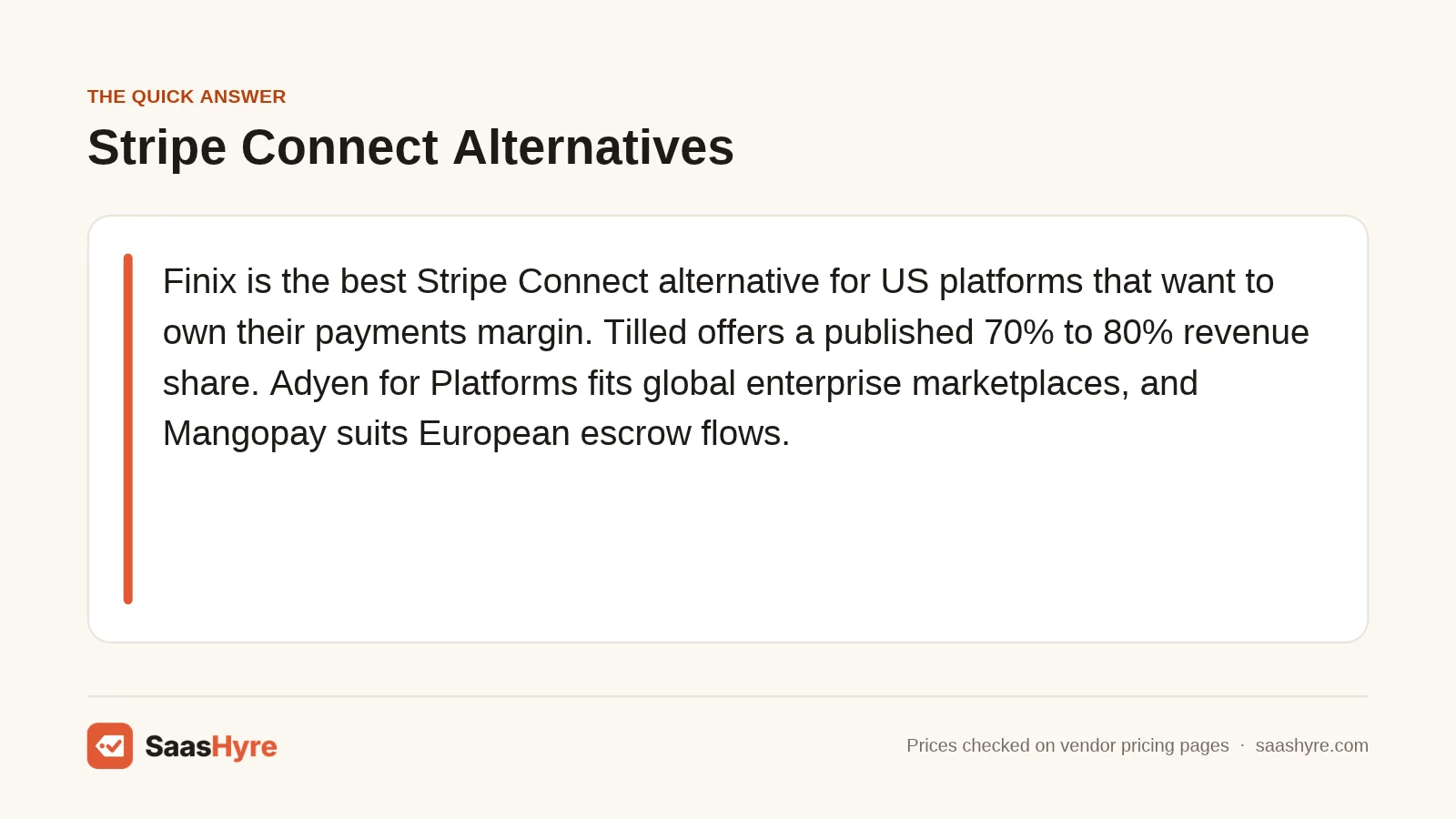
Top pick: Finix is the best Stripe Connect alternative for most US software platforms that want to own their payments margin. Tilled is the best pick if you want a clear revenue share with a flat monthly fee. Adyen for Platforms is the strongest choice for large, multi-country marketplaces.
This guide is for marketplaces and software platforms. You take money from buyers, keep a cut, and pay sellers. That is a different job from a single store taking cards. If you only need a card processor for your own sales, read our main Stripe alternatives guide instead.
Stripe Connect is popular because it handles seller onboarding, KYC checks, and payouts in one place. But the bill grows with your seller count. Per Stripe’s Connect pricing page, platforms that set their own pricing pay per active account, per payout, and on payout volume. Instant payouts add 1%. Cross-border payouts start at 0.25%.
Reviewers like the product. Stripe Connect holds 4.3 stars on G2, but G2 rates its cost at the top of its price scale. Below, you will see which alternatives publish prices, which need a quote, and how to compare them on a yearly basis.
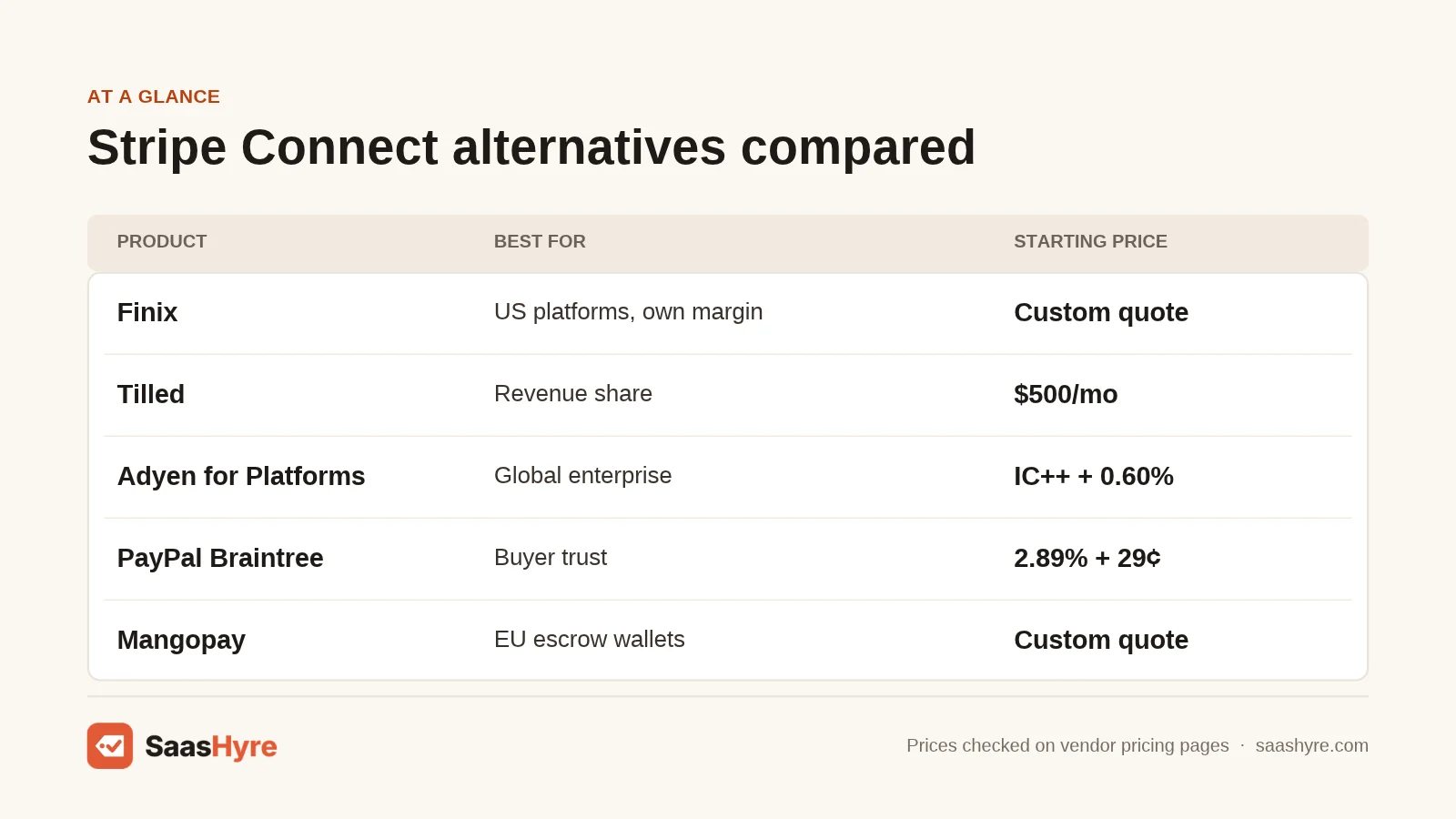
Quick Comparison: Stripe Connect Alternatives at a Glance
| Tool | Best for | Starting price | Billing | Free plan or trial |
|---|---|---|---|---|
| Finix | US platforms owning margin | Custom quote | Flat, dynamic, or custom | Demo |
| Tilled | Revenue share for SaaS | $500/mo SaaS fee | Monthly + revenue share | Demo |
| Adyen for Platforms | Global enterprise marketplaces | Interchange++ + 0.60% + 13¢ (cards) | Per transaction, minimum invoice | No |
| PayPal Braintree | Buyer trust at checkout | 2.89% + 29¢ standard | Per transaction | No monthly fee |
| Mangopay | European escrow-style wallets | Custom quote | Monthly invoice | No |
| Checkout.com | Global card acceptance | Custom quote | Flat or interchange++ | No |
| Unipaas | Vertical SaaS embedded payments | Custom quote | Custom | Demo |
| Payoneer | Paying sellers abroad | $1.50 local withdrawal | Per transaction | Free account |
How Does Stripe Connect Pricing Work?
Stripe Connect has two pricing models. If Stripe sets and collects fees from your sellers, the platform pays nothing extra. If you set your own pricing, you pay $2 per monthly active account, 0.25% + 25¢ per payout, and 0.25% of payout volume. Both models charge 1% for instant payouts.
An account counts as active in any month it gets a payout. So a marketplace with many small sellers pays the $2 fee often. Stripe also charges $2.99 per 1099 form e-filed with the IRS and $1.49 per state e-file. Those costs are easy to miss when you plan a budget. If tax forms are a big job for you, see our best AI tax software guide.
The “you handle pricing” model is where most platforms look for alternatives. It is also where you can earn money on payments, so the margin math matters.
Which Stripe Connect Alternatives Let You Earn Payments Revenue?
Finix, Tilled, and Unipaas are built for software platforms that want to earn money from the payments their users run. Finix lets you set flat, dynamic, or custom pricing for your merchants. Tilled shares 70% to 80% of revenue. Unipaas offers revenue sharing with managed risk and onboarding.
1 Finix: Best for US platforms that want to own their margin
Finix is payments infrastructure for software platforms and marketplaces.
What it does well. Finix gives you API building blocks to onboard merchants, take payments, and pay out. It also offers a path to becoming a payment facilitator yourself later, as Sequence’s Stripe Connect comparison notes.
Key features:
- Merchant onboarding and underwriting APIs
- Card, ACH, and in-person payments
- Split payouts to sellers
- Flat rate, dynamic, or custom merchant pricing
Pricing. Finix lists three paths: platforms and marketplaces, individual merchants with subscription pricing, and payouts. It does not publish rates, so check the current price with sales. See Finix pricing.
Best for: US vertical SaaS platforms with growing volume and an engineering team.
Limitations. You need developers to build on its APIs. PaymentCloud’s review notes Finix suggests about $50 million in yearly volume before taking on more risk yourself.
2 Tilled: Best for a clear revenue share
Tilled is a white-label payment facilitator built for SaaS platforms.
What it does well. Tilled publishes its revenue share, which is rare. You set merchant pricing, and Tilled pays you most of the margin.
Key features:
- White-label onboarding and merchant portal
- Custom merchant pricing
- Card and ACH payments
- Migration help for platforms leaving Stripe
Pricing. The Start-Up plan costs $500 a month with a 70% revenue share, for platforms under $5M a month. The Scaling plan costs $2,500 a month with an 80% share, for platforms over $5M. Per-transaction costs need a sales call. See Tilled pricing.
Best for: SaaS platforms that want to turn payments into a revenue line.
Limitations. The $500 monthly fee only pays off once your merchants process enough volume. It is US focused.
3 Unipaas: Best for vertical SaaS embedded payments
Unipaas is an embedded payments provider for SaaS platforms and marketplaces.
What it does well. Unipaas offers branded payment components and handles risk and compliance for you. That lets a small team launch payments without a big build.
Key features:
- Branded checkout and onboarding components
- Managed risk, KYC, and compliance
- Card terminals for in-person sales
- Revenue sharing
Pricing. Unipaas sets pricing per business based on model and volume. No rates are published, so check the current price. See Unipaas pricing.
Best for: B2B and vertical SaaS teams that want fast go-live.
Limitations. It is a smaller company than Stripe or Adyen. Its own blog ranks itself first, so weigh its claims with care.
What Are the Best Stripe Connect Alternatives for Global Marketplaces?
Adyen for Platforms, Checkout.com, and Mangopay are the best Stripe Connect alternatives for global marketplaces. Adyen fits high volume across many regions. Checkout.com covers 150+ currencies for card acceptance. Mangopay suits European marketplaces that need wallets to hold funds before payout, which works like escrow.
4 Adyen for Platforms: Best for global enterprise marketplaces
Adyen for Platforms adds seller onboarding and split payments to Adyen’s global processing.
What it does well. You get one platform for online and in-store payments across many countries. Interchange++ pricing passes card network costs through at cost.
Key features:
- Seller onboarding and KYC
- Split payments and payouts
- Local payment methods worldwide
- In-person terminals for sellers
Pricing. Visa and Mastercard cost $0.13 + interchange++ + 0.60%. There are no setup or monthly fees, but a minimum invoice applies by industry. Platform features need a quote. See Adyen pricing.
Best for: Large marketplaces with high volume in several regions.
Limitations. Ryft’s comparison notes it needs custom development work. It is not built for early-stage platforms.
5 Checkout.com: Best for global card acceptance
Checkout.com is a global processor with a newer product for software platforms.
What it does well. It processes in 150+ currencies with domestic coverage in 45+ countries. You can choose flat-rate or itemized interchange++ pricing.
Key features:
- Unified Payments API
- Many local payment methods
- Platforms product for embedding payments
- Free processing for registered charities
Pricing. Pricing is custom. Checkout.com says there are no setup or account maintenance fees. Check the current price with sales. See Checkout.com pricing.
Best for: Platforms with buyers in many countries.
Limitations. Its platforms product is newer than Stripe Connect. It also has fewer ready-made integrations.
6 Mangopay: Best for European escrow-style marketplaces
Mangopay is a European payments provider built only for marketplaces and platforms.
What it does well. Mangopay uses e-wallets for each user. Funds can sit in a wallet until a job is done, then go to the seller. That suits rentals, services, and peer-to-peer sales.
Key features:
- E-wallets for buyers and sellers
- Hold and release funds
- KYC and seller onboarding
- Payouts across country zones
Pricing. Mangopay has no public tiers or free plan. Pricing depends on volume, products, and flows, and you get a monthly invoice. Check the current price with sales. See Mangopay pricing.
Best for: European marketplaces that need to hold funds before payout.
Limitations. It is Europe first. US-only platforms will find better fits.
Which Stripe Connect Alternatives Work for Smaller Platforms?
Smaller platforms should look at PayPal Braintree and Payoneer. Braintree has published rates and no monthly fee, plus PayPal and Venmo buttons buyers trust. Payoneer does not take buyer payments, but it is a low-cost way to pay sellers in many countries. You can pair it with a separate processor.
7 PayPal Braintree: Best for buyer trust at checkout
Braintree is PayPal’s developer platform, with a marketplace option for paying sellers.
What it does well. Buyers see PayPal and Venmo at checkout, which can lift trust on a new marketplace. Standard rates are public.
Key features:
- Cards, PayPal, Venmo, and wallets
- Marketplace seller payouts
- ACH capped at $5
- Fraud and dispute tools
Pricing. Cards and wallets cost 2.89% + 29¢. ACH costs 0.75%, capped at $5. Venmo costs 3.49% + 49¢. Chargebacks cost $15. Marketplace fees are not on the page, so check the current price. See Braintree pricing.
Best for: Consumer marketplaces where PayPal brand trust matters.
Limitations. Ryft notes seller onboarding is more manual than Stripe’s. Customization is also more limited.
8 Payoneer: Best for paying sellers abroad
Payoneer is a cross-border account and mass payout service.
What it does well. Sellers get local receiving accounts in many currencies. Many already use Payoneer for other marketplaces, so onboarding is quick.
Key features:
- Mass payout tools
- Multi-currency receiving accounts
- Local bank withdrawals
- Seller cards
Pricing. Payments between Payoneer balances are free. Local withdrawals cost $1.50. Withdrawals with conversion cost 1.2% to 4%. Accounts that receive under $6,000 in 12 months pay $29.95 a year. Marketplace rates vary. See Payoneer fees.
Best for: Platforms with sellers in many countries.
Limitations. It handles payouts only. You still need a processor to take buyer payments.
How Much Do Stripe Connect Alternatives Cost per Year?
For a platform with 100 active sellers, $2 million in yearly payout volume, and 1,200 payouts a month, Stripe Connect’s “you handle pricing” fees come to about $16,000 a year before card processing. Tilled’s Start-Up plan costs $6,000 a year in SaaS fees but pays you a revenue share. Most others need a quote.
| Provider | Published platform fees | Yearly estimate (scenario) | Card processing |
|---|---|---|---|
| Stripe Connect (Stripe handles pricing) | $0 for platform | $0 | Stripe bills sellers |
| Stripe Connect (you handle pricing) | $2/active account, 0.25% + 25¢/payout, 0.25% payout volume | About $16,000 | Set by you |
| Tilled Start-Up | $500/mo, 70% revenue share | $6,000 minus your share | Quote |
| Tilled Scaling | $2,500/mo, 80% revenue share | $30,000 minus your share | Quote |
| Adyen for Platforms | No monthly fee, minimum invoice | Quote | Interchange++ + 0.60% + 13¢ |
| PayPal Braintree | Marketplace fees not listed | Quote | 2.89% + 29¢ |
| Payoneer (payouts only) | $1.50 per local withdrawal | About $21,600 if sellers bear each withdrawal | Not included |
| Finix, Mangopay, Checkout.com, Unipaas | Not published | Quote | Quote |
How we got the Stripe figure: 100 accounts × $2 × 12 = $2,400. Payouts: 0.25% of $2M = $5,000, plus 14,400 × 25¢ = $3,600. Payout volume fee: 0.25% of $2M = $5,000. The Payoneer line assumes each of the 14,400 payouts is withdrawn locally, which sellers usually pay, not you.
Which Stripe Connect Alternative Should You Pick?
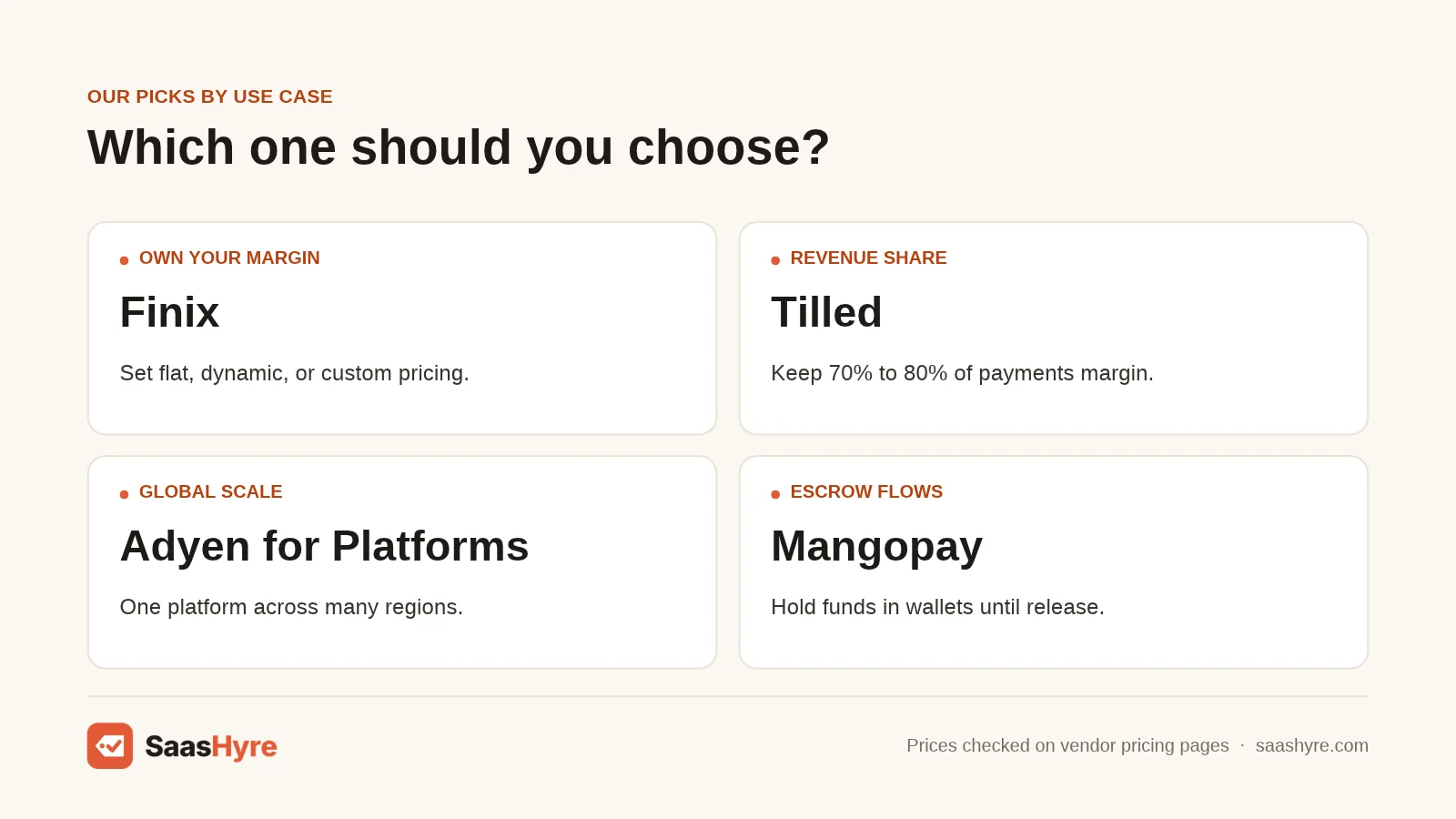
Pick Finix if you are a US software platform that wants to own payments margin. Pick Tilled for a clear revenue share. Pick Adyen for Platforms at enterprise scale, Mangopay for European escrow flows, and Braintree for consumer trust. Use Payoneer alongside a processor for global seller payouts.
- US vertical SaaS earning on payments: Finix or Tilled
- Small team wanting managed risk: Unipaas
- Global high-volume marketplace: Adyen for Platforms
- Buyers in many currencies: Checkout.com
- Hold funds until a job is done in Europe: Mangopay
- Consumer marketplace that needs PayPal: Braintree
- Sellers spread across countries: Payoneer for payouts
How to Choose a Stripe Connect Alternative
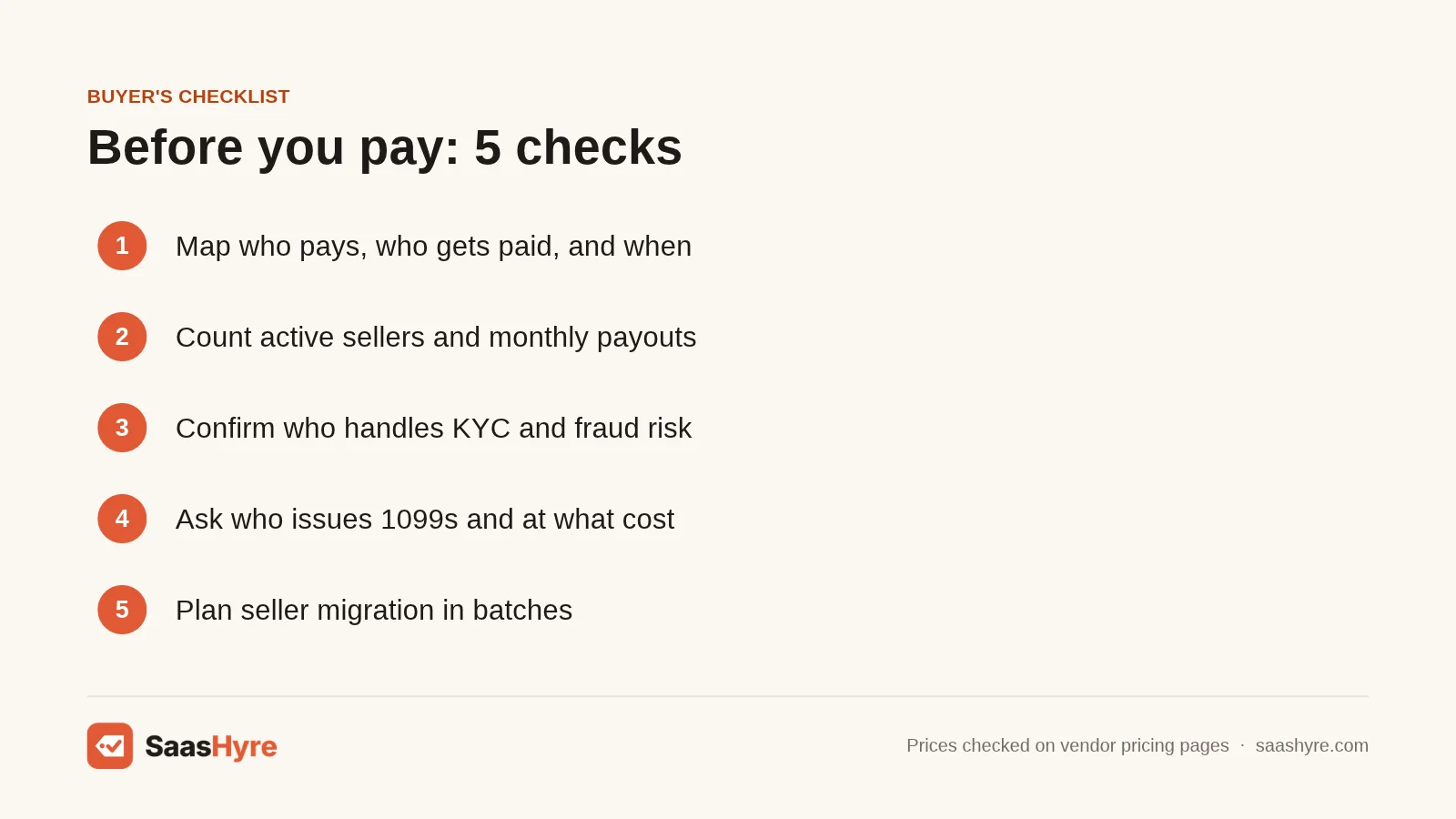
Start by mapping your money flow. Who pays, who gets paid, when, and in what currency? Then check each provider against these points.
- Who sets merchant pricing. If you want payments revenue, you need control of pricing and a clear share.
- Onboarding and KYC. Ask who handles seller checks and who carries the risk if a seller commits fraud.
- Split payments and holds. Confirm you can split one charge across sellers and hold funds when needed.
- Payout speed and cost. Compare per-payout fees, instant payout fees, and cross-border costs.
- Tax forms. In the US, someone must issue 1099s to sellers. Find out who does and what it costs.
- Migration. Moving sellers off Stripe means new onboarding. Ask about migration tools. Tilled, for example, offers migration help.
- Collections. If sellers invoice their clients, pair payments with an accounts receivable tool or invoicing software.
How We Picked These Stripe Connect Alternatives
I read the top ranking Stripe Connect alternatives pages from Ryft, Unipaas, PaymentCloud, Dodo Payments, and Sequence. I listed every provider they named and kept those that came up most and serve platforms, not single stores. Several of those pages are written by vendors that rank themselves first, so I did not copy their rankings.
For every price, I read the vendor’s own pricing page in November 2026. Where a vendor does not publish rates, I say so and point you to sales. I also read G2’s Stripe Connect listing for user sentiment. I did not build integrations or process live payments with these providers. The yearly cost table uses one example scenario so you can compare fee structures.
Conclusion
Stripe Connect is easy to start with and free when Stripe bills your sellers. Costs rise once you set your own pricing and scale your seller count. That is the moment to compare.
For most US software platforms, Finix and Tilled are the first two calls to make, because both let you earn from payments. Large global marketplaces should talk to Adyen for Platforms. European marketplaces with escrow needs should talk to Mangopay.
Since most of these providers quote custom prices, bring the same numbers to every call: active sellers, monthly volume, payouts, and countries. Then compare the yearly total, not the headline rate. Book demos with two or three providers this month, starting with Finix and Tilled.
Frequently Asked Questions
What is the difference between Stripe and Stripe Connect?
Stripe takes payments for your own business. Stripe Connect is for platforms and marketplaces that take payments on behalf of other businesses and pay them out. Connect adds seller onboarding, KYC checks, split payments, and payouts. It has its own pricing on top of card processing.
Is Stripe Connect free?
It is free for the platform if Stripe sets and collects processing fees from your connected accounts. If you set your own pricing, Stripe charges $2 per monthly active account, 0.25% + 25¢ per payout, and 0.25% of payout volume. Instant payouts cost 1% under both models.
Which Stripe Connect alternative is cheapest?
There is no single cheapest option, because most providers quote custom prices. Tilled is one of the few that publishes a structure: $500 a month with a 70% revenue share. Adyen publishes card rates of interchange++ plus 0.60% and 13¢, which can be cheap at high volume.
Can Stripe Connect alternatives split payments between sellers?
Yes. Adyen for Platforms, Mangopay, Finix, Tilled, and Braintree’s marketplace option all support splitting a buyer’s payment between your platform and sellers. Mangopay can also hold funds in a wallet until you release them. Payoneer only handles payouts.
How hard is it to switch from Stripe Connect?
It takes real work. Each seller must go through onboarding and KYC with the new provider. You also need to rebuild payment flows in your code. Ask each provider about migration support, and plan to move sellers in batches rather than all at once.